



- Are AI Overviews too volatile to optimize for? No, AI Overviews are absolutely worth optimizing for despite their volatility because they represent an additional visibility channel that layers on top of organic SEO, and ignoring them means missing opportunities to reach the nearly 60% of searches that are now zero-click.
- What did Semrush’s 2024 study reveal about AI Overview consistency? The study found that none of the tracked keywords showed the same URLs appearing all 31 days, 91% of URLs were removed at some point during the month, and only 43% of removed URLs returned later, demonstrating significant volatility.
- How can you maintain visibility in AI Overviews despite constant changes? Continuous iteration and content improvement are key—when a URL drops out, it signals that other pages are delivering better answers, giving you an opportunity to refine your content, update freshness, and strengthen E-E-A-T signals.
- What does ‘ranking’ mean in the context of AI Overviews? The term ‘ranking’ doesn’t really apply to AI Overviews; instead, focus on ‘visibility’ and ‘eligibility for inclusion’ by demonstrating expertise, experience, authority, and trustworthiness so AI systems consistently recognize your content as trustworthy enough to cite.
- Is tracking AI Overview performance meaningful given the rapid changes? Yes, but only when tracked strategically by measuring patterns and presence across multiple AI platforms like ChatGPT, Perplexity, and Google AI, rather than fixating on daily visibility changes or individual rankings.
Since the launch of AI Overviews, you’ve probably heard people talk about how much they change — how volatile they are.
You may be ranking in them one day and gone the next. You might hold a spot for two weeks, only to lose it for the rest of the month.
It can make you think — is it even worth optimizing for?
The answer is yes.
Let’s dive into why.
The discovery of volatile AI Overviews
Back in 2024, Semrush conducted a study on the consistency of AI Overviews. The study found that:
- None of the keywords studied saw the same URLs appearing every time (all 31 days tracked)
- 91% of URLs studied were removed from the AI Overviews at some point during the study period
- Only 43% of URLs that were removed returned to the AI Overview later in the month
Even though this study was conducted right as AI Overviews picked up steam, numerous people believe that there’s still validity to these numbers today.
If you think about it, AI Overviews are continually evolving and improving the way it chooses where to pull information/URLs to cite. So, naturally, that means some URLs would drop out in the process and be replaced by “better” resources.
Not to mention, as information changes, AI Overviews change too.
So, if AI Overviews are volatile and inconsistent, that begs the question…
Are AI Overviews worth optimizing for?
Yes, AI Overviews are absolutely worth optimizing for, even if they’re volatile.
The business case is simple: AI Overviews are an additional visibility channel — they don’t replace organic SEO, but layer on top of it. Strong organic SEO already impacts AI inclusion, so optimizing your site for search naturally helps your AI presence.
If you decide to ignore AI Overview optimization, you’ll miss prime opportunities to get your brand in front of people who are only checking out the AI Overview and leaving.
Already, nearly 60% of searches are zero-click, and click-through rate drops 35% when an AI Overview is present. So if you’re not optimizing for AI Overviews, you’re missing out.
At the end of the day, AI Overviews are just like traditional search in terms of rankings changing.
Could you imagine throwing in the towel the first time your blog post went from page 1 to page 2? Likely not — you would go back and reoptimize or refresh the page to help get its rankings back up.
AI Overviews are doing the same thing, albeit faster and more frequently. So, it’s not time to throw your AI Overview strategy in the garbage, but instead, lean in and optimize your pages to appear in AI-generated responses.
If AI Overviews are always changing, how can I control it?
While you can’t directly control whether you get cited in AI Overviews, you can take steps to help get yourself cited in AI Overviews and get yourself back in them if you’ve dropped out recently.
The key is continuous iteration. Updating and improving content helps pages stay visible in AI Overviews. If a URL drops out, it often signals that other pages are delivering better answers—giving you an opportunity to refine and improve your own content.
For example, our AI Overview results for “LLM marketing agency” show our page consistently appearing for weeks. This demonstrates that thoughtful, iterative content combined with strong SEO can keep your brand visible even in a fluctuating AI-driven environment.
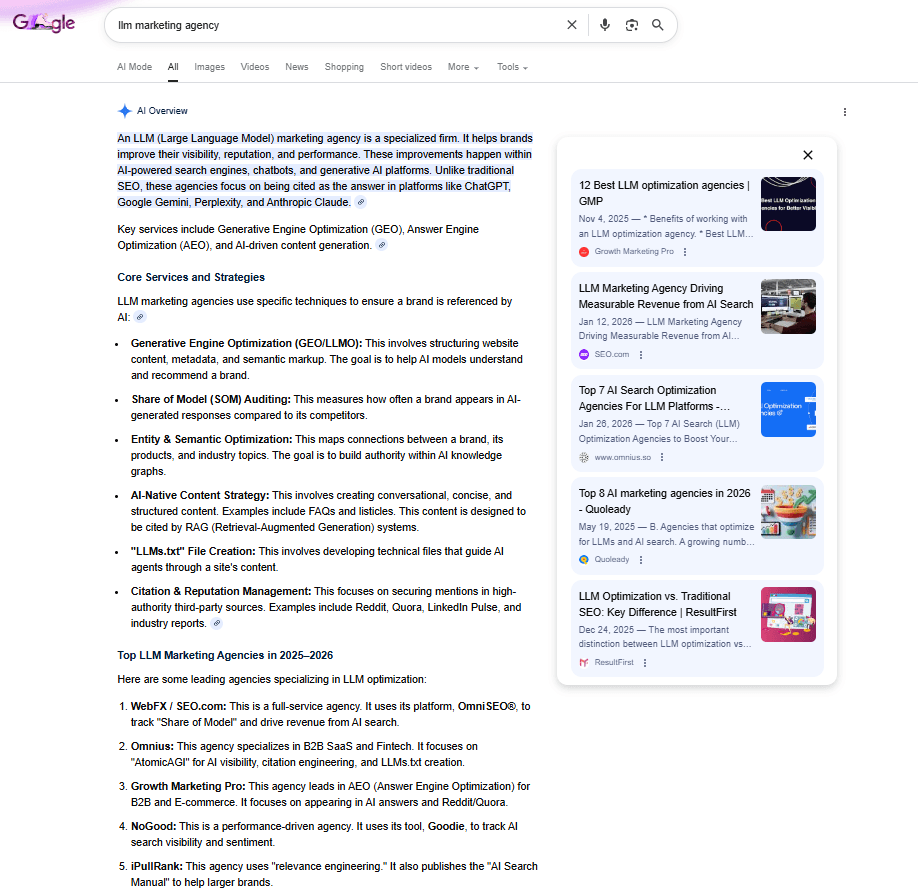
If you’re continually ensuring your content is fresh and following other best practices like creating a clear structure, leveraging FAQs, and showcasing E-E-A-T signals, you’ll increase your chances of appearing in AI Overviews.
Is the goal to “rank” in AI Overviews? What does “ranking” mean when positions change faster than you can track them?
In AI Overviews, the term “ranking” doesn’t really apply. Visibility is a better way to think about it because AI inclusion is dynamic and ever-changing, unlike traditional SEO rankings, which are more stable.
When your goal is visibility on AI platforms, the focus should be on eligibility for inclusion. The objective isn’t to claim a “top spot” in AI answers — it’s to consistently be one of the sources the AI considers trustworthy and authoritative enough to cite.
That’s where E-E-A-T comes into play: demonstrating expertise, experience, authority, and trustworthiness increases your chances of AI systems selecting your content.
Improving your site’s E-E-A-T helps AI systems recognize your content as trustworthy — and at the same time, it strengthens your organic SEO results.
Is tracking AI Overviews performance even meaningful if AI Overviews keep changing?
It is — but only if you track it strategically.
AI visibility changes rapidly, and metrics that matter today may be irrelevant tomorrow. That’s why it’s critical to measure patterns and presence across multiple AI platforms (ChatGPT, Perplexity, Google AI, and every major AI search platform), not just individual rankings.
Like I said, the goal is visibility. You want to track how consistently visible you are across things like AI Overviews.
Whether you choose to do that manually or use a tool like OmniSEO® is up to you. The important part is that you are tracking your performance.
The bottom line is, tracking AI Overview performance is meaningful when it’s measured across platforms and used to inform continuous content and SEO improvements, not when you’re fixated on daily visibility changes.
Get help optimizing for AI Overviews
Not sure where to go with your AI Overviews strategy? Our team can help!
WebFX, the team behind SEO.com, offers AI Overview optimization services to help you perform better in AI Overviews. We’ll help you put a custom strategy in place to increase your visibility in AI Overviews and get your brand in front of more prospects.
Connect with us today to see how we can help you achieve better AI visibility!

Google से परे अपनी दृश्यता बढ़ाएँ
चैटजीपीटी, पेरप्लेक्सिटी और गूगल एआई जैसे उभरते खोज प्लेटफार्मों से लीड और ट्रैफ़िक कैप्चर करें।

Google से परे अपनी दृश्यता बढ़ाएँ
चैटजीपीटी, पेरप्लेक्सिटी और गूगल एआई जैसे उभरते खोज प्लेटफार्मों से लीड और ट्रैफ़िक कैप्चर करें।
Google से परे अपनी दृश्यता बढ़ाएँ
चैटजीपीटी, पेरप्लेक्सिटी और गूगल एआई जैसे उभरते खोज प्लेटफार्मों से लीड और ट्रैफ़िक कैप्चर करें।
लेखकों