



- ¿Qué es una puntuación SEO? Una puntuación SEO es un indicador que muestra el rendimiento de un sitio web en las páginas de resultados de los motores de búsqueda (SERP) y refleja el estado general de tu estrategia de SEO.
- ¿Cómo puedes comprobar tu puntuación SEO? Utiliza una herramienta de análisis SEO, como SEO Checker, introduciendo la URL de tu sitio web, tu nombre y tu dirección de correo electrónico para generar un informe personalizado que analice tu rendimiento SEO en múltiples categorías.
- ¿Qué factores influyen en la puntuación SEO? Tu puntuación SEO incluye la creación de contenido (etiquetas de título, metadescripciones, encabezados), la capacidad de indexación, la optimización para dispositivos móviles, los datos estructurados, la seguridad del sitio web (certificados SSL) y la velocidad de carga de la página.
- ¿Cómo influye la optimización del contenido en la puntuación SEO? Un contenido bien optimizado, con palabras clave en las etiquetas de título (menos de 55 caracteres), las metadescripciones (menos de 155 caracteres), los encabezados jerárquicos, las etiquetas alt de las imágenes y los enlaces internos relevantes, mejora considerablemente tu puntuación SEO.
- ¿Qué medidas rápidas puedes tomar para mejorar tu posicionamiento SEO? Obtén un certificado SSL para garantizar la seguridad, implementa un diseño adaptativo para los usuarios de dispositivos móviles, optimiza los tiempos de carga de las páginas, utiliza correctamente el marcado de datos estructurados y asegúrate de que Google pueda rastrear e indexar adecuadamente tu sitio web a través del archivo robots.txt y el mapa del sitio XML.
¿Qué es una puntuación SEO?
Una puntuación SEO es un indicador que muestra el rendimiento de un sitio web en las páginas de resultados de los motores de búsqueda (SERP). Esta puntuación refleja el estado general de tu estrategia de SEO.
Tu estrategia de optimización para motores de búsqueda (SEO) es un elemento clave para que tu sitio web se posicione bien en los resultados de búsqueda. Pero, ¿cómo sabes si tus tácticas de SEO funcionan? ¡Comprobando tu puntuación de SEO!
On this page, we’ll cover everything you need to know about SEO scores, including:
And if you want to get your SEO score now, use SEO Checker to see where you stand!
¿Qué es una puntuación SEO?
An SEO score is a metric that indicates how well a website can perform in the search engine results pages (SERPs). This score indicates the overall health of your SEO strategy.

Cómo comprobar tu puntuación SEO
Entonces, ¿cómo se calcula la puntuación SEO? ¡La solución más sencilla es utilizar una herramienta de análisis SEO! Las herramientas de análisis SEO, como SEO Checker, toman la URL de tu sitio web, analizan tu posicionamiento en buscadores y generan un informe personalizado sobre el rendimiento de tu sitio.
Here are the steps to use the checker:
- Go to: https://www.seo.com/seo-checker/
- Input your website’s URL, your name, and email address
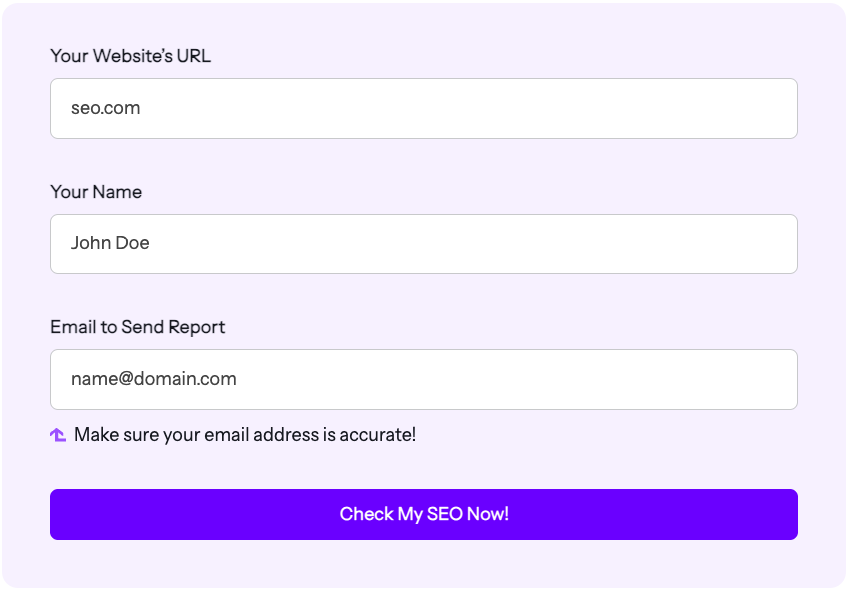
- Click “Check My SEO Now!”
- Wait for the report to generate
It’s that simple! Once you generate the report, you can read through it to see where your SEO excels and where you need to improve.
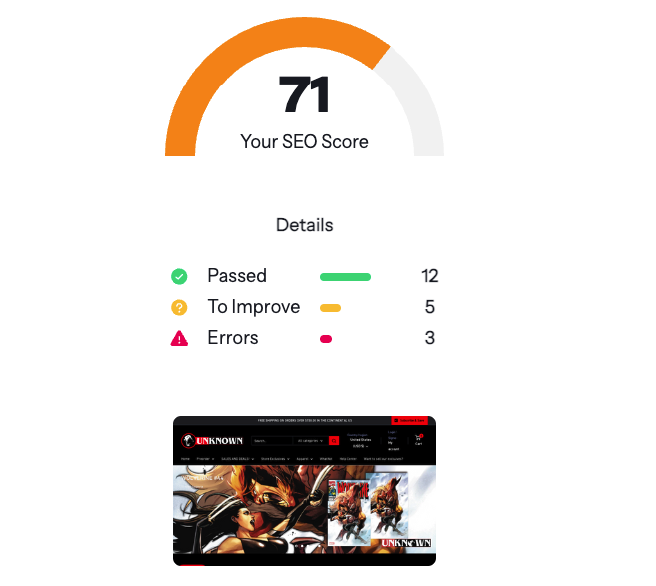
What makes up an SEO score?
So, you input your information and generate your report. Now what?
Let’s break down the different categories an SEO analyzer looks at, using SEO Checker as an example:
1. Content creation
One of the most critical parts of SEO is content creation. But, why is content important for SEO? Content is what drives people to your website and what ranks in search results. Your content, and how you optimize it for search engines, is included as part of your website SEO score.
Multiple components make up a piece of content. SEO Checker looks at aspects like your:
- Etiqueta de título
- Descripción meta
- Headings
- Alt attributions
- In-page links
All these elements impact your page’s ability to rank in search results. If your title tags are too long or your headings don’t have keywords, for example, your website may not perform as well in search results.
SEO Checker will look at each aspect and provide tips for improving. It’ll also indicate how much of an impact that element has on your SEO, and how difficult it is to fix.
2. Indexing
For your website to appear and rank in search results, Google needs to crawl and index it. That’s why indexing is part of SEO scoring. Your website’s ability to be indexed for search results will impact your overall SEO health.
Indexing is made up of multiple factors, including:
- Redirects on your website
- Your txt file
- Tu mapa del sitio XML
- Etiquetas hreflang
These elements impact how Google crawls and indexes your website, what pages it can access, and more. Using an SEO analyzer will help you identify how to improve SEO for your site.
3. Mobile-friendliness
With so many people using mobile devices on the web, mobile-friendly websites are a must for SEO. Having a mobile-friendly website keeps people engaged on your site longer, which sends positive signals to search engines.
So, what makes up your mobile score?
- Website mobile-friendliness
- Tap targets
- Mobile viewport
- Mobile rendering
The mobile aspect of your website SEO score looks at whether you deliver a functional and hassle-free mobile experience. It looks at aspects like having responsive design instead of a separate mobile website and spacing of your thumb-friendly buttons. Optimizing these elements will improve your SEO score.
4. Structured data
Structured data, known as schema markup, tells search engines what’s on your page. It’s crucial to optimize this part of your website so search engines can rank your pages appropriately.
Una herramienta como SEO Checker tiene en cuenta varios factores, pero se centra principalmente en tu Schema.org para determinar si tu información y tus datos están estructurados correctamente. Si no es así, SEO Checker te ofrecerá consejos para mejorar el marcado de tu esquema.
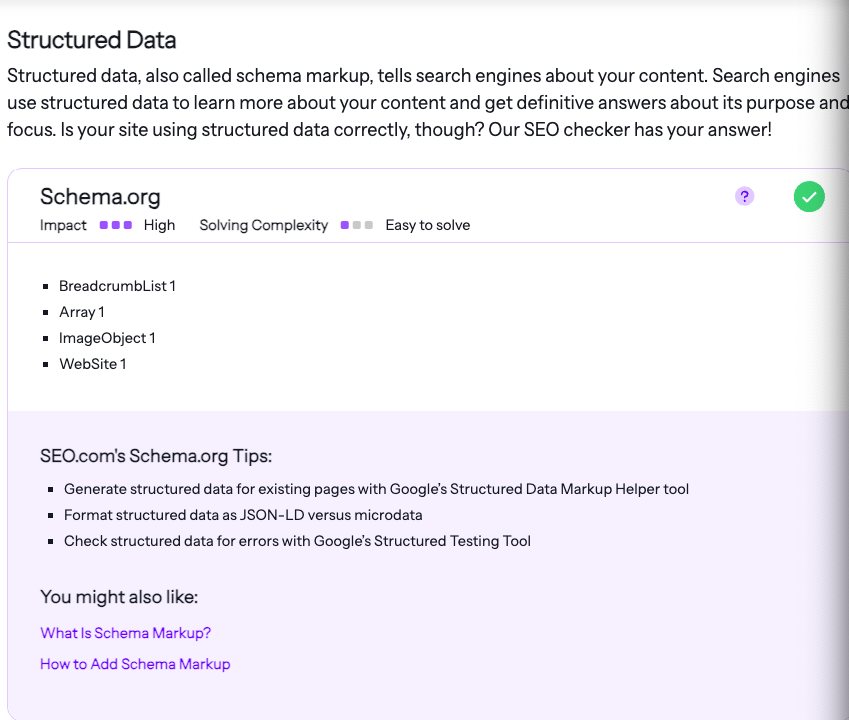
This tool will also analyze your open graph protocol, Twitter card, and microformats if you have them.
5. Security
Did you know that websites across the Internet experience an average of 94 attacks every day? Website security has become increasingly vital for ranking in search engines like Google — Google wants to direct people to websites that will protect their information.
So, as a result, website security factors into your SEO score.
The biggest elements that factor into your website SEO score are your email privacy and secure sockets layer (SSL) certificate. Your SSL, for example, ensures that any shared data is encrypted and protected.
Ensuring your website is secure is crucial for improving your SEO score.
6. Website speed

When people want information from your website, they want it fast –– they don’t want to wait for your website to load. That’s why website speed is an important factor in your SEO score. Having a fast-loading website means people stay on your site to get the information they need, which leads to longer dwell times and engagement.
SEO Checker will look at your website’s load time and see if your pages load quickly enough. It provides tips on what area of your website’s load time needs improvement.
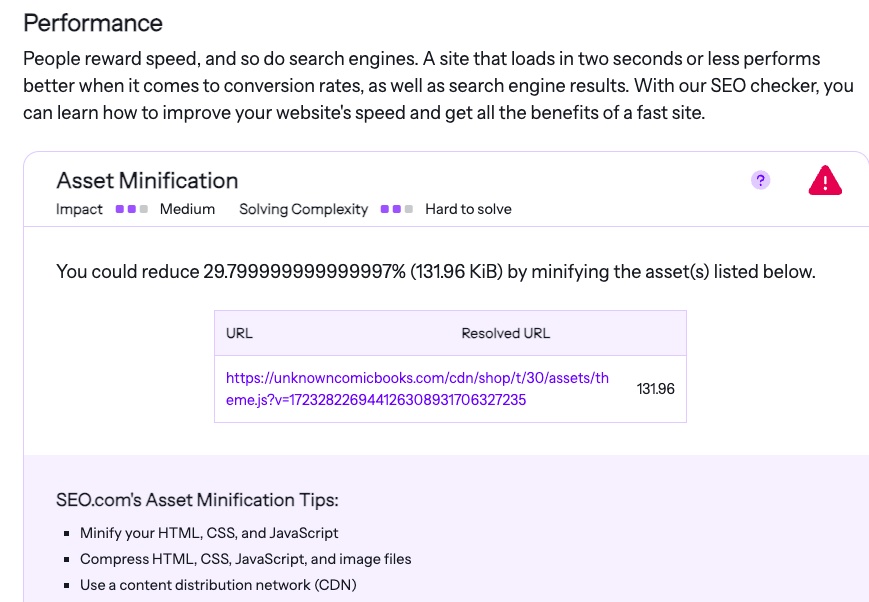
Tasks like using a content distribution system and enabling browser caching can improve your website’s SEO score.
Additional factors considered in your SEO scoring
The factors listed above are some of the most important things that impact your website SEO score, but they aren’t the only ones. Some other factors that SEO Checker will look at include:
- Technologies: SEO Checker analyzes your website’s server and technologies to ensure everything works properly.
- Branding: This SEO analyzer will look at key areas of your branding, like your website URL, to ensure you’re integrating your company’s branding and name effectively.
- Domain name: Your domain name should be concise and have your brand name integrated into it.
- Backlinks: Backlinks are links to your website from other authority sites, which help improve your website’s trust and reputation. SEO Checker analyzes your backlinks to see if you’re earning valuable ones.
- Local listings: Having a local presence is crucial for SEO. SEO Checker will analyze to see if you’ve claimed your Google Business Profile and if your name, address, and phone number are consistent across the web.
How to improve your SEO score
You got your SEO score, and you’re not happy with it. What do you do next? How can you improve your SEO score?
What your business needs will depend upon your score and the areas where you fall short, but here are some general ways to improve in each scoring area:
How to improve your content creation

If you find you need to improve your SEO score in the content area, here are some ways to boost your score:
- Optimize title tags by putting your keyword at the beginning and staying within the 55-character limit
- Limit your meta descriptions to 155 characters and make sure they summarize the page/provide a preview of what to expect
- Optimize your headings with your core keywords and use tiered headings (H1, H2, H3) to organize your pages
- Add alt tags to images
- Add relevant internal links to your pages
How to improve your indexability
Is your SEO score low because of your indexability? Here are some tips to help Google index your website:
- Use redirects to new pages
- Test your robots.txt file with Google Search Console to find any problems
- Use the correct URL format with your XML sitemap (“www” and “HTTPS” or “HTTP”)
How to improve your mobile friendliness
Does your SEO scoring show your mobile-friendliness is lacking? Here’s what you can do to improve it:
- Integrate responsive design into your website instead of using a separate mobile site
- Limit your use of plugins, like Flash and Java
- Use heatmaps to see how users interact with your website and where there might be points of friction
- Test your website to make sure it renders correctly on mobile
How to improve your structured data
Need to improve the structured data part of your SEO scoring? Here’s how you can optimize it:
- Use Google’s Structured Data Markup Helper tool to generate structured data right
- Test for errors using Google’s Structured Data Testing Tools
- Use JSON-LD versus microdata when formatting your structured data
How to improve your website security
Is your lack of website security dragging down your website SEO score? Here’s what you can do to boost your score:
- Get an SSL certificate to secure your website
- Avoid adding email addresses to your website — use contact forms instead
- Redirect your HTTP pages to HTTPS after getting your SSL certificate
Conoce tu puntuación SEO para empezar a mejorar tu estrategia de posicionamiento
Knowing your SEO score gives you a benchmark for understanding where to improve your SEO to perform better in search results.
Use our SEO Checker to get your customized report on how to improve your SEO today!
No suspendas la prueba más importante de tu sitio web
Consigue un informe de SEO de tu sitio web de forma gratuita en menos de 30 segundos.


Servicios de SEO que no son un producto en serie
Consigue una estrategia de SEO adaptada a tu negocio, tu sector y tus objetivos de ingresos.

Servicios de SEO que no son un producto en serie
Consigue una estrategia de SEO adaptada a tu negocio, tu sector y tus objetivos de ingresos.
Escritores