



- Why is E-E-A-T critical in an AI-driven search world? E-E-A-T (Experience, Expertise, Authoritativeness, Trustworthiness) has become essential because consumers are increasingly skeptical about AI-generated content and actively look for signals to determine what is real versus AI-created, making trust-building more important than ever.
- What E-E-A-T signals matter most today? Third-party validation carries the most weight, including case studies, online reviews, forum comments, industry certifications, and endorsements from respected leaders, as these external signals demonstrate genuine trust better than self-created content like biographies or editorial guidelines alone.
- How should businesses approach E-E-A-T differently because of AI? Companies need to move beyond traditional foundational strategies by actively engaging with their audience through forums, conducting first-party research studies, sharing experiments publicly, and having genuine conversations that demonstrate real expertise and experience rather than just claiming it.
- What is the biggest misconception about using AI to build trust? Marketers wrongly believe they can manipulate or curate E-E-A-T signals with AI for long-term success, but this dark-hat approach will eventually fail as search platforms like Google must combat manipulation to maintain user trust and technology adoption.
- How should AI be used in content creation for E-E-A-T? AI should serve as a collaborative tool that supports rather than leads content creation, such as generating topic ideas, transcribing interviews, or creating subject line variations, while humans provide the actual expertise, experience, and authentic voice that builds genuine trust and connection.
“I don’t know if I trust it.”
That’s a phrase you’ll hear people saying more and more as AI becomes a prominent part of the conversation. The rise of AI is creating general skepticism in consumers about what’s real and what isn’t.
When you add on the fact that AI-generated content is becoming more prominent, it makes skepticism even higher and building trust even more important.
Namely, there’s now an even bigger focus on E-E-A-T.
But how do you balance E-E-A-T and AI in this consumer-skeptical world?
I asked Sarah, our SEO expert, all about leveraging E-E-A-T to build trust in an AI-driven world.

Why is E-E-A-T so critical in an AI search world?
Sarah: Because people care about it and companies depend on it.
Menschen
People are complicated when it comes to AI.
Seeing something that acknowledges it’s AI-generated, whether it’s a disclaimer beneath an image or a product touting its AI summarization capabilities, is acceptable to people. But seeing something that presents itself as human-generated (but came about through AI) isn’t acceptable to people.
A good example is the em dash, which people now see as a common AI tell.
Because of this, people are looking for more and more ways to discern what is real and what isn’t. There’s even an entire subreddit (https://www.reddit.com/r/isthisAI/) with more than 150K+ followers that’s dedicated to determining whether something is human- or AI-generated.
(As an aside, if you’re a fan of The Matrix, the is-it-real vs. is-it-not debate ties into a great story from Keanu Reeves.)
So, people are looking for E-E-A-T signals across a website and across a brand’s online footprint, like through:
- The copywriting
- The stories you tell
- The images (including images of the business’s physical location, if relevant)
- The author’s biography
- The author’s online footprint, like their LinkedIn profile
- The recognition the brand’s received from third-parties
- The methodology behind the brand’s research (if relevant)
- The reviews or discussions across different sites about the brand and its products or services
You can think of it like the deep-dive research that you’d do before letting someone babysit your children or housesit your pets.
And if people find something that smells like unacknowledged AI, it will affect their perception of your brand, and in some cases disqualify you.
Companies
Delivering inaccurate, hallucinated information is a liability for the companies developing AI-driven experiences, whether it’s ChatGPT or Google. While they can all place a disclaimer at the bottom of their responses, if there isn’t trust in those responses, people won’t adopt the technology to the same degree that they would if they trusted it.
That’s why companies like Google are leveraging surveys for AI Mode and AI Overviews, which allows them to find out if users think the information is correct and reliable.
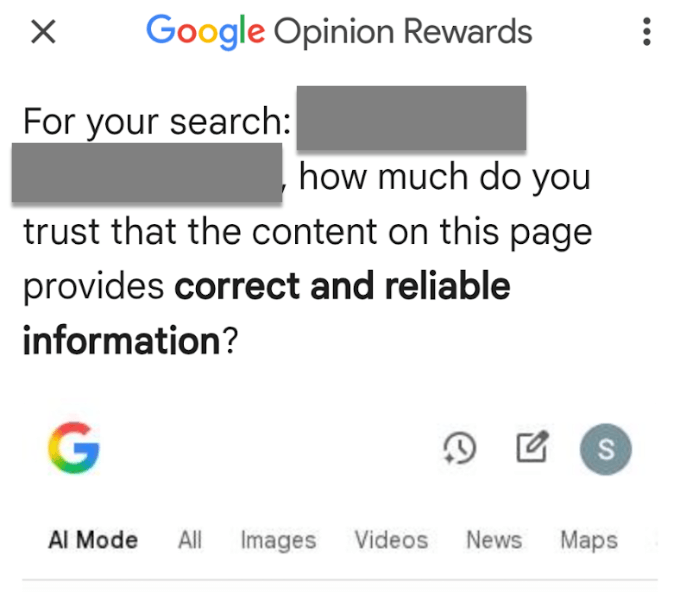
This survey is also giving $1.40 for a response, which is almost triple what normal surveys are, emphasizing the importance to Google.
So, naturally, it’s a two-way street — users need to know what is and isn’t AI-generated, and companies (like Google) need to know that when AI-generated responses appear, they’re reliable.
Otherwise, it won’t work.
Instead of becoming the platform for all use cases, from search to discovery to generation, the platform plateaus and loses its chance at being the next Google, Facebook, etc.
These companies aren’t looking to become the go-to AI image generator. They’re looking to become the platform for all-things AI — that’d be a massive data moat for them. And they need users to trust them for that.
Do you have to change the way you approach E-E-A-T because of AI content?
Sarah: That depends on your current approach.
The traditional E-E-A-T strategies still matter, but we can look at them more as foundational. For example:
- Biografien von Autoren
- Editorial guidelines or policies
- Relevant certifications and/or awards
- Leadership biographies
- Geschichte des Unternehmens
- Fallstudien
- First-person writing to share experiences
- Bewertungen
What we’re seeing more of is companies demonstrating E-E-A-T by stepping off stage and sitting down with their market.
They’re connecting with people by offering advice on forums (including Reddit, but also some more niche sites), investing in first-party data research studies (you can see an example of this in our recent AI Overviews study), and sharing their tests and experiments (this can range from an automotive body shop trying a new product via YouTube to a marketer testing an AI Overview optimization and posting their results to Substack).
And what happens when businesses do that (and do it well) is that people respond by:
- Sharing, whether offline or online, how you’ve helped them
- Checking your website (or physical location) to learn what else you have to offer
- Engaging, like responding to your post or initial reply
This then circles back and feeds into that initial stage of researching that babysitter to gauge their trust, expertise, experience, and authority.
In the current search landscape, what E-E-A-T signals matter most?
Sarah: What other people say about you, and that takes shape in different ways, like:
- Fallstudie
- Online review
- Forum comment
- Recognition, like a certification from Microsoft or an award from Google
- Endorsement, like an industry leader resharing something you’ve said or congratulating your team’s accomplishment
You can have a well-written biography, a leadership page, and a set of editorial guidelines, but if there is radio silence on what others think of you, that places a big question mark above your brand. Are you AI-generated, like Ahrefs’ recent brand experiment, or are you a business that’s only beginning (or hasn’t put much towards online marketing)?
What’s the biggest misconception marketers have about using AI to build trust?
Sarah: On the dark-hat side of things, the ability to manipulate or curate it with AI.
While that’s true right now (as demonstrated by Ahrefs’ experiment), it’s not a long-term strategy for success. Look back at Google’s biggest updates to its search engine — they focused on tackling spam and manipulation tactics because…and this goes back to the first question…people won’t adopt the technology if they don’t trust it. And if they don’t adopt it, companies like Google, OpenAI, Meta, etc. can’t monetize it.
Putting in the work to build real E-E-A-T signals will set your business on-course for long-term success. And that can mean:
- Running email campaigns to invite customers to share their experience (like in an online review)
- Inviting high-performing accounts to serve as a case study
- Working towards an industry certification (which could be as simple as a Google Analytics / GA4 certification!)
- Getting in front of the camera or the keyboard to share your opinion, first-hand experience, etc., whether in a post or reply
Today, E-E-A-T is more collaborative. You can’t settle for what’s in your control. You have to get out and interact with your audience.
Is it possible that leaning too heavily on AI for content could actually be hurting E-E-A-T?
Sarah: Certainly.
People are looking for AI-generated signals when reading a blog post, evaluating a product, or calling a customer support line — and that signal can range from a disclaimer of ‘hey, I used AI to write this post because my writing is 1/5.‘ to someone seeing an em dash and assuming AI was involved. The difference is people react better when companies are upfront about using AI (unless you’re Coca Cola*) vs. when they’re not.
So, when it comes to using AI for content (to build E-E-A-T), one approach is to use AI as one stair in a staircase. So, for example:
| Staircase | Stair |
| A weekly post in a forum on a troubleshooting topic | AI generates the topic idea. You craft the response. |
| A study on how NPS scores affect your client retention rate | AI evaluates the dataset. You review and produce the final report. |
| A share on how you helped sixth-graders better understand cell division | AI generates diagrams where kids share what’s right / wrong. |
| A request for online reviews from recent customers | AI generates subject line ideas and variations |
| A case study on you and a client’s recent success | AI transcribes the interview and highlights specific quotes |
| An email on your team’s experiments from this quarter | AI generates a framework for the outline |
The idea is it’s collaborative. You’re using AI to support vs. lead because at the end of the day, what you are sharing is a demonstration of your expertise and your experience — and that’s what not only builds trust with people, but connection.
Start building your E-E-A-T signals today
E-E-A-T is fundamental to your success both in traditional search and AI search. Showing that your business is an expert and trustworthy is crucial for getting people to choose you over your competition.
Connect with us today to see how we can help you build better E-E-A-T signals to build your brand’s trust in an AI-driven world!

Machen Sie Ihre SEO-Strategie zukunftssicher mit OmniSEO®
Auf Wiedersehen Suchmaschinenoptimierung, hallo Suche überall Optimierung.

Machen Sie Ihre SEO-Strategie zukunftssicher mit OmniSEO®
Auf Wiedersehen Suchmaschinenoptimierung, hallo Suche überall Optimierung.
Machen Sie Ihre SEO-Strategie zukunftssicher mit OmniSEO®
Auf Wiedersehen Suchmaschinenoptimierung, hallo Suche überall Optimierung.
Schriftsteller


*I personally give Coca-Cola a thumbs-up for how they’ve communicated and shared their AI video generation adventures.