



- ¿Por qué es importante realizar un seguimiento de los clientes potenciales y los clientes procedentes del SEO? El seguimiento de los clientes potenciales y los clientes procedentes del SEO ofrece una visión completa del rendimiento de las acciones de marketing, más allá de los simples visitantes del sitio web, y pone de manifiesto que el SEO suele generar más clientes e ingresos que los canales de publicidad de pago, a pesar de que las cifras de tráfico sean menores.
- ¿Qué herramienta puede recopilar datos de atribución SEO de forma automática? Attributer es una herramienta que rastrea el origen de los clientes potenciales detectando las fuentes de los visitantes, almacenando los datos en las cookies del navegador y registrando automáticamente la información de atribución en campos ocultos de los formularios cuando los visitantes envían formularios de contacto en tu sitio web.
- ¿Cómo se configura Attributer para el seguimiento SEO? Instala el fragmento de código de Attributer en tu sitio web, añade cinco campos ocultos (Canal y Desglose de canal 1-4) a tus formularios de captura de clientes potenciales, y la herramienta rellenará automáticamente estos campos con datos SEO, como el motor de búsqueda, la URL de referencia y las palabras clave, cuando se envíen los formularios.
- ¿Qué informes ayudan a medir el ROI del SEO de forma eficaz? Tres informes clave son: «Clientes potenciales por canal» (que compara el SEO con otros canales de marketing), «Clientes procedentes del SEO por motor de búsqueda» (que muestra qué motores de búsqueda generan más clientes) y «Ingresos del SEO por grupo de páginas de destino» (que identifica qué tipos de contenido generan más ingresos).
- ¿Cómo mejora la atribución adecuada las decisiones de marketing? Gracias a un seguimiento preciso de los clientes potenciales y los clientes, las empresas pueden medir el verdadero retorno de la inversión de sus esfuerzos de SEO, comparar el rendimiento con el de otras iniciativas de marketing, como Google Ads o Facebook Ads, y asignar los presupuestos de marketing de forma más eficaz para maximizar el crecimiento del negocio.
Tools like Google Analytics make it really easy to see how many website visitors you are getting from your SEO efforts, it’s often much harder to track how many leads & customers you are getting.
Fortunately, there is a solution.
In this article, we’ll outline how you can attribute leads & customers to SEO in your company’s CRM, and show you a few reports you can run to understand the ROI of your SEO efforts.
- Why It’s Important to Track Leads & Customers from SEO
- Tools for Capturing SEO Attribution Data
- Tres pasos para realizar un seguimiento de los clientes potenciales y los clientes procedentes del SEO con Attributer
- 3 Reports to Run to Help You Understand the ROI of SEO
Why it’s important to track leads & customers from SEO
Imagine you run a pool maintenance company and are doing SEO, Google Ads & Facebook Ads to attract new customers to your business.
If you were using SEO analytics tools like Google Analytics to measure visitors, you’d probably get something like this:
| SEO | Facebook Ads | Google Ads | |
| Gastar | $5,000 | $5,000 | $5,000 |
| Visitors | 200 | 500 | 400 |
If this was the only information you had access to, then it would look like your Facebook Ads and Google Ads were far outperforming your SEO efforts. As a result, you’d probably start to spend more on those.
However, imagine if you could see the results all the way down to the number of customers and the amount of revenue generated. You’d have something like this:
| SEO | Facebook Ads | Google Ads | |
| Gastar | $5,000 | $5,000 | $5,000 |
| Visitors | 200 | 500 | 400 |
| Clientes potenciales | 30 | 40 | 40 |
| Customers | 25 | 7 | 12 |
| Ingresos | $45,000 | $8,000 | $18,000 |
Looking at the numbers above, you can actually see that your SEO efforts are far outperforming your paid ads:
- You got more customers from SEO (25) than Google Ads and Facebook Ads combined (19)
- You got more revenue from SEO ($45,000) than Google Ads and Facebook Ads combined ($26,000)
- Your conversion rate from lead to customer is higher for SEO (83%) than for your paid ads (17.5% for Facebook Ads and 30% for Google Ads)
When you’re able to track SEO and the performance of your various marketing initiatives down to the number of customers and amount of revenue generated, you’re able to get the full picture of how they are performing and can allocate your budget accordingly. It also helps you prove the value of SEO and your other digital marketing campaigns to leadership.
Deja de hacer conjeturas y empieza a crecer.
Our DataTech experts provide the guidance and strategies you need to harness your data, optimize campaigns, and achieve significant revenue gains.

Tools for capturing SEO attribution data
There are a lot of ways to get this valuable data into reports. It all depends on your set up as to which one will work the best for you!
Some CRMs like Nutshell provide easy to use form builders that will capture this data automatically.
If you use WordPress, a plugin like Handl UTM Grabber could be your best option.
Here at SEO.com, we use a tool called Attributer to track where our leads and customers are coming from (including those that come from our SEO efforts). Here’s how to set it up:
Tres pasos para hacer un seguimiento de los clientes potenciales y los clientes procedentes del SEO con Attributer
1. Install Attributer & add hidden fields
Once you’ve created an Attributer account, you’ll receive a snippet of code to place on your website. Depending on what website builder you use (WordPress, Wix, Webflow, etc) you should just be able to add it directly to your site, typically through the Settings section.
When the code is up and running on your site, you need to add a couple of hidden fields to the lead capture form on your website. Those hidden fields are:
- Channel
- Channel Drilldown 1
- Channel Drilldown 2
- Channel Drilldown 3
- Channel Drilldown 4
Adding hidden fields to most form-building tools is easy. You can usually just drag and drop a ‘Hidden’ field type into your form. Attributer has documentation on how to do this for all the major form-builders, including Gravity Forms, Wix Forms, Webflow Forms, etc.
2. Attributer writes SEO information into the hidden fields
When a visitor lands on your site from search engines like Google or Bing, Attributer detects where they came from and saves the data in a cookie in the visitor’s browser.
Then when they complete a form on your site (like your ‘Contact Us’ or Request A Quote’ form), Attributer will write the SEO data into the hidden fields on the form, which will be captured together with the leads’ name, email, etc. upon from submission.
To demonstrate, let’s continue the example from above and pretend I’m providing digital marketing services for a pool maintenance company. If someone comes to the site from a Google search, clicks around a few pages on the site then fills out a contact form, Attributer would write the following data into the hidden fields:
- Channel = Organic Search
- Channel Drilldown 1 = Google
- Channel Drilldown 2 = www.google.com
- Channel Drilldown 3 = The keyword they searched for (if it’s passed by the search engine)
On top of this, Attributer would also capture and pass through the data on the visitor’s landing page (i.e. sydneypools.com/services/pool-cleaning) and the landing page group (i.e. /services).
3. Use this data to understand how many leads & customers you are getting
If your company uses a CRM system like Salesforce, Pipedrive, Hubspot, etc. then you can send this data into your CRM.
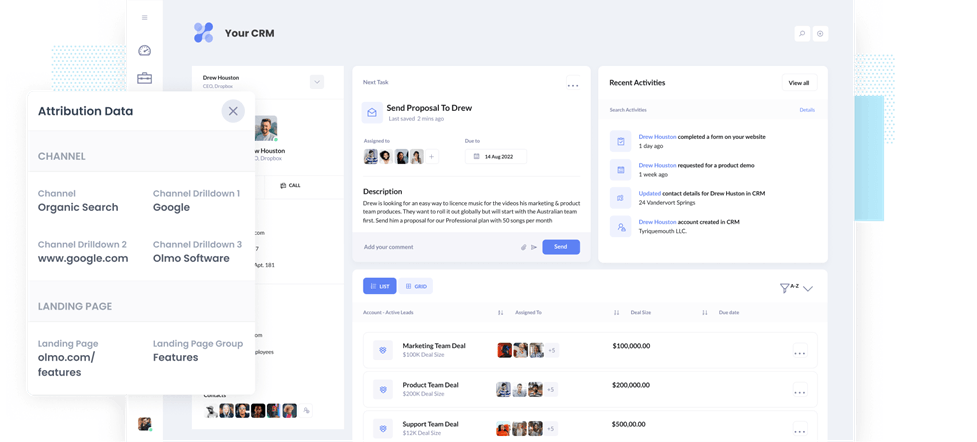
Once it’s in, you can use your CRM’s built-in reporting tools to create reports that show how many leads you got from SEO, how many of those became customers, how much SEO revenue was generated, etc.
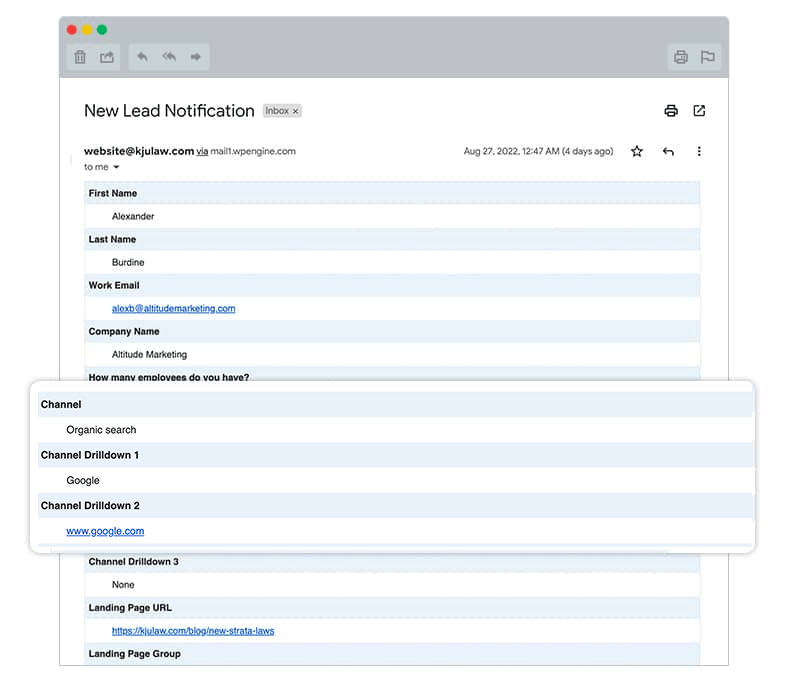
Alternatively, if you don’t use a CRM and simply manage and respond to new leads from your email inbox, you can include this data in your new lead notification email so you can see how many leads you are getting from SEO that way.
3 reports to run to help you understand the ROI of SEO
If you are sending information about where each of your leads came from into a CRM, or even if you are just sending it to a spreadsheet, you should be able to run reports like the ones below:
1. Leads By Channel
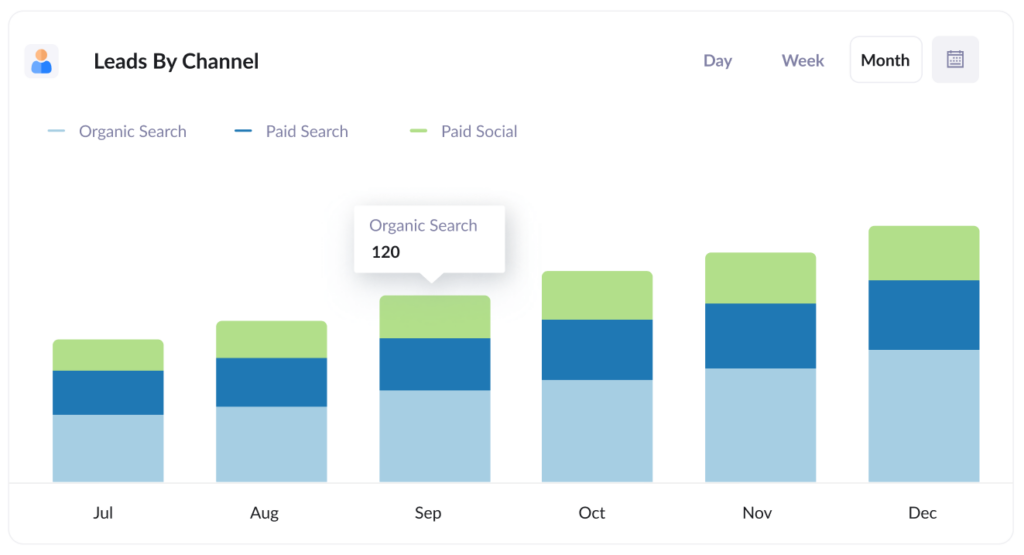
The chart above shows how many leads were generated broken down by the channel they came from.
It’s a good way to understand how SEO is performing for your business compared to other channels like Paid Search or Paid Social.
As you can see, this report clearly shows the value SEO is providing. It’s actually generating more leads for the business than paid channels like Google Ads and Facebook Ads, and it’s growing too.
2. Customers from SEO by search engine
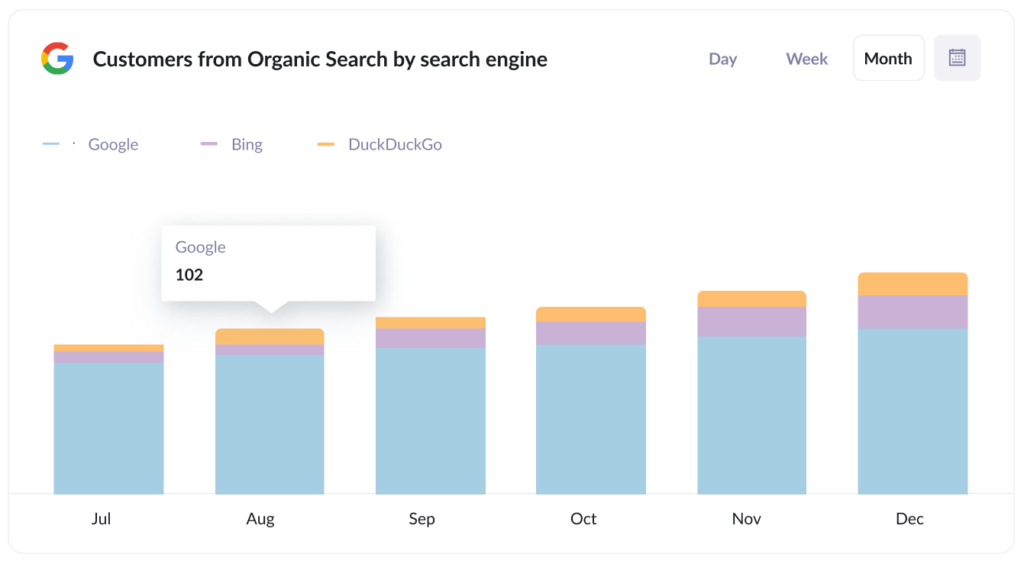
This graph shows how many customers the business has generated from their SEO efforts (or investment in enterprise SEO services), broken down by the search engine they came from.
As well as answering basic questions like ‘How many customers do I get from our SEO efforts’, ‘Why my website doesn’t drive leads‘, and ‘Which search engines are giving us most of our customers’, this report can also be useful to calculate the conversion rate of leads to customers as well.
It’s quite common for leads from Organic Search to convert much better down the funnel than leads from sources like Facebook Ads, so this report can help you understand what the average conversion rates are and how they compare to other channels.
3. Ingresos por SEO por grupo de páginas de destino
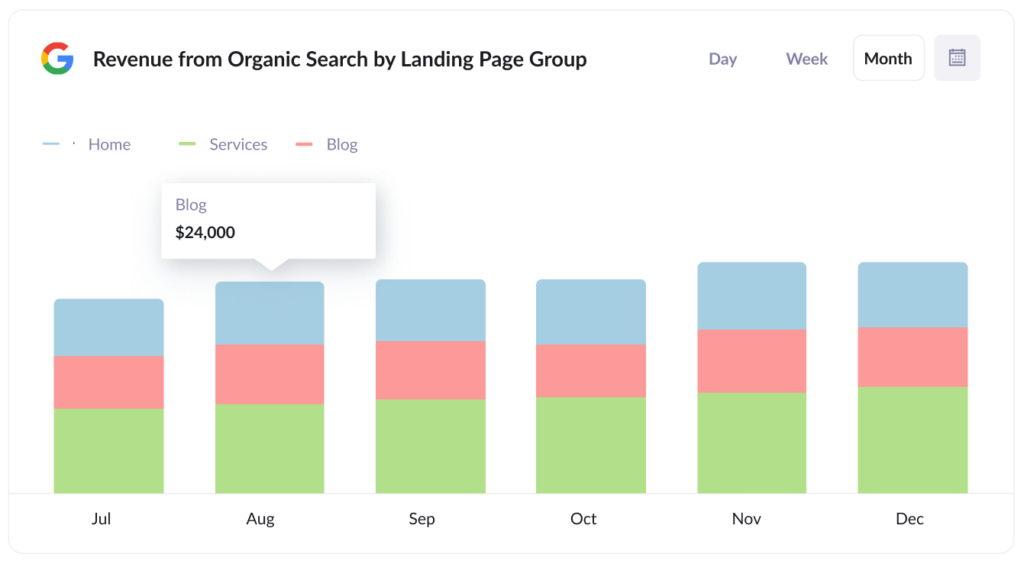
The example graph above shows the amount of revenue generated from customers who have come from your SEO efforts, broken down by the landing page group (I.e. the grouping of pages based on the subfolder in the URL).
This report allows you to see what types of content are generating customers & revenue from search engines, and can help you identify what you need to create more of.
Similarly, if you do see a change in the amounts of customers & revenue coming from SEO, this report can help you identify what happened. Was it that the homepage saw a boost in rankings? Or is it that the blog posts and webinars you’ve been diligently creating are starting to get traction?
Make better marketing decisions with proper attribution
When you start to track how many leads & customers you are getting from your SEO efforts, you’re able to measure how much return on investment you are getting and if it’s better or worse than other marketing initiatives like Google Ads and Facebook Ads.
And knowing that can help you make better decisions about how to spend your marketing budget to grow your business.
And if you need any help setting it up, our team is experienced with Attributer and the various form-building tools it works with, so can help get it up and running on your site!

Servicios de SEO que no son un producto en serie
Consigue una estrategia de SEO adaptada a tu negocio, tu sector y tus objetivos de ingresos.


Deja de hacer conjeturas y empieza a crecer.
Our DataTech experts provide the guidance and strategies you need to harness your data, optimize campaigns, and achieve significant revenue gains.
Índice
- Why It’s Important to Track Leads & Customers from SEO
- Tools for Capturing SEO Attribution Data
- Tres pasos para realizar un seguimiento de los clientes potenciales y los clientes procedentes del SEO con Attributer
- 1. Instalar Attributer y añadir campos ocultos
- 2. El atributo introduce información de SEO en los campos ocultos
- 3. Utiliza estos datos para saber cuántos clientes potenciales y clientes estás consiguiendo
- 3 Reports to Run to Help You Understand the ROI of SEO
- 1. Clientes potenciales por canal
- 2. Clientes procedentes de SEO a través de motores de búsqueda
- 3. Ingresos por SEO por grupo de páginas de destino
- Make Better Marketing Decisions with Proper Attribution

Deja de hacer conjeturas y empieza a crecer.
Our DataTech experts provide the guidance and strategies you need to harness your data, optimize campaigns, and achieve significant revenue gains.
Escritores