



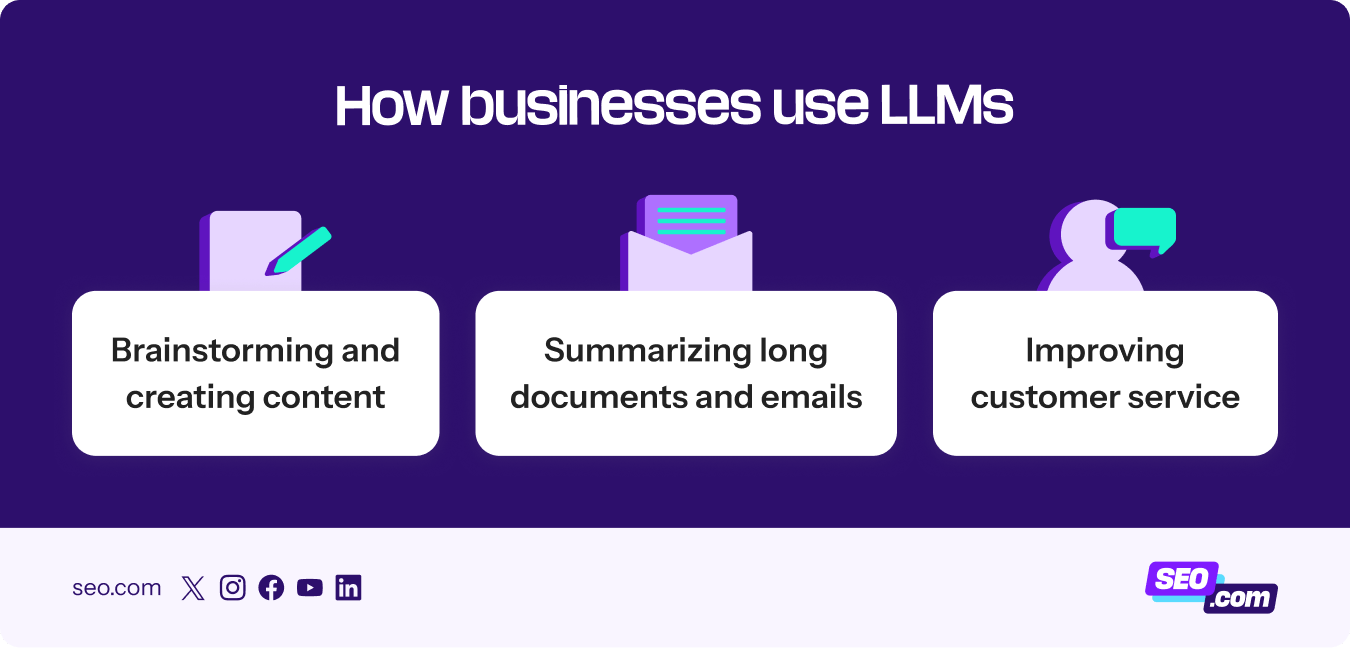
An LLM is a type of artificial intelligence that understands, processes, and generates text based on the input it gets. Many businesses leverage LLMs to brainstorm and create content, summarize long documents and emails, and improve customer service. LLMs are also becoming a more prominent part of the search experience, making them an important part of your marketing strategy too.
The buzz around AI is impossible to ignore, but the terminology can be overwhelming. Large language models (LLMs), generative AI, and machine learning — it’s a lot to keep straight, especially when you’re trying to focus on your business goals. Yet nearly 67% of organizations are now using generative AI products that rely on LLMs, making this technology too significant to dismiss as just another trend.
For marketers and business owners, understanding what an LLM actually is and how it works isn’t optional anymore. It’s the foundation for making smart decisions about whether this technology belongs in your marketing strategy. Discover what an LLM is in simple, jargon-free terms so you can confidently evaluate if they’re right for your business.
What is an LLM?
An LLM is a type of artificial intelligence designed to understand and generate humanlike text based on the input it receives. Think of it as an advanced autocomplete that can predict, summarize and generate entire documents, not just the next word in a sentence.
At its core, an LLM focuses on understanding and creating text that sounds natural and human. When you ask it a question, provide a prompt or feed it information, it processes that input and generates a response that mirrors how a person might write or speak. This capability makes LLMs particularly valuable for language-related tasks, from drafting emails to answering customer questions.
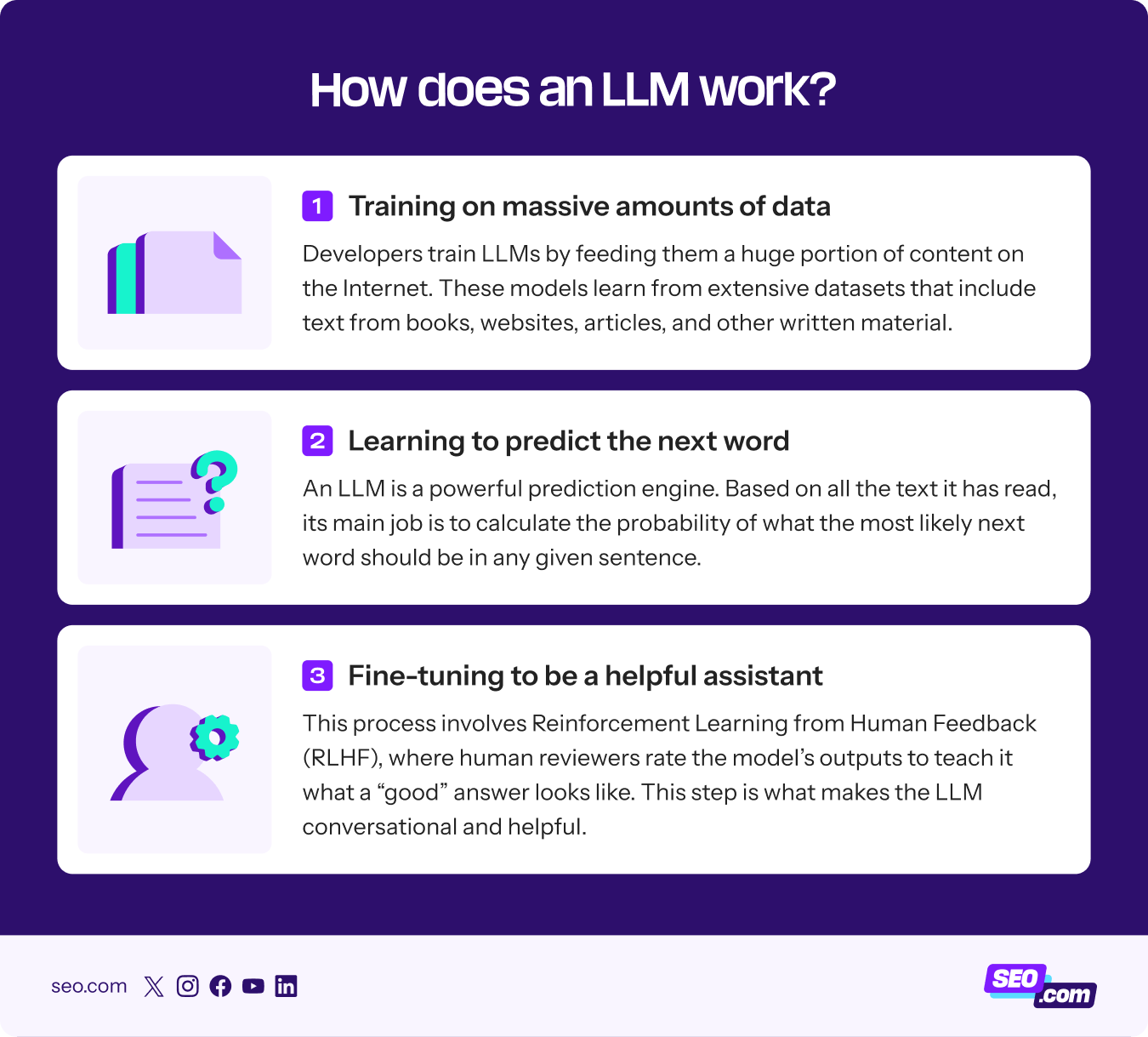
How does an LLM work?
The process involves three main steps that transform raw data into a tool capable of having conversations, answering questions and creating content. Here’s a simplified overview of what happens behind the scenes.
Training on massive amounts of data
Developers train LLMs by feeding them a huge portion of content on the Internet. These models learn from extensive datasets that include text from books, websites, articles, and other written material. Data exposure is how they learn grammar, facts, writing styles and reasoning patterns.
The goal is to cover various topics, writing styles, and contexts so the model can handle almost any question or prompt you throw at it. Through this training, LLMs understand context, so they know the difference between a financial bank and a river bank based on how you use the word in a sentence.
Learning to predict the next word
At its simplest, an LLM is a powerful prediction engine. Based on all the text it has read, its main job is to calculate the probability of what the most likely next word should be in any given sentence.
Give it the beginning of a sentence, and it calculates the probability of every possible next word. The model selects the word with the highest probability, then repeats the process for the next word, and so on. LLMs use this prediction loop to generate coherent paragraphs, articles, and even creative content.
Fine-tuning to be a helpful assistant
After initial training, humans step in to fine-tune the model. This process involves Reinforcement Learning from Human Feedback (RLHF), where human reviewers rate the model’s outputs to teach it what a “good” answer looks like.
This step is what makes the LLM conversational and helpful. It teaches the model to follow instructions, answer questions clearly, and avoid generating inappropriate or unhelpful responses. Without this fine-tuning, the model would be good at predicting text but not particularly useful for real-world applications.
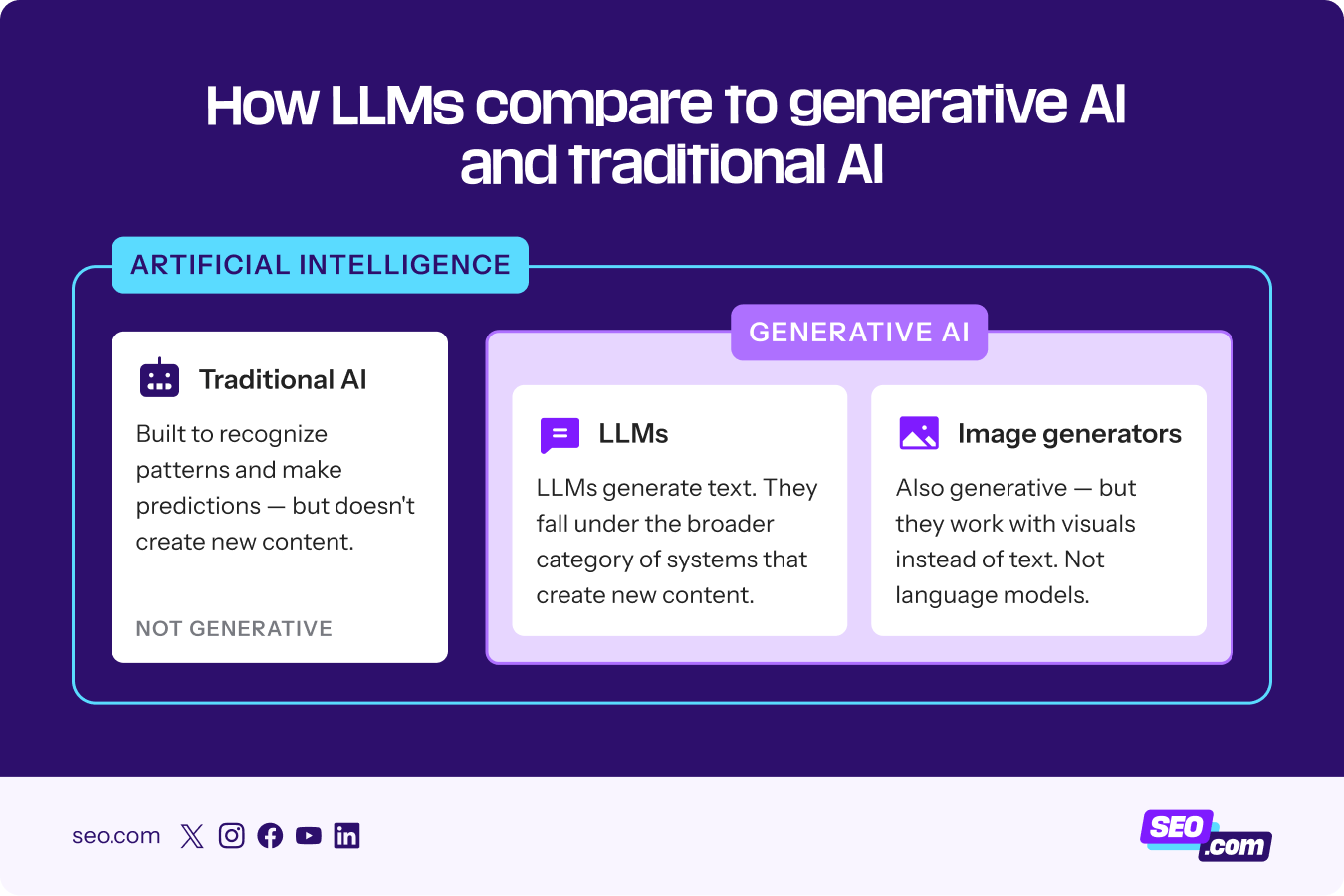
How LLMs compare to generative AI and traditional AI
These terms get thrown around interchangeably, but they’re not the same thing. Understanding the distinction matters when evaluating tools for your business. AI is like the whole car, with the others being engine parts.
Here are the key distinctions:
- LLMs are a type of generative AI — They fall under the broader category of AI systems that create new content.
- Generative AI is a category of AI — Not all AI is generative — some AI systems are built to recognize patterns or make predictions without creating new content.
- Not all generative AI is a language model — Image generators, for example, fall under generative AI but work with visuals instead of text.
If you’re looking to create written content or automate text-based tasks, an LLM is the right tool. For businesses focused on optimizing for generative AI in search, knowing where LLMs fit into the broader AI landscape helps you choose the right strategies.
How businesses use LLMs
Now that you understand what LLMs are and how they work, let’s look at how businesses are actually using them. These practical applications show how LLM technology translates into real marketing and operational value.
Brainstorming and creating content
LLMs can be used as a creative partner to generate blog post ideas, draft emails, and create social media copy. An LLM’s content creation capabilities help marketers overcome writer’s block and increase content output without sacrificing quality.
The trend is already widespread. 14% of UN press release text is estimated to be LLM-assisted, reflecting how organizations are integrating this technology into their workflows. Content creation is one of the most common use cases, helping businesses scale their LLM marketing applications and maintain a consistent content calendar even with limited resources.
Keep in mind that LLMs aren’t meant to replace human writing completely. They’re meant to be used as helpful tools to aid with content creation.
Summarizing long documents and emails
An LLM can quickly summarize long reports, research papers, or cluttered email threads, saving time and helping teams extract key insights efficiently. LLMs can process and condense hundreds of pages of text into a few key bullet points.
Because an LLM understands the context and semantics of the data, it can correctly tag and categorize information to simplify sorting and decision-making. An LLM’s summarization capability is particularly valuable for marketing teams managing large volumes of customer feedback, competitive research or campaign performance data.
Improving customer service
LLMs power intelligent chatbots that can answer customer questions around the clock, understand conversational language, and resolve issues without human intervention. Unlike older, rule-based chatbots that could only respond to specific commands, LLMs allow for more natural, humanlike conversations.
LLM-assisted chatbots allow customers to ask questions in their own words and receive helpful, contextually appropriate responses. For your business, this could translate to reduced support costs and improved customer satisfaction through faster response times.
Why LLMs matter for marketing
LLMs matter for marketing because more people are leveraging LLMs to find information. Platforms like ChatGPT, Claude, and Gemini are becoming popular places people now turn to for more in-depth answers.
As a result, search is diversifying. People aren’t just going on Google or Bing to find information. They’re also turning to these LLMs to help do research to make them ready to buy.
So, if you aren’t optimizing for LLMs, you’re missing prime opportunities to reach your audience where they’re spending their time.
Is your business ready for LLM technology?
LLM adoption is transforming user engagement and online behavior, making it crucial for businesses to assess their position. Ask yourself these questions to determine if your business is ready:
- Do you have repetitive text-based tasks that consume valuable team time?
- Do you struggle with content creation volume or maintaining a consistent publishing schedule?
- Is your team spending too much time on manual data analysis or document review?
If you answered yes to any of these questions, LLM technology could deliver immediate value to your operations. The key is identifying where text-based automation or assistance would free up your team to focus on strategic work.
Take advantage of LLMs now
LLMs have shifted from a futuristic concept to a practical business tool. For marketers, they offer real potential to scale content creation, improve customer engagement, and extract insights from data faster than ever before. They’re also a new medium for marketers to reach their audience as they research and discover the products or services they need.
SEO.com helps businesses turn AI capabilities into measurable marketing outcomes. Whether you’re exploring LLM-powered content strategies or looking to integrate AI tools into your existing campaigns, our team bridges the gap between technology and real-world results.
Ready to see how LLMs can work for your business? Contact us online to see how our LLM marketing services can help elevate your company!

Get found in AI-powered search results
Be a brand AI engines recommend with a customized AI search strategy from the experts at WebFX.

Get found in AI-powered search results
Be a brand AI engines recommend with a customized AI search strategy from the experts at WebFX.
Writers