



What is content debt?
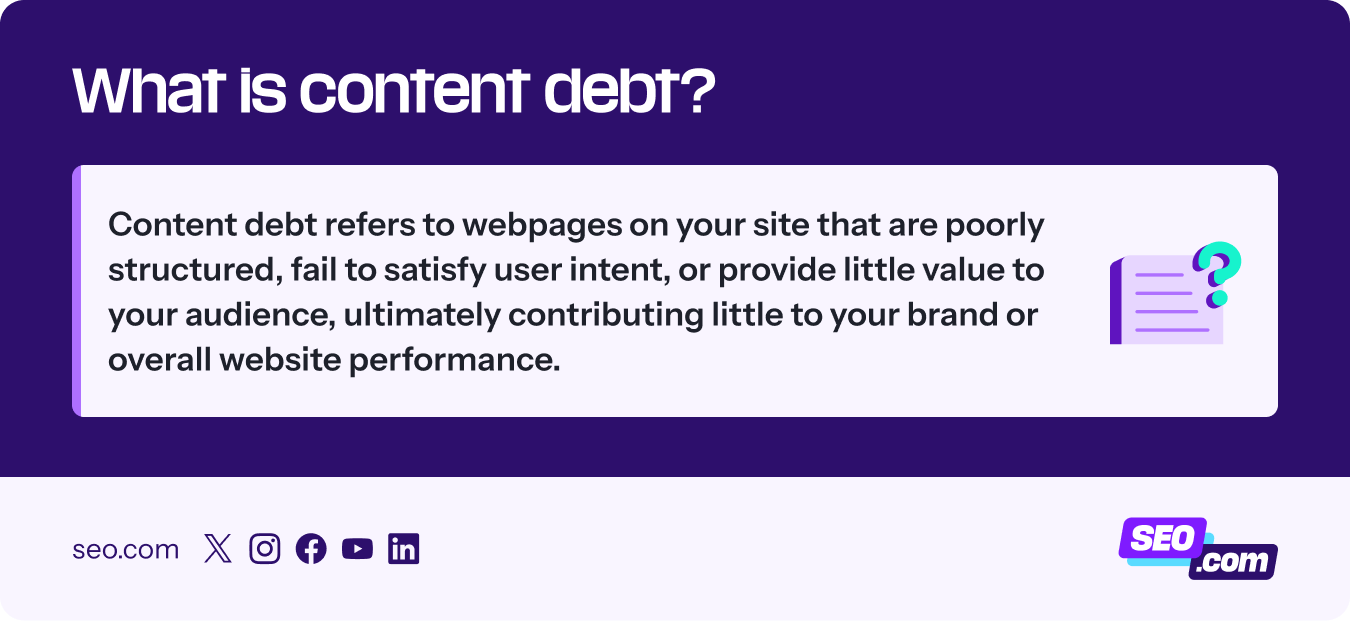
Content debt refers to webpages on your site that are poorly structured, fail to satisfy user intent, or provide little value to your audience, ultimately contributing little to your brand or overall website performance.
With AI engines becoming so mainstream, you’re hearing a lot of talk about how you need to have really high quality content in order to get in them.
So that means having content that’s helpful and useful to your audience — maybe it includes original thoughts and ideas or data. It’s the things users wants when reading about a topic that helps them better understand it.
But there’s also another side to that that you really have to consider, which is content debt.
In this blog:
What is content debt?
If you haven’t heard of content debt before, it’s basically the pages on your website that are poorly structured, don’t really answer user intent, or just generally not helpful to your audience.
These pages essentially don’t really add any value to your website or your brand. They exist in your content ecosystem, but they’re not really doing anything for your brand.
What’s the impact of having content debt?
So now that we’re really focusing on high quality content and trying to make content that gets in AI engines, you may be thinking, well, what is the impact of me having content debt?
Having content debt on your website doesn’t inherently hurt your overall ability to perform well in AI engines. It does, however, create missed opportunities with the content that isn’t well optimized.
Having unstructured, poorly structured, outdated, or decaying content means you risk losing visibility in AI engines for those specific pages.
So it kind of makes it a little bit pointless to have that content on your website because if it’s not getting cited in AI engines and it’s not ranking well in Google (or driving leads), it’s not really doing anything for your website.
What can I do to combat content debt?
So, what can you do with your content debt if you have a lot of pages that aren’t performing really well and aren’t really driving traffic for your business?
The best thing to do is try to optimize them so that they can perform better in all search engines.
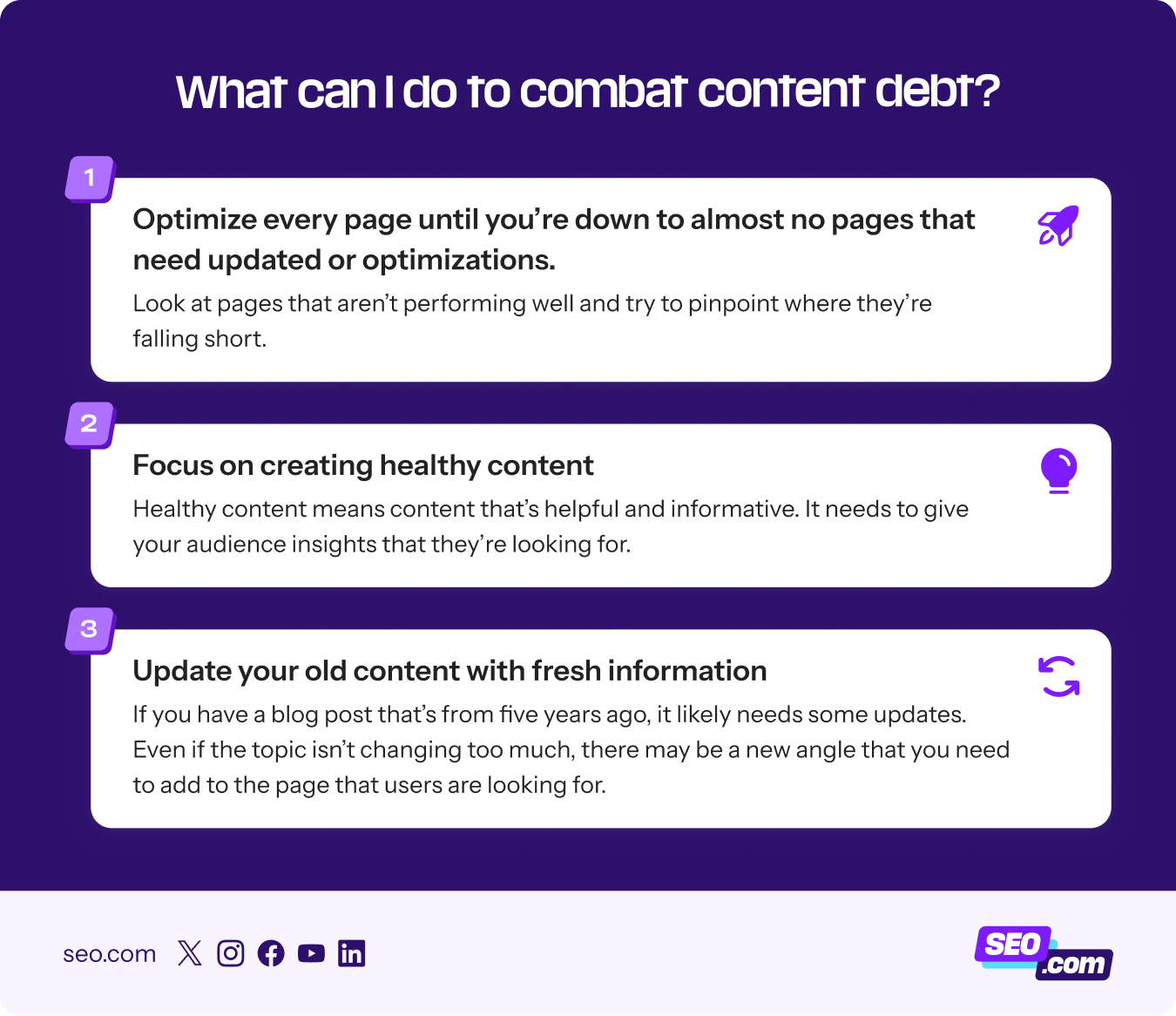
You want to optimize every page until you’re down to almost no pages that need updated or optimizations.
So realistically, the goal is just to focus on creating healthy content — content that’s helpful and informative.
It needs to be something your audience wants to read. It gives them insights that they’re looking for and all that good stuff.
So as you’re going through your website and making optimizations for AI engines, look at pages that aren’t performing well and try to pinpoint where they’re falling short. So if you have a blog post that’s from five years ago and you haven’t touched it, it likely needs some updates and some fresh information.
Even if the topic isn’t changing too much, there may be a new angle that you need to add to the page that users are looking for.
If you a related question to your topic into Claude or Perplexity, for example, you can kind of see what information it’s pulling and you may find that, “Oh, I’m not addressing this or I’m not addressing that.”
Then you can include it in your page, and then it’ll be refreshed, new, and better serve your audience.
Want to hear about more topics like these?
If you want to get topics like these sent straight to your inbox, subscribe to our email newsletter!

Stop Writing Blog Posts that Don’t Drive Results
Let our professional copywriters help create valuable, strategic content that drives qualified traffic to your website!


Stop Writing Blog Posts that Don’t Drive Results
Let our professional copywriters help create valuable, strategic content that drives qualified traffic to your website!

Stop Writing Blog Posts that Don’t Drive Results
Let our professional copywriters help create valuable, strategic content that drives qualified traffic to your website!
Expert Takes
from the SEO.com team
Writers