



You shouldn’t only prioritize GEO/AEO in 2027 because traditional search still holds majority of search share, generative engines aren’t the only place people search, not everyone uses AI search engines, AI engines are very top heavy in the user journey, and attribution is still messy. GEO should definitely be part of your search strategy, but don’t abandon your traditional search strategy in the process (you still need it).
AI engines have undoubtedly become a big focus for businesses since 2025. Now, in 2026, it all people can think about.
The new focus has become:
How can I get more citations in generative engines?
What kind of prompts should I be targeting?
How can I optimize my website for LLMs?
Some businesses have even taken this to the extreme and are only focusing on GEO (or AEO) for 2026.
Let me tell you why that’s a mistake.
5 Reasons why you shouldn’t only prioritize GEO/AEO in 2026
1. Traditional search still holds supreme
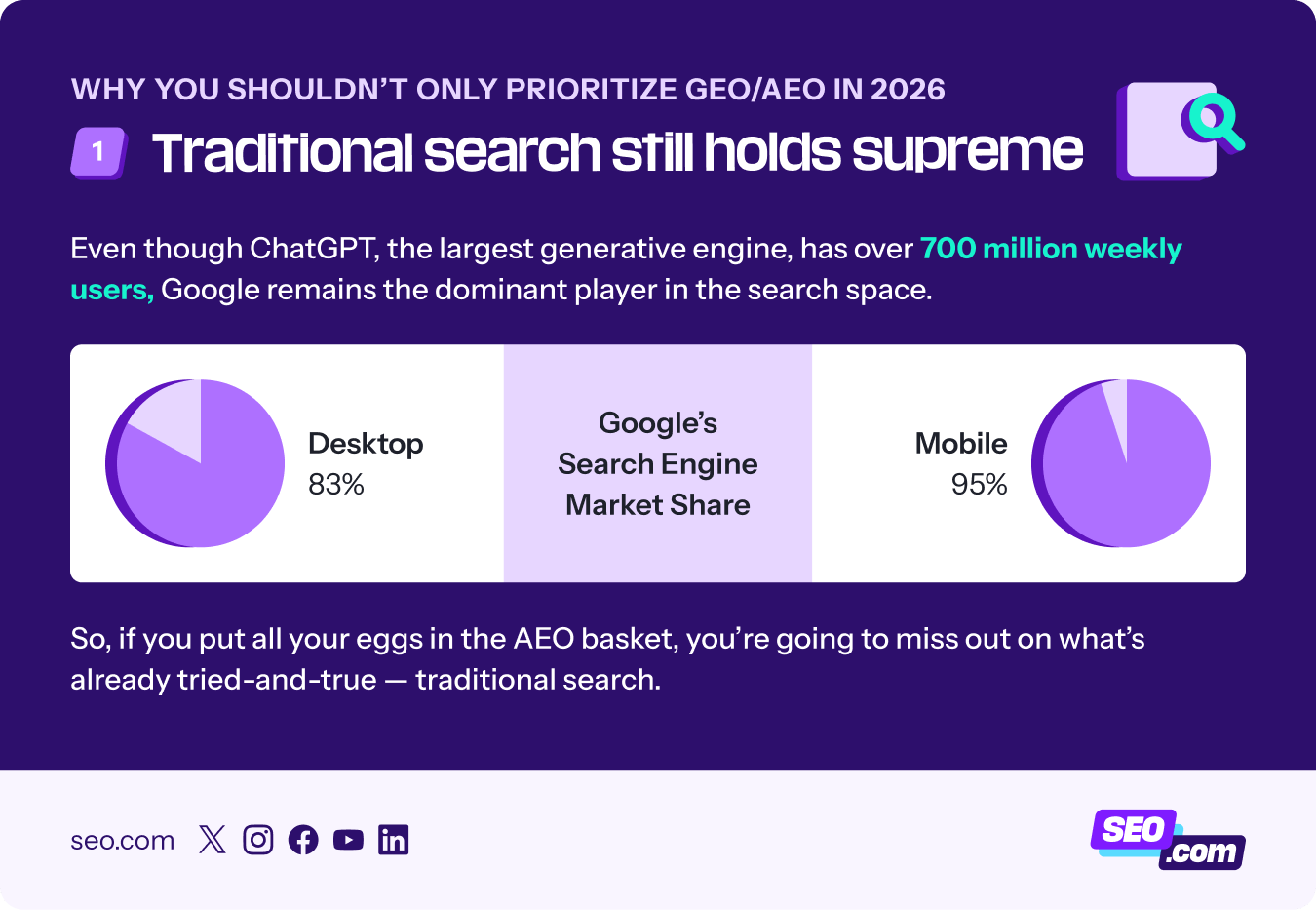
Even though ChatGPT, the largest generative engine, has over 700 million weekly users, it still only holds a sliver of the search market share. Google remains the dominant player in the search space, holding 83% of the search engine market share for desktop and 95% for mobile.
So while generative engines are all the buzz and continue to grow, it doesn’t change the fact that Google search remains dominant. Even if people are turning to LLMs like ChatGPT or Gemini, they’re still using traditional search as a core part of their discovery journey.
So, if you put all your eggs in the AEO basket, you’re going to miss out on what’s already tried-and-true — traditional search.
2. Generative engines aren’t the only place people are searching
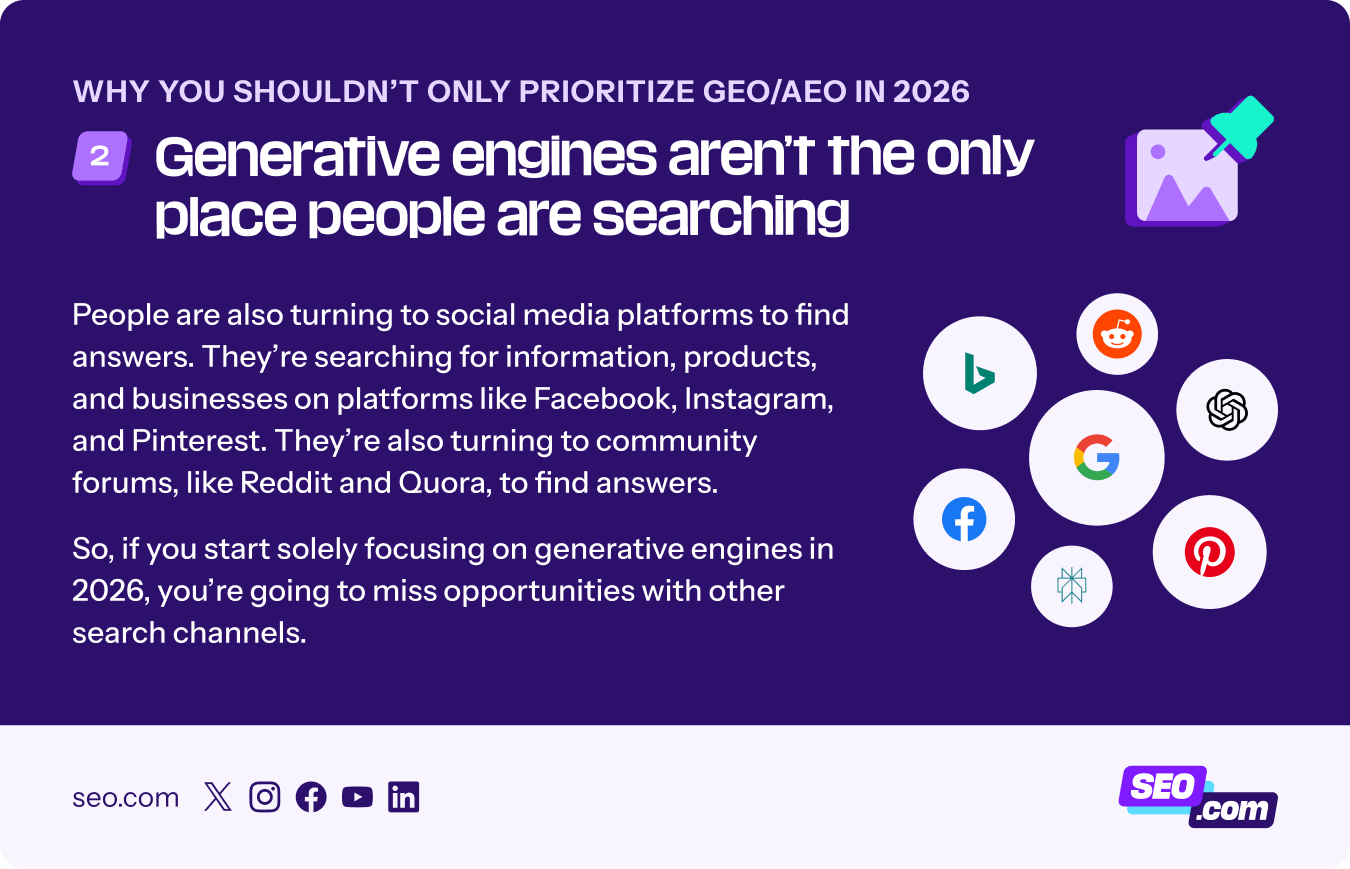
Because platforms like ChatGPT, Gemini, and Perplexity are gaining popularity, many businesses think that’s where the new wave of search is. But realistically, generative engines aren’t the only place people search for information.
As I mentioned above, traditional search still holds a lot of weight. People are still going to Google and Bing to get answers, so they can’t be forgotten.
But it’s not just traditional and generative engines, either.
People are also turning to social media platforms to find answers. They’re searching for information, products, and businesses on platforms like Facebook, Instagram, and Pinterest.
They’re also turning to community forums, like Reddit and Quora, to find answers. Even when people are searching for answers through Google, they’re searching phrases like “best apartments in Harrisburg Reddit” or “how to fix a gap in laminate flooring Reddit.” People seek out specific forums on Reddit to get answers from real people.
So, if you start solely focusing on generative engines in 2026, you’re going to miss opportunities with other search channels.
3. Not every audience uses generative engines as a core part of their journey
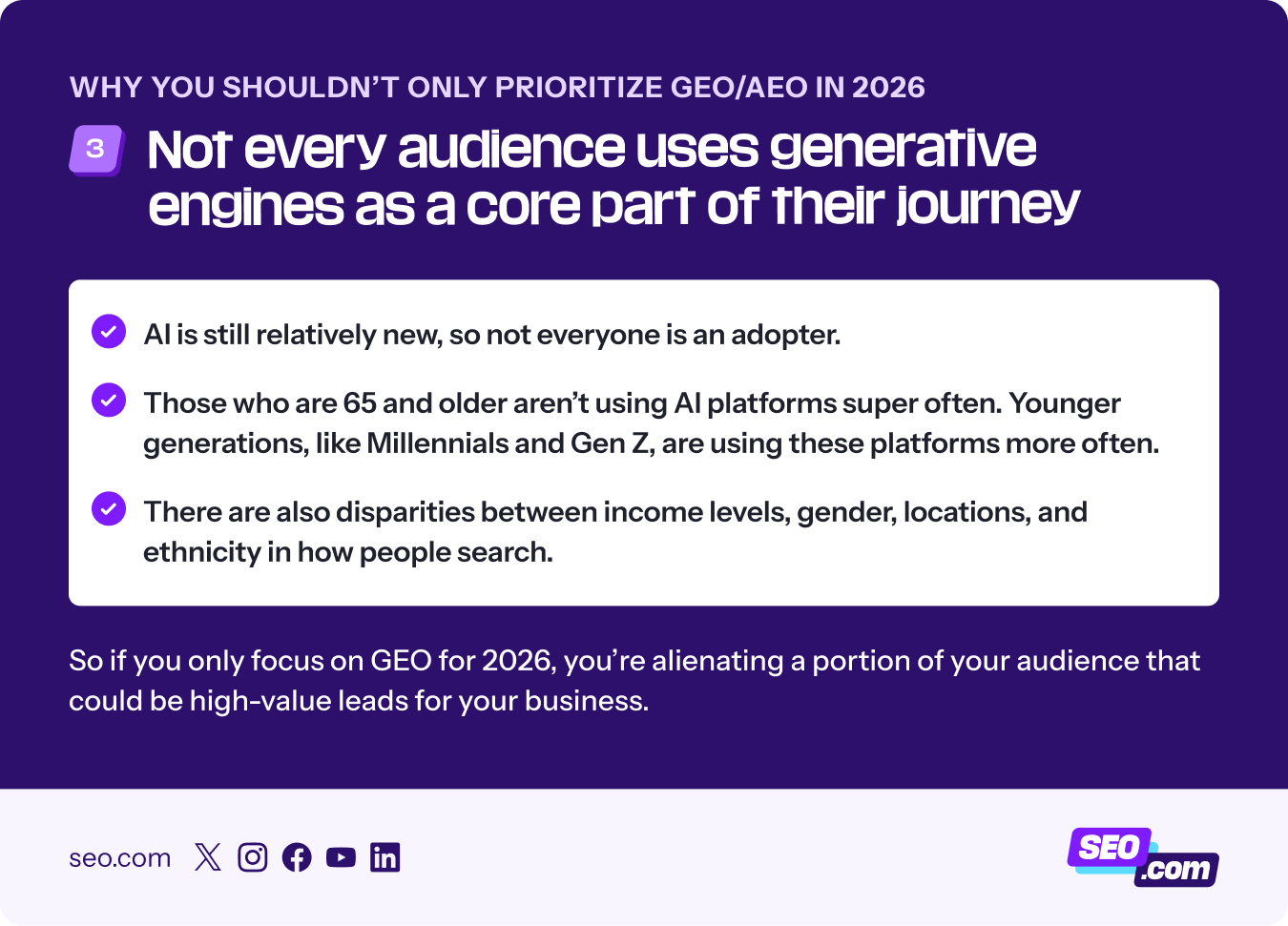
AI is still relatively new, so not everyone is an adopter. There are plenty of audiences, niches, and industries where people aren’t really using AI all that often.
Those who are 65 and older, for example, aren’t using these platforms super often. Younger generations, like Millennials and Gen Z, are using these platforms more often.
There are also disparities between income levels, gender, locations, and ethnicity.
All of that to say, not everyone in your audience is using generative engines. So if you only focus on GEO for 2026, you’re alienating a portion of your audience that could be high-value leads for your business.
4. Generative engines are very top-of-the-funnel heavy
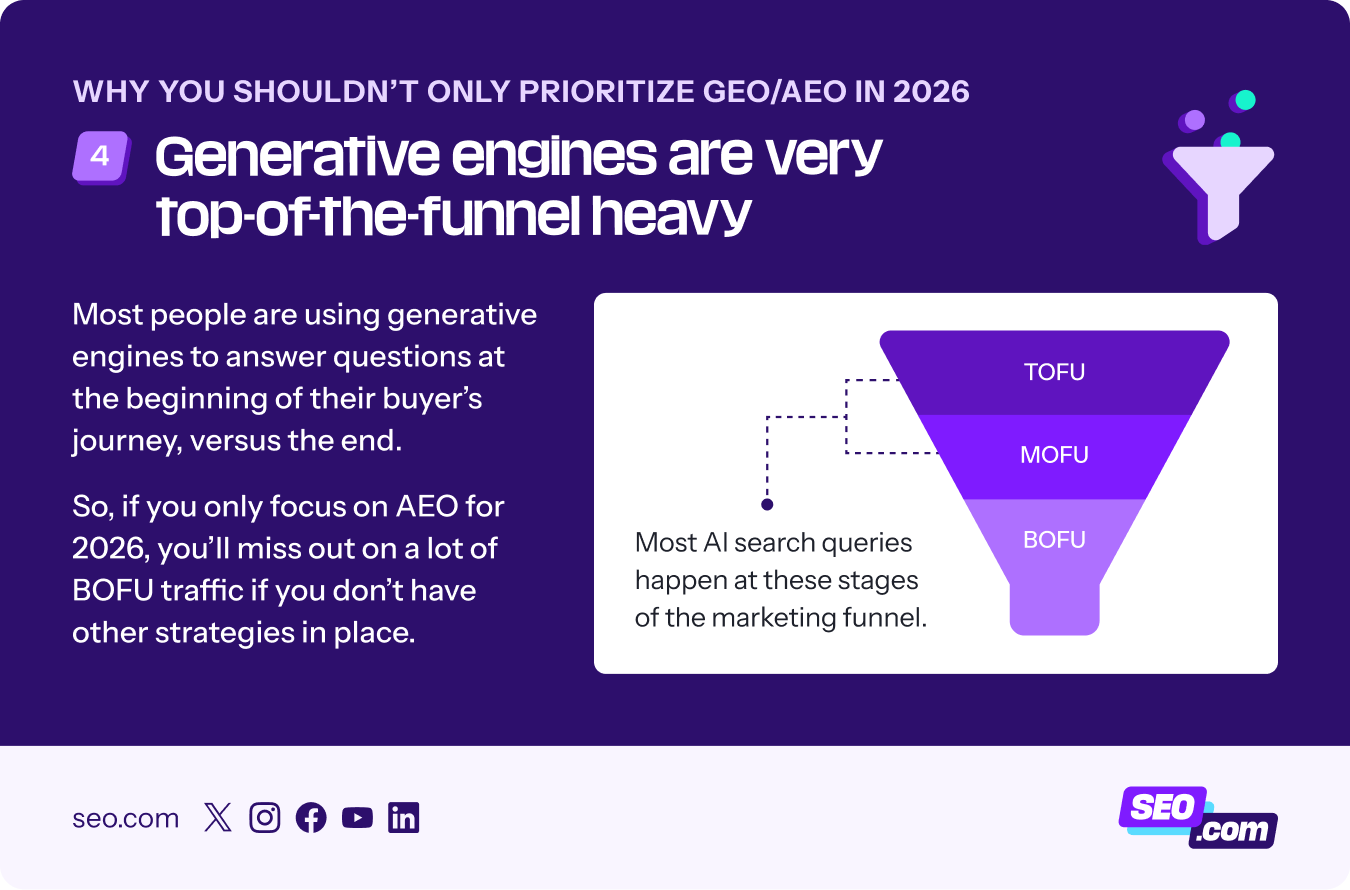
When generative engines started to get more popular, the biggest shift that took place was the loss of organic traffic in search engines like Google. The traffic was either lost to generative engines or AI Overviews in search results.
But, the traffic that was lost was generally top-of-the-funnel traffic. Most people are using generative engines to answer questions at the beginning of their buyer’s journey, versus the end.
That’s not to say that no BOFU queries are happening on platforms like ChatGPT, but that it’s more frequently TOFU and MOFU searches taking place on generative engines.
So if you only focus on AEO for 2026, you’ll miss out on a lot of BOFU traffic if you don’t have other strategies in place.
5. Attribution is still messy
Since generative engines are still so new, the attribution is still relatively messy. While there are some really solid tools on the market that can help you track citations, mentions, and the like, there are still a lot of unknowns with GEO’s attribution.
In some cases, you may have trouble:
- Knowing if the AI mentioned you because of something you published recently or because it knew you already
- Knowing if the mention or citation directly drove a conversion
- Which pages are being pulled from (if there are no citations, but you’re mentioned in a response) for information
If you’re going all in on this strategy and not focusing on anything else, it’ll be really hard for you to know what the ROI is of your investment (especially if you aren’t using a solid tool for tracking).
Diversify your search strategy with Omnichannel SEO
Just because generative engine optimization is trending and turning heads doesn’t mean all your eggs should go in that basket. Having a diversified, omnichannel SEO strategy will benefit you better than relying on one search strategy to carry you through.
With omnichannel SEO, you focus on your search visibility across all search engines — Google, ChatGPT, Reddit, Facebook, and more. Wherever people search for information, you can optimize your business’s presence to reach those people. Want to learn more about our approach to GEO? Connect with us today to see how we can help you optimize your presence wherever people search!

Future-Proof Your SEO Strategy with OmniSEO®
Goodbye search engine optimization, hello search everywhere optimization.


Future-Proof Your SEO Strategy with OmniSEO®
Goodbye search engine optimization, hello search everywhere optimization.

Future-Proof Your SEO Strategy with OmniSEO®
Goodbye search engine optimization, hello search everywhere optimization.
Writers