



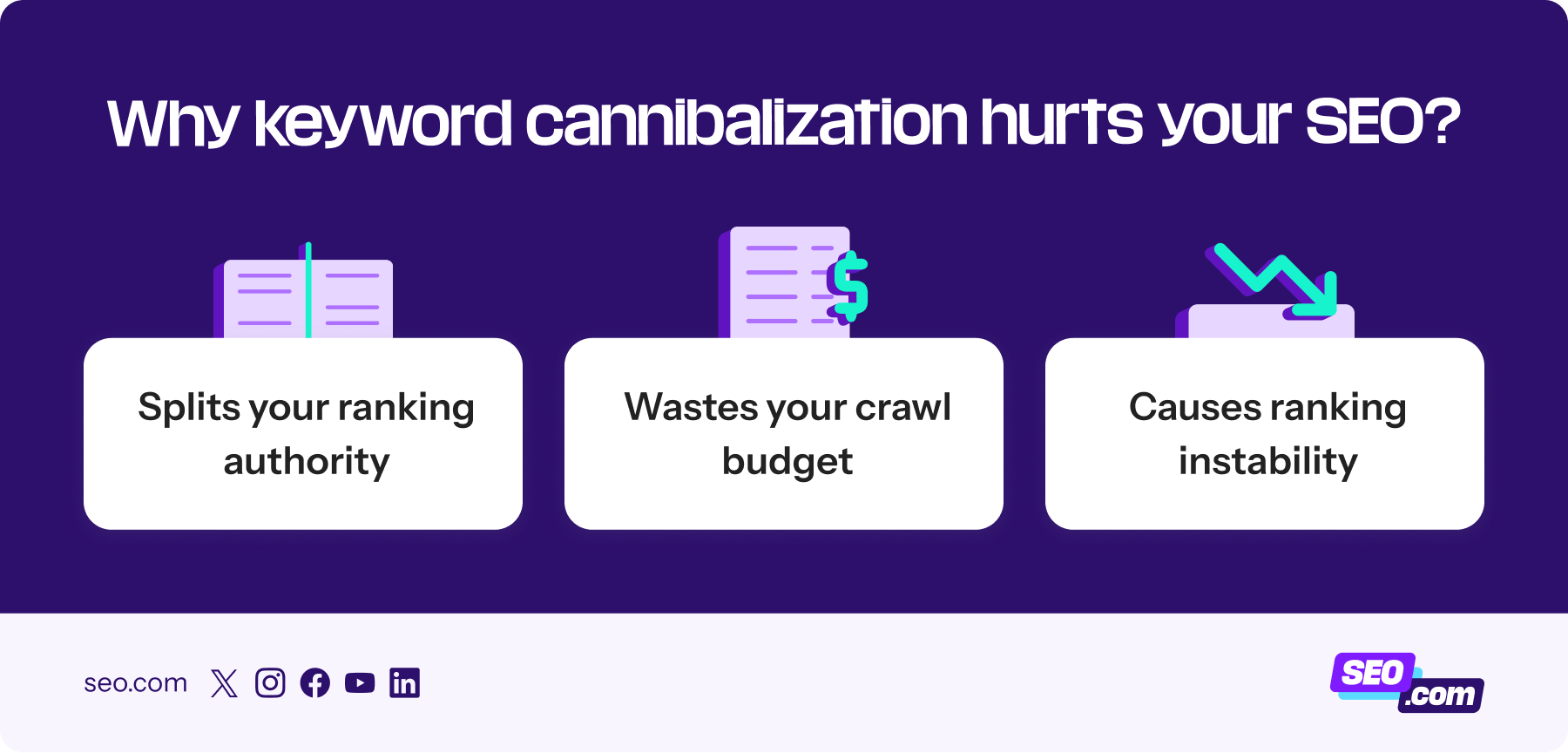
Keyword cannibalization is when multiple pages on your website target the same keyword and intent, causing them to compete in search results with each other. Cannibalization is problematic because it splits your ranking authority, wastes your crawl budget, and causes ranking instability. You can fix any keyword cannibalization issues by consolidating and merging pages, setting up a 301 redirect, adding canonical tags, and reoptimizing for different keywords.
You’ve been investing in content. You’ve published blog posts, updated service pages, and built out resource guides. But your rankings aren’t climbing the way you expected — and in some cases, they’re bouncing between positions week after week with no clear explanation.
The problem might not be what you’re missing — it could be what you’re duplicating.
Keyword cannibalization occurs when your own pages compete against each other in search results, splitting ranking signals and confusing search engines about which page to prioritize. It’s a common issue, but it’s often invisible until you know where to look.
Discover what keyword cannibalization is, why it damages your search engine optimization (SEO) performance, how to identify it on your site, and how to fix it.
What is keyword cannibalization?
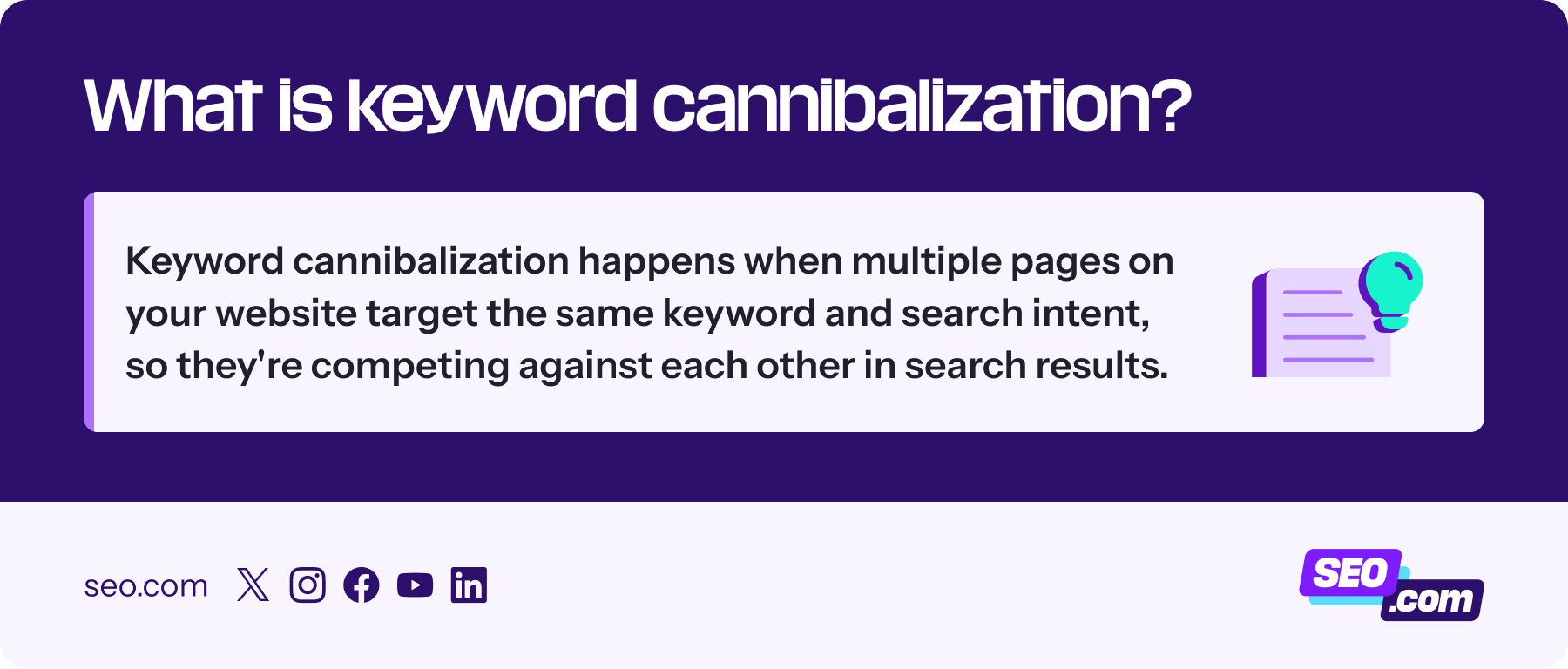
Keyword cannibalization happens when multiple pages on your website target the same keyword and search intent, so they’re competing against each other in search results.
The key factor here is intent. It’s not just about keyword overlap — two pages that use the same keyword but serve different intents don’t necessarily cannibalize each other. The search intent behind a keyword determines whether pages are truly competing.
For example, a blog post titled “What Is Content Marketing?” and a services page titled “Content Marketing Services” might both target the keyword “content marketing.” But one serves informational intent, and the other serves transactional intent. They’re not cannibalizing each other because they answer different user needs.
On the other hand, if you publish two blog posts — one titled “How to Do Keyword Research” and another titled “Keyword Research: A Step-by-Step Guide” — and both target the same keyword with the same informational intent, you have a cannibalization problem. Google can’t tell which page to rank, so neither performs as well as a single, comprehensive resource would.
Why keyword cannibalization hurts your SEO
Keyword cannibalization doesn’t just create competition between your pages — it actively weakens all of them. Here’s how:
It splits your ranking authority
Ranking authority is the accumulation of backlinks, internal links, and engagement behavior that signals to search engines that a page is valuable and trustworthy. When multiple pages target the same keyword and intent, they divide that authority rather than concentrate it.
None of the competing pages becomes strong enough to earn a top ranking — instead, you have two or three weak ones scattered across page two or three.
Consolidating that authority into a single page gives you a much better chance of ranking where it matters.
It wastes your crawl budget
Google has a finite crawl budget, which is the number of pages it will crawl on a given site within a given time. When multiple pages compete for the same intent, Google spends crawl resources on pages that duplicate effort rather than discovering and indexing new, unique content.
Crawl budget is mostly a big-site problem. Google’s crawl budget guide is written for sites with 1 million+ unique pages that change about weekly, or 10,000+ unique pages that change daily. Google calls those figures a rough estimate, not exact cutoffs, and says sites that don’t fit that profile don’t need the guide. For most sites, the bigger cost of cannibalization is split links and ranking signals, not wasted crawling.
Google’s crawl budget documentation directly states that duplicate URLs waste crawl budget. Every time Google crawls a redundant page, it’s missing an opportunity to index something fresh and valuable.
Inefficient crawling can slow down how quickly new content gets indexed and starts ranking. Eliminating cannibalization helps Google use its resources where they matter most.
It causes ranking instability
Ranking instability is often the most visible and frustrating symptom for site owners. When Google cannot determine which page to rank for a query, it rotates between them. One week, page A ranks. The next week, it drops to page two, and page B shows up on page one.
Instead of putting all the authority to one, strong page, it’s diluting the authority between two pages. So, neither of them ends up being “strong enough” to rank well.
If you’ve noticed unexplained ranking fluctuations — your target keywords bouncing between positions without any obvious changes to your site or the competitive landscape — keyword cannibalization may be the explanation.
Google is essentially testing which page to prioritize, and the instability reflects its uncertainty.
How to find keyword cannibalization on your site
Diagnosing keyword cannibalization is straightforward if you know where to look.
The most reliable method is to use Google Search Console.
- Open Search Results in Google Search Console.
- Filter by a specific query you want to investigate.
- Switch from the Queries tab to the Pages tab.
- If two or more URLs are earning impressions for the same query, you have a potential cannibalization issue.
It’s the best way to confirm cannibalization with real data.
Google’s John Mueller has noted that Search Console only reports pages that were actually shown for a query, and said it’s not really “cannibalization” if it’s theoretical. Two URLs with real impressions for one query is your evidence. Overlap on a keyword spreadsheet is not.
For a faster check, use the Google site search operator. Type site:yourdomain.com “your target keyword” into Google. If multiple pages from your site appear for the same phrase, those pages may be cannibalizing each other.
The second method isn’t as precise, but it’s useful for a quick scan.
How to fix keyword cannibalization
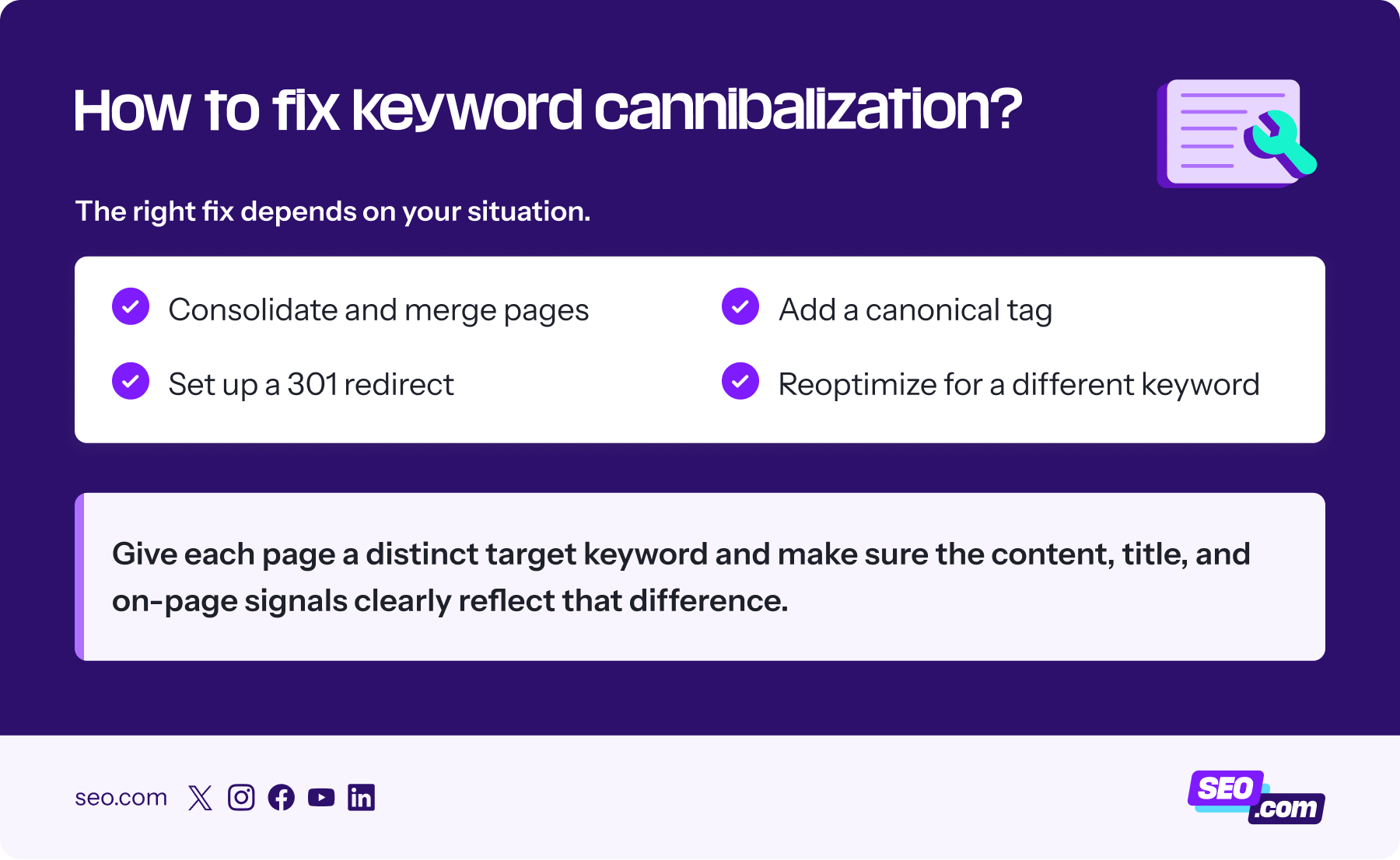
The right fix depends on your situation. Here are four methods:
Consolidate and merge pages
When two pages target the same keyword and intent, combine the best content from both into one comprehensive, authoritative page. Delete or redirect the weaker page.
Consolidation is a form of strategic content pruning — removing redundant content to strengthen what remains. The merged page should be the stronger URL, not necessarily the newer one. Look at which page has more backlinks, better engagement metrics, or a more established history in search results, and build from there.
Consolidation works especially well when both pages have valuable information, but neither is performing well on its own. Merging them creates one powerful resource.
Set up a 301 redirect
When one page clearly outperforms the other, and the weaker page doesn’t add unique value, use a permanent 301 redirect to send traffic and ranking signals from the weaker URL to the stronger one.
Consolidating all authority into the page you want to rank is the cleanest solution when you’ve identified a clear winner and don’t need to preserve the weaker page.
Add a canonical tag
Sometimes both pages need to remain live — for example, if one serves a distinct user-experience purpose or has been linked to externally. In this case, a canonical tag or URL signals to Google which version is the preferred page for indexing and ranking purposes.
The other page stays accessible to users, and Google can consolidate signals like links into the canonical version. This works best for duplicate or very similar pages. If the two pages serve different purposes, merging them or reoptimizing o
Canonical tags are ideal for ecommerce sites with product variations or sites that need to maintain separate URLs for tracking or user-experience reasons.
Reoptimize for a different keyword
Sometimes, both pages have genuine value and shouldn’t be merged or redirected. In this case, the fix is to differentiate them — give each page a distinct target keyword and make sure the content, title, and on-page signals clearly reflect that difference.
Proper SEO keyword research can prevent cannibalization from happening in the first place. When you map out keywords before creating content, you can give each page a unique search intent so Google can confidently assign each one to a different query.
If you’re fixing an existing issue, reoptimize the weaker page to target a related but distinct keyword. Adjust the H1 heading, meta title, URL (if feasible), and opening paragraphs to reflect the new focus and allow both pages to rank without competing.
FAQs about keyword cannibalization
1. How do I check if my site has keyword cannibalization?
The most reliable method is Google Search Console:
- Open the Search Results report
- Filter to a specific query
- Switch to the Pages tab
If two or more URLs earn impressions for the same query, you likely have cannibalization.
For a faster check, run site:yourdomain.com “your keyword” in Google — if multiple pages surface for the same phrase, they may be competing.
2. Is keyword cannibalization always bad for SEO?
In 99% of cases, keyword cannibalization is bad. If you have two pages that optimize for the same keyword and same intent, they’re going to dilute authority.
The 1% that’s an exception? When you’re targeting the same keyword but two different intents.
Take the keyword “All-inclusive resorts in Mexico.” Someone searching that term may be trying to find a list of the best resorts to compare and see their options, or they may be ready to book and just want to choose the best one.
In that case, you could be targeting both intents with two different types of content.
Keyword cannibalization is truly a problem when both pages answer the same user need, forcing Google to choose which page to serve to the user.
3. Should I use a 301 redirect or a canonical tag to fix it?
Use a 301 redirect when one page clearly wins and the weaker page adds no unique value — it consolidates all authority into the stronger URL. Use a canonical tag when both pages must stay live (e.g., product variations or externally linked pages), signaling the preferred version while keeping the other accessible. If both pages have genuine, distinct value, reoptimize one for a different keyword instead.
Build a stronger SEO foundation with help from our experts
Keyword cannibalization is just one of many technical SEO issues that can quietly drain your rankings and traffic. The team behind SEO.com, WebFX, brings 30 years of applied SEO experience to help clients diagnose and resolve these problems before they become costly.
Our team specializes in keyword research, site audits, and ongoing performance tracking — the exact services that help you clean up cannibalization issues and prevent them from developing in the first place. We work with businesses across industries to build SEO strategies that drive measurable results and revenue growth.
Ready to strengthen your SEO foundation? Learn more about our SEO services and see how we can help your site perform at its best.


Keep Up With The Changing Landscape of SEO
Join our newsletter to receive practical tips and expert advice to help you improve your website’s visibility.

Keep Up With The Changing Landscape of SEO
Join our newsletter to receive practical tips and expert advice to help you improve your website’s visibility.
Writers