



If you’ve been following Google’s recent updates, you’ve likely noticed a flood of new terms related to artificial intelligence — AI Overviews, AI Mode, and Gemini.
The search landscape is shifting rapidly and keeping up with terminology alone can feel overwhelming.
Google AI search is an ecosystem of AI-powered features now offered by the search engine used by over 1.5 billion people worldwide.
These features change how answers appear, how users interact with results, and how your business earns visibility. Understanding this landscape is the first step to adapting your strategy and positioning your brand for success in AI-driven search.
A high-level overview of Google AI search
Google AI search represents a fundamental shift in how the search engine delivers information. Rather than simply matching keywords to web pages, Google now uses AI to understand complex questions and context to generate direct answers.
The system pulls information from multiple authoritative sources, synthesizes it, and presents it as a more complete answer. AI search aims to reduce the number of pages someone needs to visit to find what they’re looking for.
The scale of this shift is significant. Google AI search features now reach billions of users daily, fundamentally changing search behavior and how people discover information online. For businesses, this means the traditional approach of ranking for a keyword no longer guarantees visibility or traffic.
“Google AI search has met a need that users have long wanted — the ability to ask more complex questions and get actual, relevant results. Before, asking a long-query was a gamble as to whether you’d get the right URL with an answer. Now, it’s faster and easier than ever.”

Macy Storm
Content Marketing Consultant

The core components of Google’s AI search ecosystem
Three distinct elements make up Google’s AI search ecosystem: AI Overview, AI Mode, and Gemini. Each serves a different purpose and appears in different contexts, but they all aim to deliver faster, more comprehensive answers to user queries.
AI Overviews are AI-generated snapshots in your results
AI Overviews appear at the top of traditional search results pages. They provide quick, synthesized answers to your query by pulling information from multiple web sources and condensing it into a readable snapshot.
-
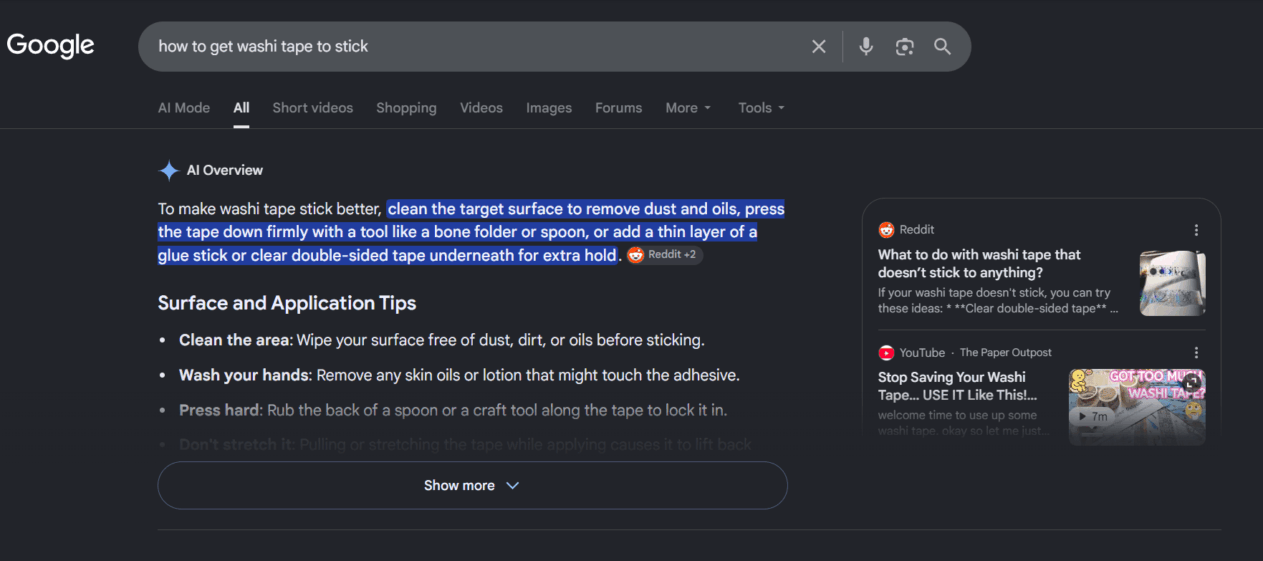
Google AI Overviews showing for a query about washi tape
Unlike older featured snippets that extract text from a single page, Google’s AI Overviews combine insights from multiple sources to create responses. It still links to the websites it references, so users can verify information or explore topics in greater depth.
AI Overviews typically sit above the traditional “10 blue links” and serve as a starting point before users decide to click a specific result.
AI Mode is a fully conversational search experience
AI Mode creates an immersive, chatbot-style interaction. Rather than receiving a mix of AI-generated content and traditional links, users engage in a back-and-forth conversation where they can ask follow-up questions, request clarification, or explore related topics.
While Google’s AI Mode is available as a standalone website, it’s mainly used within AI Overviews to encourage people to explore further. It appears as a search box at the end of the AI Overviews.
-
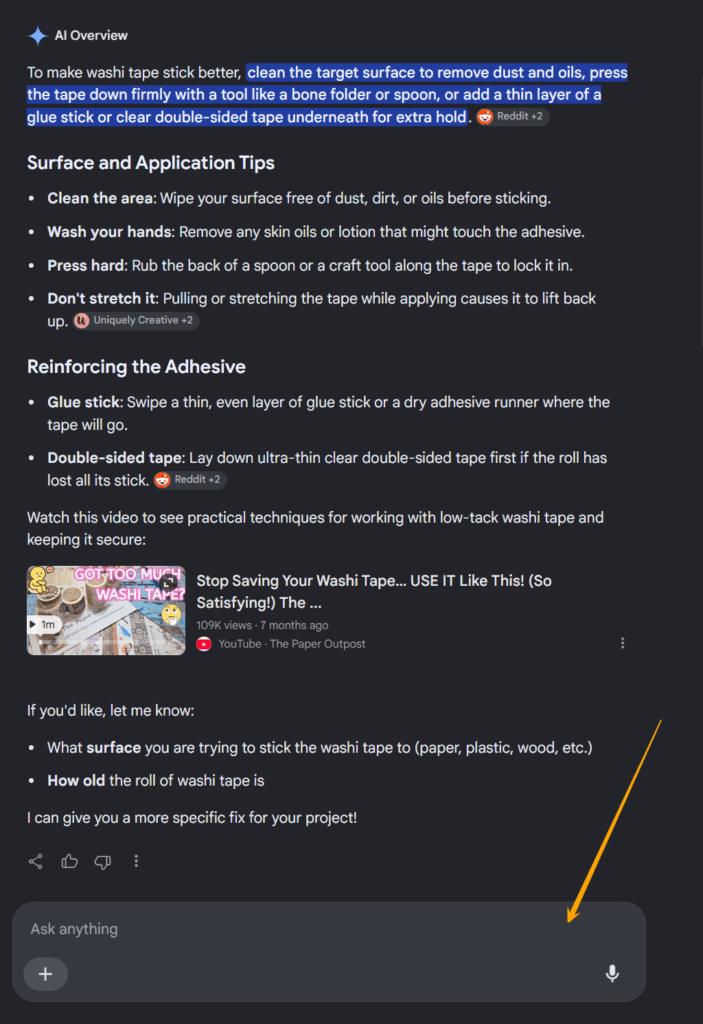
Google AI Mode appearing at the bottom of AI Overviews
Google’s AI Mode is a more dramatic departure from traditional search. It shifts the experience from browsing multiple sources to maintaining a continuous dialogue with an AI assistant that draws from those sources on your behalf.
Gemini is the research engine

Gemini is the equivalent of ChatGPT — it’s a generative engine that enables you to do everything from conducting research to creating images. Google’s Gemini app has already surpassed 1 billion monthly users.
With Gemini, users can do deep research to get better information, create images using a specific prompt direction, and upload files for context about queries. It also offers different models that users can adjust based on what they need for the query.
How does Google AI search work?
Understanding the technology behind Google AI search helps clarify why it produces different results than traditional keyword-based search. Two key mechanisms drive how the system finds and presents information.
Query fan-out asks multiple questions at once
When you ask Google a complex question, the AI doesn’t search for that exact phrase. Instead, it uses a technique called query fan-out to break your single question into smaller, related queries.
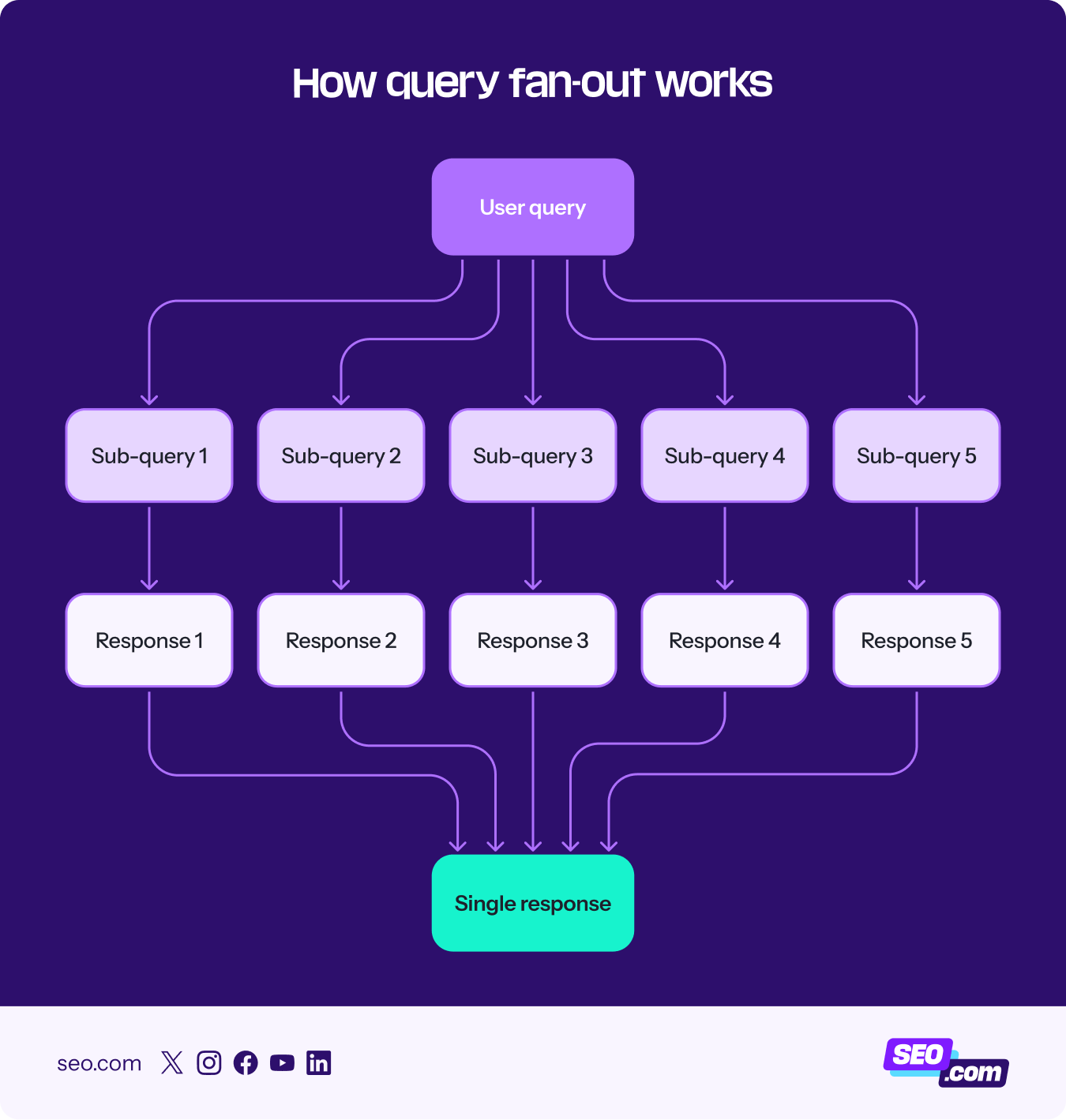
For example, if you ask for the best project management software for remote teams, the AI might simultaneously search for information about project management features, remote collaboration tools, user reviews of popular platforms, and pricing comparisons. It then synthesizes findings from all those sub-queries into a single answer.
Google AI search can address multifaceted questions more thoroughly than traditional search can. Rather than running several separate searches yourself, the system anticipates the different angles of your question and researches them all at once to produce a single, helpful response.
Retrieval-augmented generation grounds answers in web data
Retrieval-augmented generation (RAG) solves a critical problem with AI-generated content: LLMs like Gemini rely on training data from a specific point in time, so they can’t naturally provide up-to-date information or account for recent developments.
RAG addresses this by retrieving live data from the web before generating an answer. When you submit a query, the system first searches authoritative sources for current, relevant information. It then uses that data to augment its response, ensuring the answer reflects current facts rather than outdated training data.
Google AI search responses are more accurate and timely thanks to RAG. The system can tell you about breaking news, recent product launches, or current best practices because it’s not relying solely on what it learned months or years ago.
What does the rise of Google AI search mean for your business?
The shift to AI-powered search creates both challenges and opportunities. Understanding how these changes affect your business helps you adapt your approach and maintain visibility in Google search results.
Impacts to website traffic and user behavior
When Google answers questions directly on the search results page, users have less reason to click through to individual websites. Informational queries have seen reduced organic traffic, since users can get the information they need and move on.
User behavior evolves alongside these features and searches become more conversational and complex. People ask longer, more specific questions because they know AI can handle nuanced queries better than keyword-based search could.
The future of AI in search will likely accelerate these trends. Businesses that rely solely on capturing high-volume, simple queries may see continued declines in traffic as AI features handle more of those searches directly.
New opportunities for visibility and authority
The shift also creates an opportunity. Since Google AI search pulls information from authoritative sources to generate its answers, high-quality content can still drive visibility.
Your content can serve as a source for Google’s AI when generating answers. When the system cites your website, users see your brand associated with expert information. Even if they don’t click through to your site right away, the association builds authority and trust.
The key is creating comprehensive, expert-level content that thoroughly addresses complex topics. Content that demonstrates genuine expertise, covers topics from multiple angles, and provides unique insights stands a better chance of being a reference source.
Stay ahead of the curve with SEO.com
Adapting your strategy to this new reality requires expertise, ongoing insights, and a partner who stays ahead of the curve.
SEO.com helps businesses like yours navigate the complexities of AI-driven search and turn these changes into opportunities for growth. Stay informed as the landscape continues to shift by signing up for our email newsletter.


AI search is changing fast. Are you keeping up?
Get expert breakdowns and insights on the latest AI search trends and changes.


AI search is changing fast. Are you keeping up?
Get expert breakdowns and insights on the latest AI search trends and changes.
Writers