



Working on your Google AI visibility not only means optimizing for AI Overviews and Gemini, but AI Mode, too.
If you’ve searched in AI Mode and are saying “why isn’t my site showing in AI Mode?” I’ve got answers.
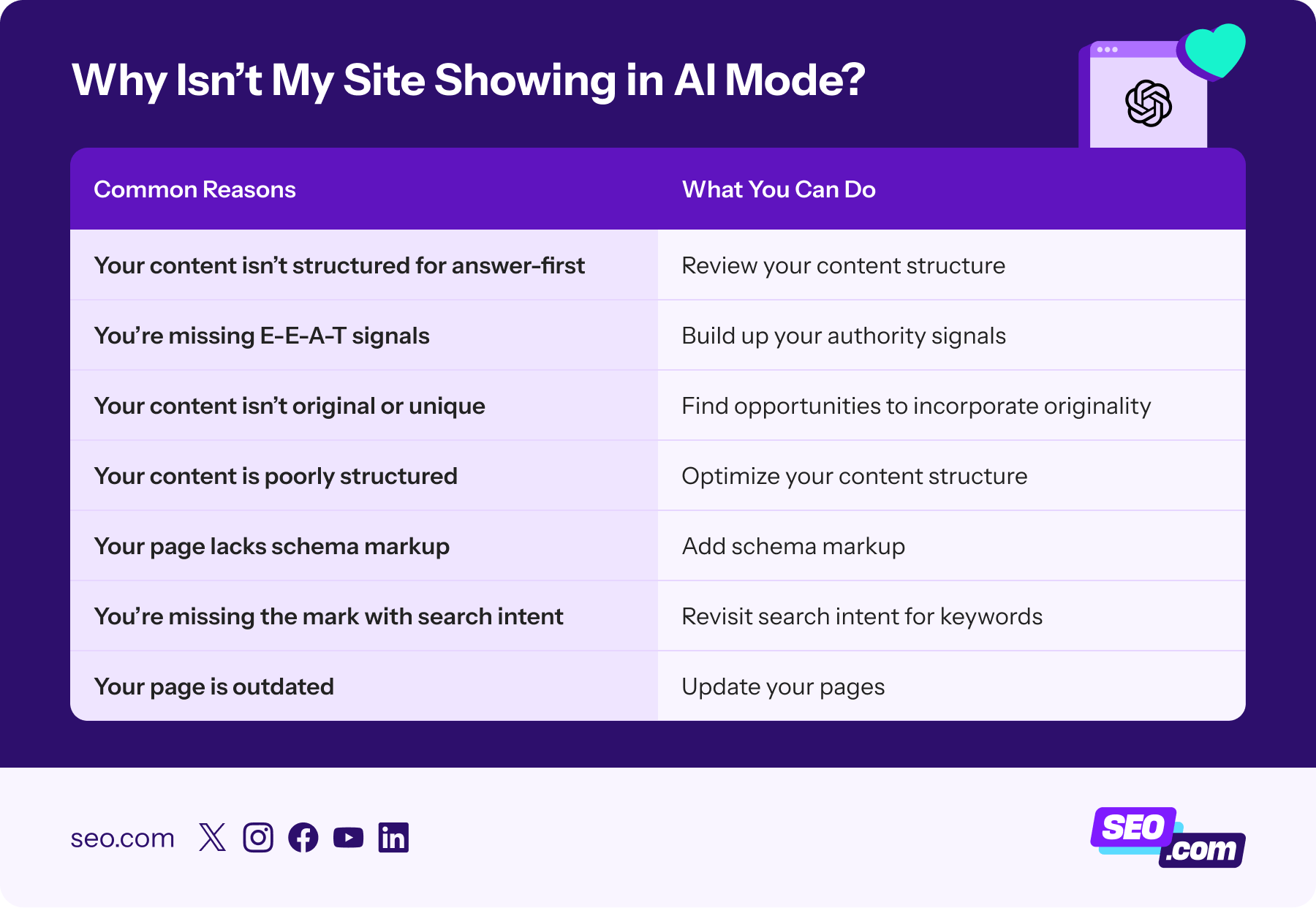
Let’s talk about these seven reasons why your site is not showing in AI mode responses:
- Your Content Isn’t Structured for Answer-first
- You’re Missing E-E-A-T Signals
- Your Content Isn’t Original or Unique
- Your Content is Poorly Structured
- Your Page Lacks Schema Markup
- You’re Missing the Mark with Search Intent
- Your Page is Outdated
Why isn’t my site showing in AI Mode?
If you website isn’t showing in AI Mode, it might be for one of these reasons:
1. Your content isn’t structured for answer-first
Optimizing your content for answer-first is a key component to increasing your chances of appearing in AI Mode responses. That means answering any questions directly and providing a clear, succinct answer to the question.
AI engines aren’t going to spend time sifting through paragraphs of storytelling and prose to get an answer. Instead, they’re pulling from resources that provide answers directly. This is the core principle behind answer engine optimization (AEO), and it’s what separates AEO from traditional SEO in an AI-ready content strategy.
What you can do: Review your content structure
Review your content structure to see if you’re answering questions directly within your content. Essentially, whatever your heading covers should have a direct answer below it.
For example, if you heading sayings “How much of my income should I put into savings?” the answer directly below it should be “You should put X percentage of your income into your savings account.”
Direct answers will help you increase your likelihood of getting cited in AI Mode.
2. You’re missing E-E-A-T signals
E-E-A-T signals like author biographies, certain schema, and brand mentions help show Google you are a trusted and authoritative source. If you don’t have these signals on your website, Google is less likely to view you as a trusted source and cite you.
With so many people having the ability to create content using AI, simply creating content isn’t enough anymore. You need content that demonstrates experience, expertise, authoritativeness, and trustworthiness to have a chance at being cited.
What you can do: Build up your authority signals
Building up authority signals will help Google see you as a reputable source and make you more likely to earn citations in AI Mode.
As mentioned above, you can build authority signals through:
- Author biographies: Attribute your blog posts to the experts writing them. Create author biographies that share the experts credentials, experience, and awards to help build that expertise.
- Schema: Schema like Person/Author, Organization, and Review/Rating schema can help send those authority signals for your pages.
- Brand mentions: Getting mentions on third-party, reputable sites serve as reputation signals that you’re a trustworthy resource of information. Building a Reddit marketing strategy is one way to earn those mentions on a platform AI engines actively cite.
3. Your content isn’t original or unique
If you aren’t appearing in AI Mode, it may be because your content isn’t original or unique. With so many people leveraging AI to create content, a lot of content repeats the same information. So if your content is generic and doesn’t bring anything new to the conversation, you won’t appear in AI Mode responses.
Even if you aren’t using AI, you still might be creating content that’s repeating the same things other people say in effort to get it to rank. But now, you need to go beyond the search results — you need to integrate original ideas, angles, and thoughts to your content.
What you can do: Find opportunities to incorporate originality
Incorporating originality can come in the form of:
- Expert insights: Have experts at your company share a unique perspective or quote about the topic to add originality to the page.
- Thought leadership: Have an original idea about a topic in your industry? Structure it as thought leadership and share your unique perspectives on the topic.
- First-party data: First-party data is a great way to incorporate originality — it’s data people can’t find anywhere else.
4. Your content is poorly structured
Having poorly structured content makes it challenging for AI engines, like AI Mode, to surface information from your pages. If your content is disorganized or lacks hierarchy, you’ll struggle to appear in AI Mode responses.
What you can do: Optimize your content structure
The solution for this one is simple — improve your content structure to make it more AI engine friendly. That means doing things like:
- Using headings and subheadings to organize your content
- Integrating bulleted and numbered lists for easy skimming
- Adding callout boxes to draw attention to important information first
- And more!
5. Your page lacks schema markup
Schema markup gives extra clarity and context for any bot crawling your website. If you site lacks schema markup, it’s likely hurting your SEO performance and your ability to appear in AI Mode responses.
With schema markup, you provide context for crawlers as they’re surfacing and pulling information from your website. This additional context helps show relevance of your pages, which can make you more likely to get cited in AI Mode.
What you can do: Add schema markup
The solution is simple — add schema markup to your pages to help provide contextual relevance to AI engines.
You can use a tool like Schema Markup Generator to help you create certain types of schema for your pages.
Just make sure you aren’t adding schema for the sake of adding it — it should be contextually relevant to the page.
6. You’re missing the mark with search intent
Missing the mark with search intent makes it difficult for AI Mode to understand how your page is relevant to the search query. If you’re off-base with search intent, you’re less likely to appear in AI Mode responses compared to competitors that meet search intent.
The important thing to note is that search intent can change over time. A keyword may focus on specific information at one point, just to shift in another direction a few months later as Google gathers context and analyzes search behavior.
What you can do: Revisit search intent for keywords
The simple solution: Look at the search intent for keywords you’re targeting and make sure you’re hitting it. If you’re missing information that would meet search intent, make sure you add it. Keep in mind you don’t have to add everything you see, but if there’s a major section you’re missing that’s often mentioned, get it on your page.
7. Your page is outdated
Still wondering “Why am I not appearing in AI Mode?” Well, it might be because your page is outdated and hasn’t been refreshed in some time. Google’s AI engines, including Gemini, look to freshness as a signal, so if your pages hasn’t been touched in a few years (or even a few months!), it could be signaling to Google that your page is outdated.
What you can do: Update your pages
Update your pages to send that freshness signal to Google’s AI engines, so they know you have fresh information on the page. Make sure the information on the page is still relevant and accurate to your knowledge. Even something as simple as adding new graphics can give Google that freshness signal it’s looking for!
What if my pages still aren’t appearing in AI Mode?
If all of the above issues with appearing in AI Mode don’t apply to you, it may be as simple as this: You’re not seeing your pages in AI Mode, but others are.
AI engines are volatile, meaning the answers constantly change. You could ask the same question twice and get two different answers generated from the same engine. Then when you factor in location and user behaviors, it’s a whole different ball game.
Just because you aren’t seeing yourself in AI Mode responses, or any AI engine responses for that matter, doesn’t mean that no one is seeing you. That’s a separate issue from traditional Google visibility — if you suspect your site is missing from standard search results too, read why your site isn’t showing up on Google for the eight most common causes.
That’s why it’s important to use AI tracking software, like OmniSEO® or Otterly.ai, to help you keep tabs on your overall visibility. It gives you a clearer picture of whether you’re appearing at all for queries, so you don’t have to rely on just your searches for visibility insights.
You can check out our list of best AI visibility tools to get recommendations for software to track your overall visibility in AI engines.
Get help improving your AI visibility
If you aren’t appearing in AI engines, whether it’s AI Mode, ChatGPT, Claude, or somewhere in between, the experts behind SEO.com (WebFX) can lend a hand. We have a skilled team of AI search experts that know how to help you improve your visibility across AI engines.
Connect with us today to see how our AI SEO services can help you elevate your your visibility and mentions across popular AI search engines!

Get found in AI-powered search results
Be a brand AI engines recommend with a customized AI search strategy from the experts at WebFX.


Get found in AI-powered search results
Be a brand AI engines recommend with a customized AI search strategy from the experts at WebFX.
Get found in AI-powered search results
Be a brand AI engines recommend with a customized AI search strategy from the experts at WebFX.
Writers