



If you want to build AI citations, you need to create answer-first content, build FAQ sections to answer related questions, offer data that can’t be found elsewhere, build authority trust signals, and focus on value with content. AI engines will look for these things and consider factors like content structure, authority signals, freshness, and brand reputation when picking brands to cite and mention.
Building AI citations is a big focus for 2027, but you may not know where to start (or what to do).
That’s why we’ve created this comprehensive guide to help you understand:
How do AI engines decide who to cite?
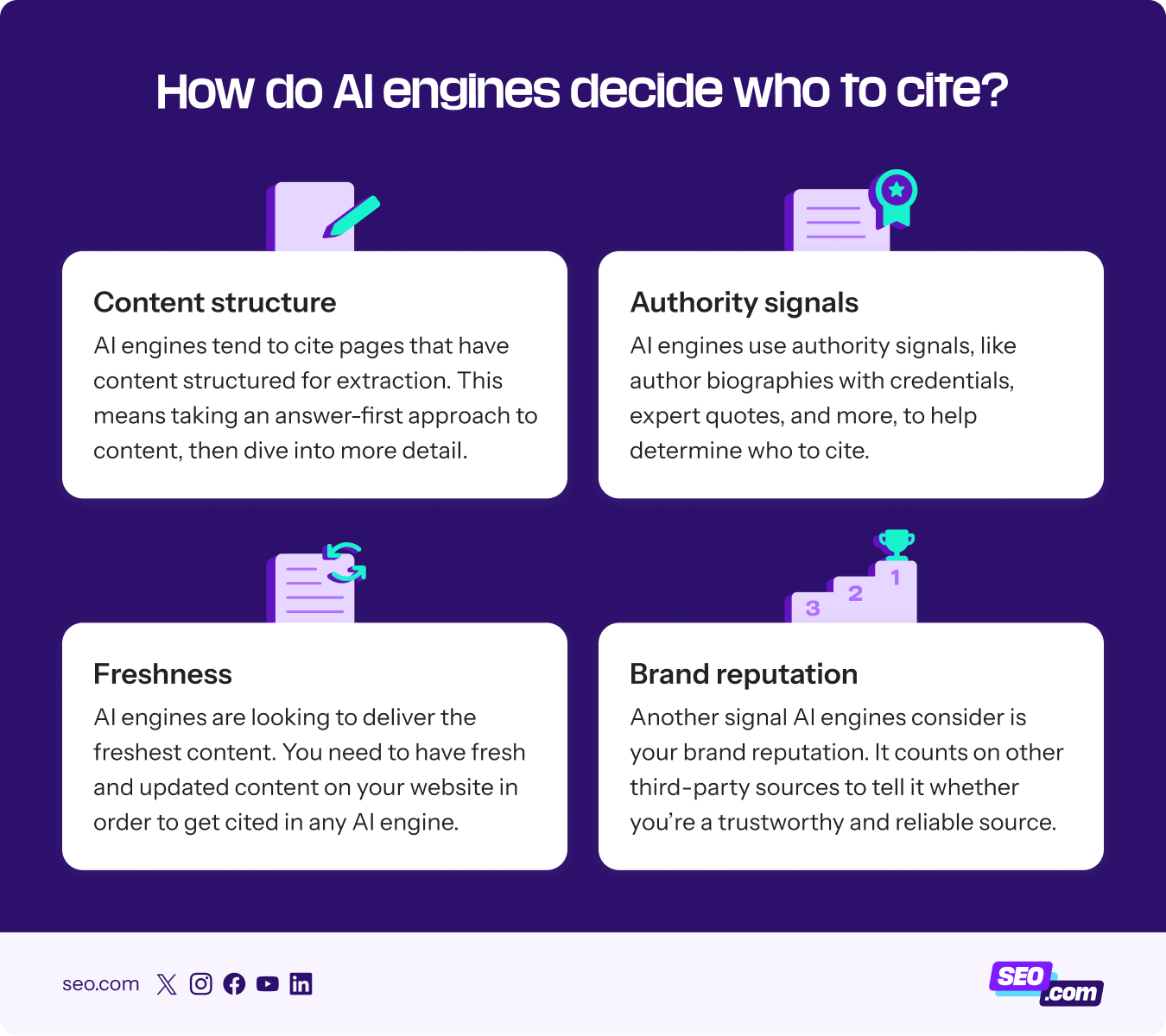
AI engines decide who to cite based on factors like content structure, authority signals, freshness, and brand reputation.
Let’s break each of those down:
1. Content structure
AI engines tend to cite pages that have content structured for extraction. Basically, you’re taking an answer-first approach to content where you provide the answer to the question first, then dive into more detail.
AI engines don’t want to sift through multiple paragraphs of information to find an answer for a user — they want quick answers so they can extract it easily.
If you have the answer three paragraphs down in a section but your competitor has it in the first paragraph, your competitor is more likely to get cited than you.
2. Authority signals
AI engines use authority signals, like author biographies with credentials, expert quotes, and more, to help determine who to cite.
At the end of the day, AI engines want to cite reputable, trustworthy sources for users. So, these engines will look for those authority signals to determine who is trustworthy enough to cite. Having these signals increases your chances of getting cited in AI responses.
3. Freshness
Another important signal for getting cited in AI engines is freshness. AI engines don’t want to deliver old or stale content — they’re looking to deliver the freshest content.
You need to have fresh and updated content on your website in order to get cited in any AI engine. If your content is months or years old, you’ll miss out on opportunities to be cited.
4. Brand reputation
Another signal AI engines consider is your brand reputation. What people say about your brand has an impact on whether AI engines trust you as a cited source. It’s counting on other third-party sources to tell it whether you’re a trustworthy and reliable source.
If you have a poor brand reputation, you’ll struggle to build AI citations.
How to build AI citations
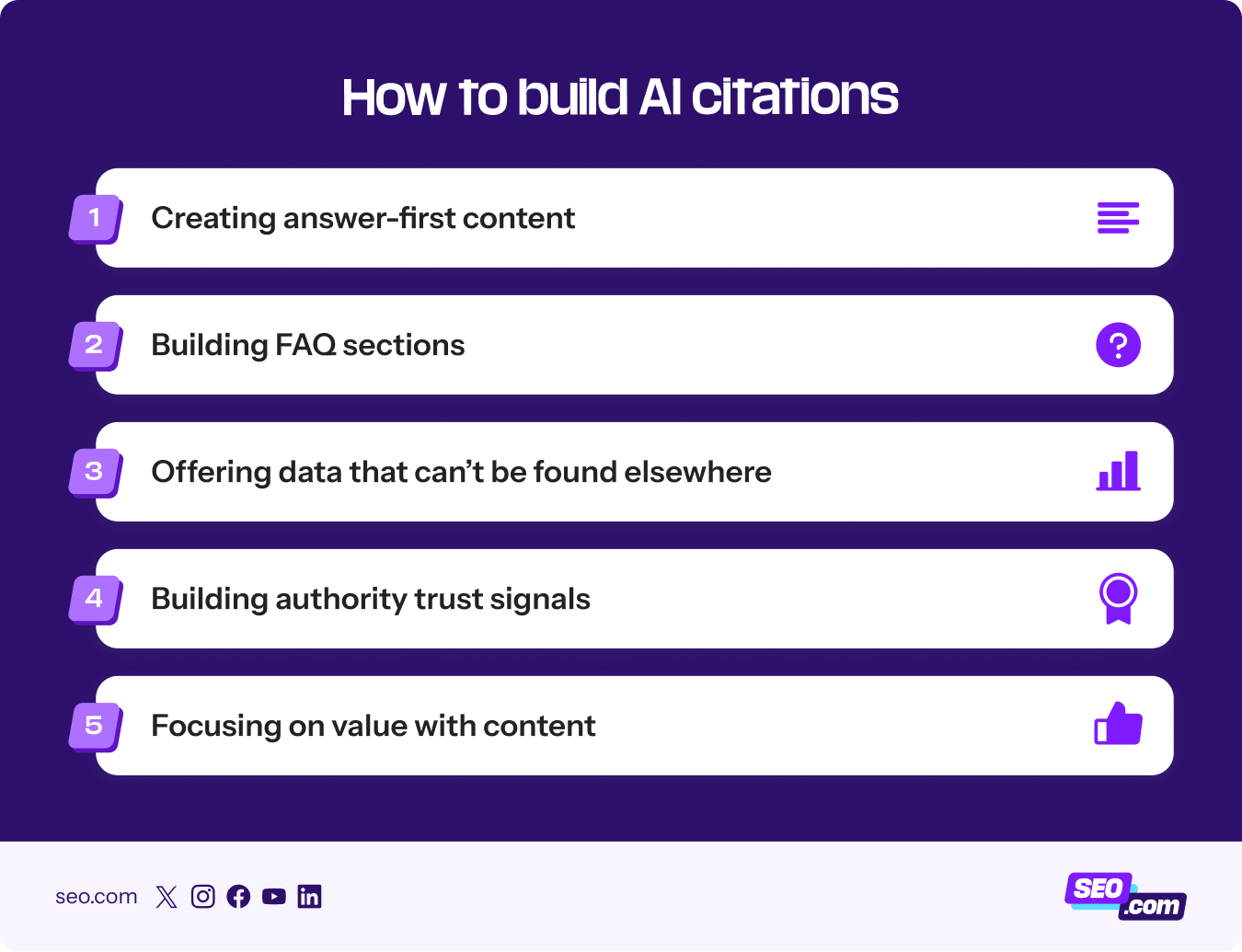
While there’s no guarantee you can get cited by AI engines, there are things you can do to improve your chances of earning citations. You can build citations by:
- Creating answer-first content
- Building FAQ sections
- Offering data that can’t be found elsewhere
- Building authority trust signals
- Focusing on value with content
Let’s break it down:
1. Creating answer-first content
Creating answer-first content enables the information on your page to get extracted easily. Essentially, you provide the most important information first, so AI engines can process it, extract it, and cite it in responses.
Similar to humans, AI engines don’t want to dig through paragraphs of content to find a simple answer. They want immediacy, so providing answers right at the beginning helps increase the chances that you’ll get cited in results.
2. Building FAQ sections
FAQ sections help you provide citation opportunities for your website because they use an answer-first structure. You ask questions and answer them directly — it’s a prime setup for getting cited in AI engines.
FAQs are also valuable because of the way AI engines seek out, synthesize, and process information. When someone conducts a query, AI platforms don’t just consider that original query. Instead, they fan out to multiple related subqueries.
Consider a query like “What is the best car to buy in 2026?” AI engines aren’t just searching that query — they’re searching additional related queries like:
- What are the most affordable cars to buy?
- What are the safest cars on the market?
- What are the best car brands in 2026?
- Best features to have in a car in 2026
- Tips for buying a car in 2026
That’s where having an FAQ can benefit your website greatly. If you have an FAQ section addressing all these related questions, you increase the chances you’ll get cited in the response to the query.
3. Offering data that can’t be found elsewhere
Offering unique, first-party data is a great way to build AI citations. AI engines often prioritize pages that provide unique data that can’t be found anywhere else online. If your content provides unique data, you increase the chances of being cited by AI engines.
So, how do you get first-party data?
First-party data can come from:
- Behavioral data (how people interact with your website, products, etc.)
- Transactional data (purchases, average order value, etc.)
- Demographics
- Engagement data
- Surveys or questionnaires
Basically, any data you gather that isn’t already synthesized and published can be used as first-party data and give your content the edge it needs to get cited.
4. Building authority trust signals
AI engines cite sources that are reliable and trustworthy. To get AI engines to see you as trustworthy, you need to have trust signals in place that build your E-E-A-T.
E-E-A-T signals include things like:
- Author bios: Author bios help tell AI engines that the person sharing the information is credible and trustworthy. By integrating credentials and qualifications, it shows what makes them qualified to share this information or perspective, which in turn builds credibility for your website.
- Expert quotes: Original thoughts are unique and have value for boosting your trust and authority signals. Integrating your teams’ unique insights can help elevate your content and provide those unique perspectives.
- Original photos: Original photos are great for adding a unique experience/perspective that can’t be found elsewhere. If you work in home services, for example, having original photos from a client project can make your content unique and stand out (and therefore more citable).
- Data integration: It doesn’t have to just be first-party data — integrating any data relevant to the topic you’re covering helps increase the authority of your content.
Explore: Balancing E-E-A-T and AI in a Consumer Skeptical World →
5. Focusing on value with content
If you want to build AI citations, you need to ensure your content is valuable enough to be cited in AI responses. Creating generic, skim-the-surface content isn’t going to get you cited in AI engines — thorough content will.
You’ve probably heard a lot of people say “just make high-value content!” But what does that even mean? What makes content high-value?
Here’s the way to look at it: Someone should be able to read your content and have a really good idea of what you’re talking about. They should walk away from your content with minimal questions about what you mean.
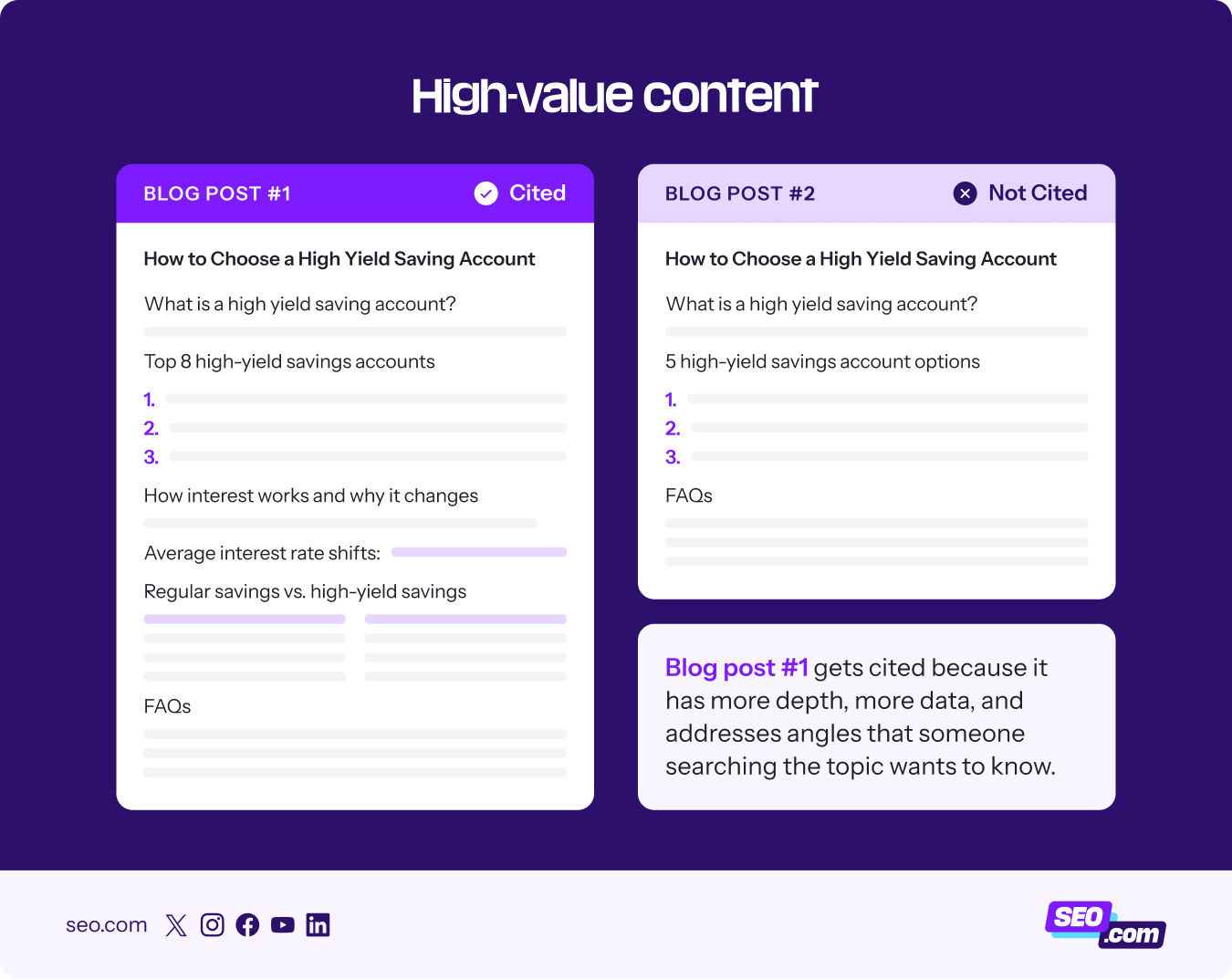
Let’s say we have two blog posts both writing about how to choose a high yield saving account.
Blog post #1 does the following:
- Defines what a high-yield savings account is
- Gives an in-depth list of the top 8 high-yield savings accounts
- Explains how interest works and why it changes, plus shares average interest rate shifts
- Shares 5 key differences between a regular savings and high-yield savings
- Includes an FAQ with 6 common questions
Blog post #2 does the following:
- Defines what a high-yield savings account is
- Gives a quick list of 5 high-yield savings account options
- Includes an FAQ with brief answers to 10 common questions
Which do you think is more likely to get cited?
If you said blog post #1, you’re right. Blog post #1 has more depth, more data, and addresses angles that someone searching the topic wants to know.
Basically, you want to ensure that your content actually is beneficial to your audience and covers all the information they want to know. Don’t create generic content that barely skims the surface of the topic.
Explore: Content Qualities That Get Cited By AI →
How to measure AI citations
Now that you know how to build AI citations, let’s talk about tracking them. You can track AI citations by either manually checking or using a tool to help you keep track of your citations.
To manually track citations, you’d need to layout what prompts you want to track for your content. You’d then search those prompts in whatever AI engines you’re monitoring to see if your brand shows up as a mention or citation.
The easier option, however, is to use a tool that will do all the work for you. An AI SEO tool like OmniSEO® enables you to input the prompts you want to track and automatically see whether you’re getting cited for those searches.
Using an AI visibility tool, specifically, will help you measure how many times you’re being cited and where you’re being cited in AI engines.
FAQs on AI Citations
Do I just track AI citations or should I track rankings too?
AI rankings aren’t a thing. With traditional search, rankings were one of the primary ways that companies tracked the success of their SEO strategy. But rankings don’t matter anymore with AI search.
Whether you’re the first cited source or the third, it doesn’t matter — it all holds the same weight. The importance, now, is that you’re cited or mentioned at all.
AI engines are now serving primarily as visibility engines — so the focus is now on citations and brand mentions to ensure you’re getting in front of your audience.
How is getting cited by AI different than ranking in Google?
Getting citations is arguably harder than earning rankings in Google solely because not a lot is known right now about how to get cited. A lot of experts are still figuring out what works, whereas SEO had more solid practices for helping you rank in search results.
Basically, things keep evolving with AI SEO as AI engines continue to develop and change, which can make it feel a lot harder to optimize for.
Additionally, AI engines are much more inconsistent — some queries don’t have citations at all because it pulls from the AI engine’s training data. Ranking in Google, on the other hand, was consistent — there were always blue links showing up in the search results.
Do backlinks play a role in AI citations?
Yes and no.
Previously, backlinks were a huge ranking signal for ranking in traditional engines. It was a signal of quality and authority of your content, especially when those backlinks came from high-authority domains.
But do backlinks matter for AI search?
Backlinks don’t have as much power as they did for SEO. Truly, only branded backlinks (backlinks that the anchor text is your company) really have direct benefit because they serve as branded mentions, which do have impact.
But, backlinks can be an internal signal as to the quality of your content. If you’re creating content that’s earning good backlinks, it means the content is likely high-quality, which is what AI engines want.
How long does it take to show up in AI citations?
Showing up in AI citations can be anywhere from instant to a few days. It really depends upon how primed your content and brand is for AI engines.
Not to mention, you can be showing up in AI citations one day and gone the next. Or, you may show up for one person but not another. The landscape is constantly changing, which makes it difficult to really know how long it takes to show up.
Start building AI citations today
AI search is the future, so if you haven’t started working on building AI citations, you’re going to fall behind. Using the optimizations we listed above, you can get your website primed to start showing up in AI engines.
Need help building up AI citations? Explore our AI SEO services, powered by WebFX, to see how we can help improve your visibility and citations across AI engines!



AI search is changing fast. Are you keeping up?
Get expert breakdowns and insights on the latest AI search trends and changes.


AI search is changing fast. Are you keeping up?
Get expert breakdowns and insights on the latest AI search trends and changes.
Writers