



- What is replacing keyword targeting in GEO? Topic targeting is becoming more important than keyword targeting because generative engines prioritize comprehensive coverage of subjects rather than specific keyword phrases, though keywords still matter for traditional SEO.
- How should content be structured for generative engines? Content should be structured with immediate answers after questions, clear headings, structured summaries, and citable information—allowing generative engines to easily extract and synthesize quick responses for users.
- Why are brand mentions crucial for GEO success? Since generative engines don’t use traditional rankings, increasing brand mentions across the web through guest blogging, thought leadership, and authentic community engagement helps establish authority and improves citation likelihood in AI responses.
- What type of personalization matters in 2026? Personalization means curating information delivery based on user needs, skill levels (beginner vs. expert), funnel progression, and relevant subtopics—meeting users where they are with tailored, appropriate content.
- Why invest in AI search performance tracking? As GEO becomes a more lucrative channel generating leads and traffic, businesses need AI search performance tracking software like OmniSEO®, Otterly.ai, Rankscale, or Ahrefs Brand Radar to measure visibility and ROI from generative engines.
Generative Engine Optimization (GEO) trends for 2026:
There’s no doubt about it — generative engines are garnering a lot of interest from people.
ChatGPT, Perplexity, and Gemini are gaining more users each day.
People are saying, “Just ask ChatGPT.”
With so many people turning to generative engines like these, it means that more people will adopt generative engine optimization (GEO) in an effort to reach these searchers.
So, if you’re one of those people, you’re probably wondering: What does the future of GEO look like?
I compiled a list of the top six trends I predict will become the focus of GEO for 2026.
1. Topic targeting > keyword targeting

One of the biggest GEO trends for 2026 is focusing on topic targeting over keyword targeting. That means targeting broader subjects (topics) instead of specific words or phrases (keywords) people search.
SEO traditionally relies on identifying keywords, integrating those keywords into core parts of your page, and providing relevant information related to those terms. With generative engines, keywords don’t matter as much.
While they can help provide context, keywords aren’t solely determining what appears in generative engine results — it’s moreso the topic and subsequent information covered that’s being considered.
So, don’t abandon keywords completely. They’re still important for traditional SEO. But if your goal is to start appearing in more generative engine results, you’ll want to focus on targeting specific topics and making sure you thoroughly address questions related to the topic.
2. Rise of structured, succinct content

One of the biggest generative engine optimization trends you can’t ignore is the need for structured, succinct content. Generative engines aren’t spitting out the leagues of lead-up you wrote before getting to the point. They’re delivering summarized and synthesized information to give users a quick answer.
As a result, marketers will start modifying their content structure to appease generative engines.
That means things like:
- Providing an immediate, quick answer after addressing a question
- Using headings to clearly structure content
- Creating structured summaries that sum up pages
- Structuring content to be citable
Essentially, creating content that provides immediate answers will become crucial for appearing in generative engines.
3. Focusing on brand visibility and mentions

Another GEO trend for 2026 is shifting focus to brand visibility and mentions. Since generative engines don’t operate on a “ranking” system like traditional search, there aren’t positions to be vying for. Instead, the focus is on getting your brand cited or mentioned in the response.
So, for 2026, focusing on boosting brand mentions across the web will be huge.
But how do you get your brand mentioned across the web?
You can increase brand mentions by:
- Guest blogging on third-party websites
- Creating original thought leadership (that gets linked to, mentioned, and endorsed)
- Getting mentions on aggregate websites
- Engaging authentically within your community online (on Reddit, for example)
Essentially, the more your brand is mentioned across the web in association with your industry, the more likely you are to be viewed as an authority in your space and get cited.
4. Bigger desire for personalization

One of the GEO trends taking shape in 2026 is the desire for personalization. I’m not talking about putting someone’s name at the top of a website — I’m talking about curating information delivery based on who’s receiving it.
This means doing things like:
- Addressing specific user needs
- Addressing subtopics relevant to users
- Tailoring content to funnel progression
- Tailoring content to skill level (beginner vs. expert)
This type of personalization really focuses on meeting the user where they’re at with relevant information.
It’s going to be a huge trend for 2026 as more people start using generative engines.
5. Platform loyalty will take shape

I think one of the biggest things we’ll see happen with generative engines in 2026 is the formation of platform loyalty. People are going to feel more confident about which generative engines they like best and likely stick to them.
While ChatGPT arguably has the largest market share for generative engines, platforms like Copilot, Gemini, and Perplexity still capture some of the market.
Considering LLMs just got popular in 2025, people were still trying and experimenting with different AI platforms. Those AI platforms also heavily evolved their product with it being such a new market, causing user interactions with different platforms to fluctuate.
I think 2026 will see people sticking to the generative engines they like best. Similar to how people have preferences between Google and Bing, you’ll see people have preferences of which generative engines they use.
So while ChatGPT may end up being the Google of generative search, it doesn’t mean that other generative engines should be ignored when optimizing for them. Instead, you’ll want to focus on what platforms your audience uses most, so you can reach them there.
6. Investment in AI search performance tracking software
To wrap up this list of generative engine optimization trends, I’ll address a pretty prominent one for the year — investing in AI search performance tracking software.
As GEO continues to grow and more people use AI search platforms to find answers, it’s becoming a more lucrative channel. You will get leads and traffic coming from these generative engines. So, to get a better idea of what this channel is doing for your business, you’ll need to track performance.
So, finding the right AI search performance tracking software will be a big focus for 2026.
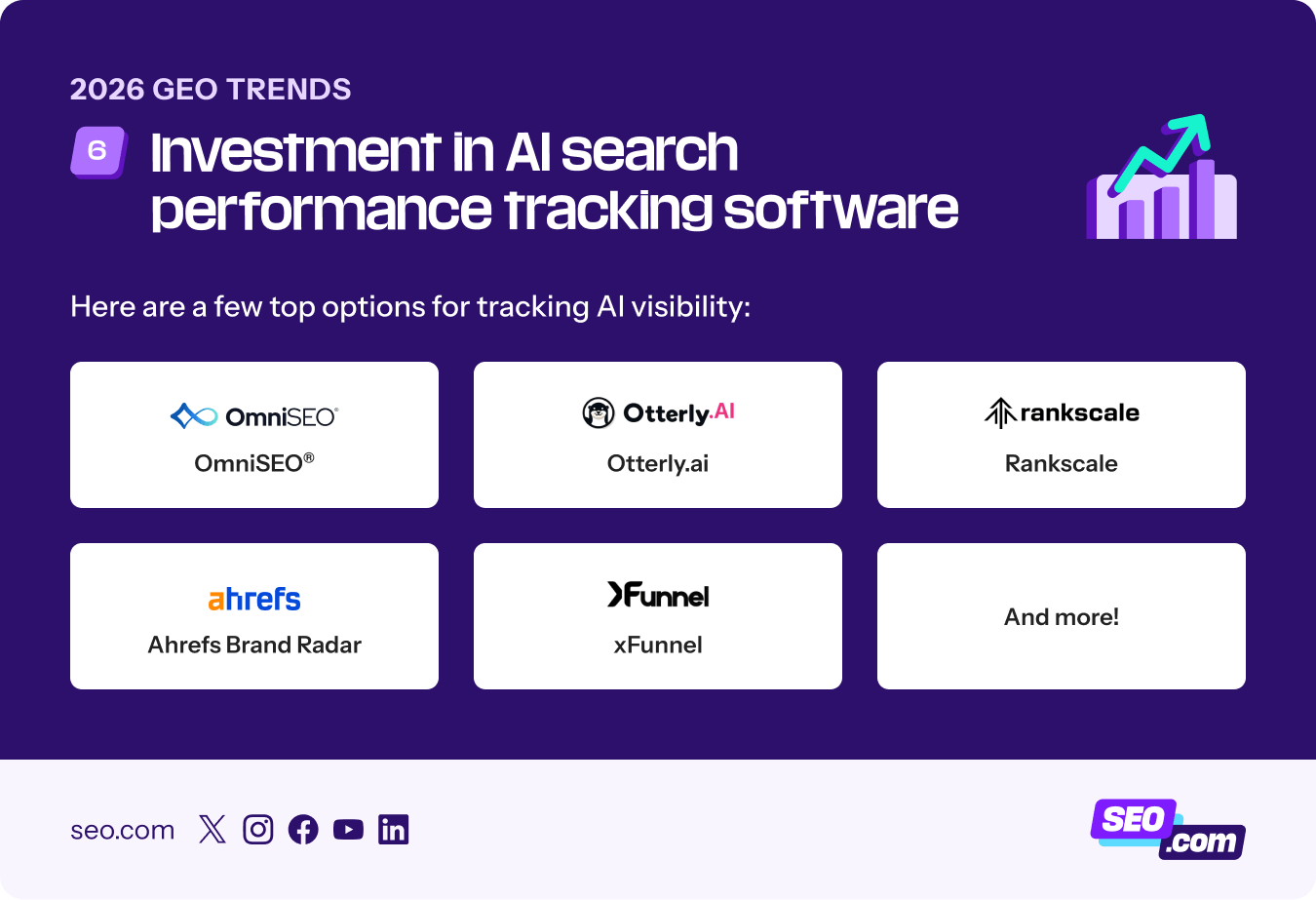
Want to start looking now? Here are a few top options for tracking AI visibility:
- OmniSEO®
- Otterly.ai
- Rankscale
- Ahrefs Brand Radar
- xFunnel
- And more!
Follow these GEO trends for 2026 success
GEO isn’t going away anytime soon, which is why you need to keep on top of the latest GEO trends to ensure you’re keeping your strategy effective.
Don’t have the time to dedicate to developing and building up your GEO strategy?
The WebFX team — the group behind SEO.com — can handle it for you! We’ve got a team of marketing experts that keep up with the latest changes in search and can help you set up your strategy for success.
Connect with us today to learn more about our GEO services!

Future-Proof Your SEO Strategy with OmniSEO®
Goodbye search engine optimization, hello search everywhere optimization.


Future-Proof Your SEO Strategy with OmniSEO®
Goodbye search engine optimization, hello search everywhere optimization.
Future-Proof Your SEO Strategy with OmniSEO®
Goodbye search engine optimization, hello search everywhere optimization.
Writers