


- Why don’t high-ranking pages always appear in AI Overviews? Strong traditional search rankings don’t guarantee AI Overview visibility because AIOs pull from a smaller, more selective set of sources that prioritize clear answers, close intent alignment, and content that’s easy for AI systems to summarize and trust.
- What types of queries trigger AI Overviews most often? Informational queries trigger AIOs 39% of the time, with longer informational queries (eight or more words) triggering them 67% of the time — question-based, long-tail, or natural language queries perform best for AI Overview visibility.
- How should content be structured to appear in AI Overviews? Content should answer the primary question within the first few sentences, use clear headings and bullet points for easy scanning, and employ short paragraphs with logical sectioning that helps both readers and AI systems quickly understand the message.
- What role does E-E-A-T play in AI Overview citations? Experience, Expertise, Authoritativeness, and Trustworthiness (E-E-A-T) significantly influence which sources AI systems cite — pages lacking author context, credible references, or signals of real expertise get overlooked in favor of more established sources, especially in sensitive topics.
- How can you build topical authority for AI Overviews? Creating related content that explores topics from multiple angles and linking those pages together signals to Google that your site is a reliable source — AI Overviews favor brands that consistently cover a topic rather than isolated articles.
Why you aren’t appearing in ai overviews
You’re likely missing out on AI Overviews because your content doesn’t fully match the search intent, answer questions quickly, or provide enough depth and real-world insight. Weak authority signals, structural issues, and technical or user experience problems can also prevent AI systems from trusting your page. Often, it’s a mix of these factors rather than a single issue.
If you’re investing in SEO but still not getting cited in Google’s AI Overviews (AIOs), you’re not alone. Many brands assume that strong rankings automatically lead to AI Overview visibility — but that isn’t always the case.
AI Overviews pull from a smaller, more selective set of sources. They prioritize content that answers questions clearly, aligns closely with intent, and is easy for AI systems to summarize and trust. That means it’s entirely possible to rank well in traditional search results and still be invisible in AI-generated summaries.
In this guide, we’ll break down why you aren’t appearing in AI Overviews, even if your content performs well elsewhere. Then, we’ll walk through the most effective ways to fix those issues and improve your chances of being cited consistently.
9 reasons why you aren’t appearing in AI Overviews
If your content isn’t showing up in AI Overviews, it’s usually not because of one single mistake. In most cases, it’s a combination of intent mismatches, structural issues, authority gaps, or trust signals that aren’t strong enough for AI systems to rely on.
Here are the most common reasons brands struggle to earn AI Overview citations, and how those issues typically show up in real content.
- You’re Not Targeting Queries That Actually Trigger AI Overviews
- Your Page Doesn’t Match the Search Intent Closely Enough
- Your Content Doesn’t Answer the Question Fast Enough
- Your Page Lacks a Structure That AI Can Easily Extract
- Your Content Doesn’t Sound Like a Natural, Conversational Answer
- Your Content Lacks Depth, Originality, or Real-world Insight
- Your Site Doesn’t Show Strong E-E-A-T Signals
- You Haven’t Built Enough Topical Authority in Your Niche
- Technical SEO or User Experience Issues Make Your Site Harder to Trust
1. You’re not targeting queries that actually trigger AI Overviews
AI Overviews appear more frequently for informational searches, especially longer, more conversational queries. If your pages primarily target commercial or transactional keywords, like “pricing,” “services,” or “buy now,” they may not qualify for AI Overview citations.
Even well-written content won’t appear in AIOs if the query itself doesn’t consistently trigger an overview. This is one of the most overlooked reasons brands miss out on visibility.
2. Your page doesn’t match the search intent closely enough
Search intent plays a big role in AI Overview visibility. If the query implies a definition, explanation, or step-by-step answer — but your page delivers a sales-forward narrative or a loosely related discussion — AI models may overlook it.
Before citing a source, AI Overviews look for content that answers the question in the expected format. When that alignment is off, even authoritative pages get ignored.
3. Your content doesn’t answer the question fast enough
Many AI Overview citations come from pages that address the main question within the first few sentences. If your answer is buried under long introductions, background context, or storytelling, AI models may never surface it.
This is especially common in blog posts that “warm up” the reader instead of getting straight to the point. If your answer is too far down the page, it’s harder for AI systems to find a clean, quotable response to cite.
4. Your page lacks a structure that AI can easily extract
AI Overviews favor content that’s clearly organized and easy to parse. Pages without clear headings, bullet points, lists, or short paragraphs make it harder for AI systems to identify key takeaways.
Even strong content can struggle to appear if it’s presented as large blocks of text with minimal formatting or visual hierarchy.
5. Your content doesn’t sound like a natural, conversational answer
AI Overviews are designed to mirror how people naturally explain things to one another. Content that relies heavily on jargon, stiff phrasing, or keyword-heavy language may technically answer the question. But they still feel unnatural to summarize.
If your writing sounds more like it was written for a search engine than a real person, AI systems may favor a clearer, more conversational alternative.
6. Your content lacks depth, originality, or real-world insight
AI Overviews don’t just look for surface-level explanations. When multiple pages offer similar definitions or advice, AI systems tend to cite the source that provides additional context, such as examples, practical context, or original insights.
Content that restates what’s already widely available without adding clarity or nuance is less likely to stand out.
7. Your site doesn’t show strong E-E-A-T signals
Experience, Expertise, Authoritativeness, and Trustworthiness (E-E-A-T) matter more when AI systems decide which sources to cite. If your content lacks author context, credible references, or signals of real expertise, AI Overviews may default to more established sources.
This becomes especially important in competitive or sensitive topics, such as healthcare and legal matters, where accuracy and trust are critical.
8. You haven’t built enough topical authority in your niche
AI Overviews often pull from brands that consistently cover a topic, rather than just one isolated article. If your site only has a single page addressing a subject, AI systems may not see you as a reliable authority.
Topical authority is built through clusters of related content, internal linking, and ongoing coverage that shows depth over time.
9. Technical SEO or user experience issues make your site harder to trust
Even if your content is strong, technical or user experience (UX) issues can limit whether Google trusts it enough to cite. Slow load times, poor mobile usability, crawling issues, or hard-to-read layouts can all reduce your eligibility for AI Overviews.
If users struggle to navigate or engage with your page, AI systems may infer that it’s less helpful than competing sources.

Does your website appear in AI Overviews ?
Check your website’s performance in AI Overviews and organic search results.

How to appear in AI Overviews
The good news — each one of the issues above is fixable. Once you understand what’s blocking your visibility, improving your chances of appearing in AI Overviews becomes much more straightforward.
If you’ve been trying to understand how to rank in AI Overviews, these best practices are essential starting points.
- Identify AI Overview-triggering Queries
- Accurately Match Search Intent and Summarize Early
- Improve Structure and Clarity
- Strengthen Authority and Credibility Signals
- Build Topical Authority Beyond a Single Page
- Monitor Performance and Refresh Content Regularly
1. Identify AI Overview-triggering queries
Start by identifying the keywords in your niche that already trigger AI Overviews. Tools like SEO.com’s AI Overview Checker can help you see which queries display AIOs today.
According to SEO.com’s recent AI Overview keyword study, informational queries trigger AIOs 39% of the time, and informational queries with eight or more words trigger them 67% of the time. Targeting these patterns enables you to capitalize on existing opportunities.
Consider looking out for question-based, long-tail, or natural language queries like “What to expect during outpatient physical therapy” and “How often should you replace HVAC air filters.”
2. Accurately match search intent and summarize early
Make sure your content delivers exactly what the query asks for quickly and efficiently. Address the primary question near the top of the page, then expand on it with supporting details.
This mirrors featured snippet optimization and provides AI systems with a clear answer to summarize.
Let’s take, for example, an article on the topic “how to find a private lender.” In the article, they include a brief section about what a private lender is and answer the question clearly and concisely.
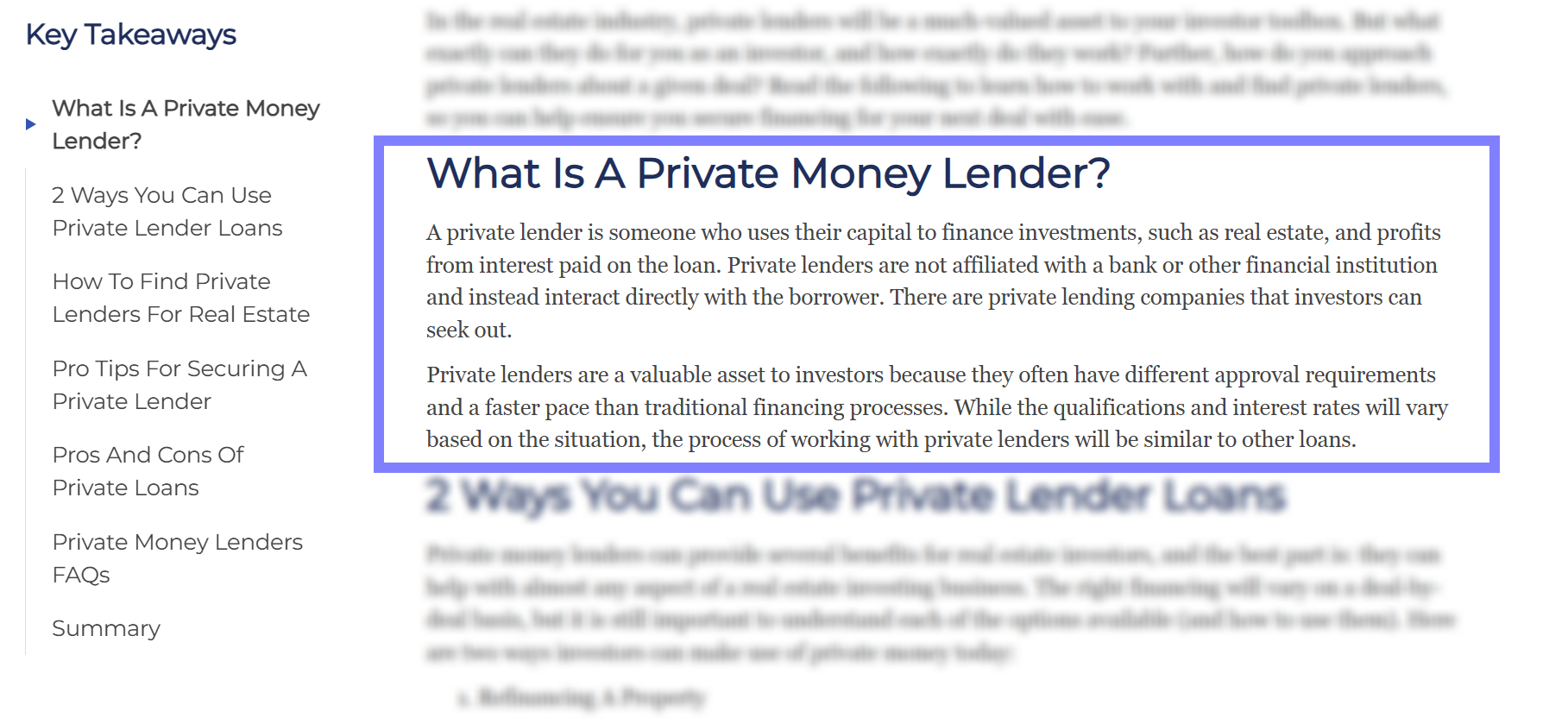
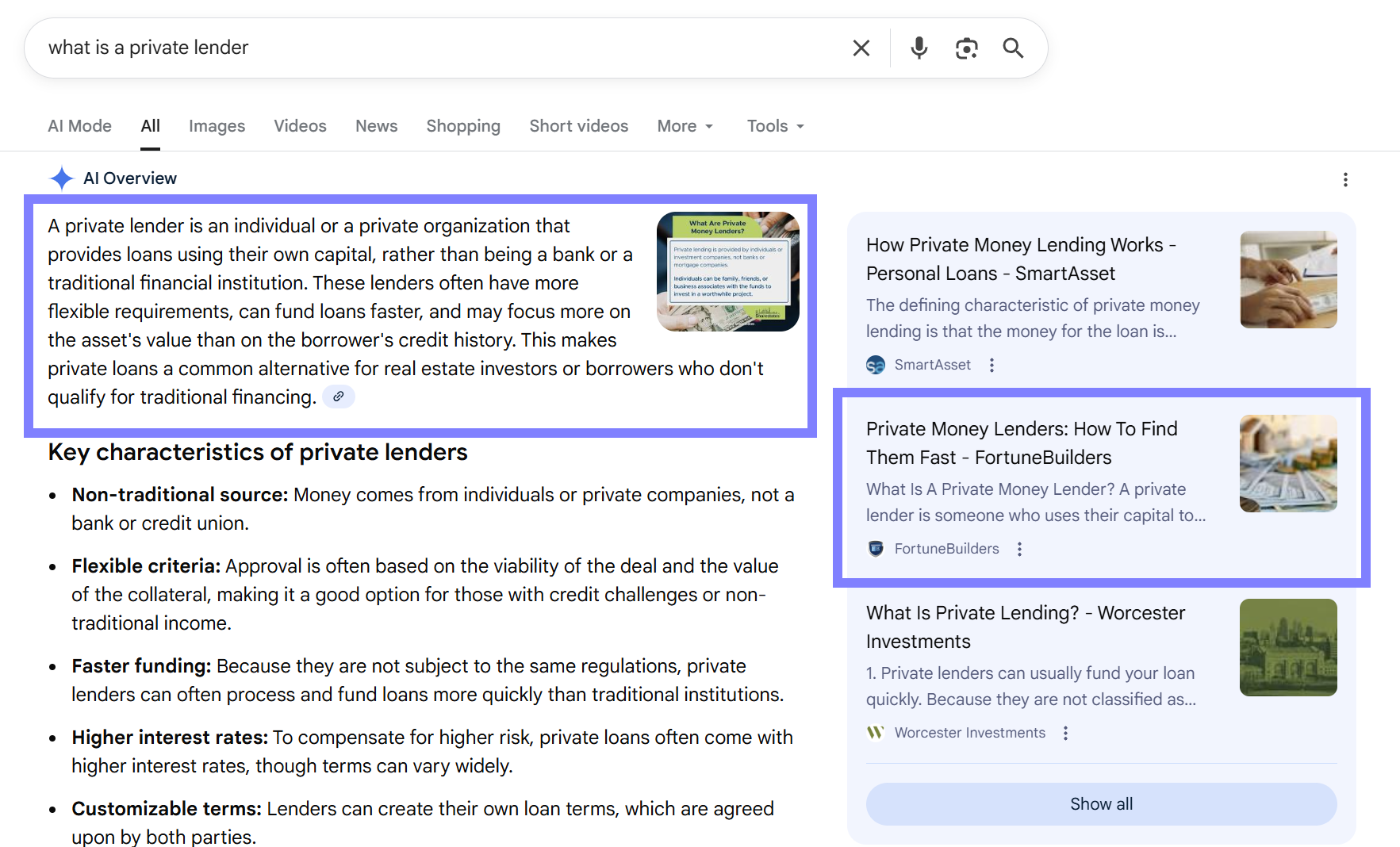
If you search, “what is a private lender,” you’ll see that the AI Overview summarized the definition from their article and cited them:
Google has also started showing AI overviews in local queries.
3. Improve structure and clarity
Use headings, bullet points, short paragraphs, and clear sectioning to make your content easy to scan and navigate. Well-structured pages help both readers and AI systems understand your message faster.
Where appropriate, schema markup (such as FAQPage or HowTo schema) can provide additional clarity about the purpose of your content.
4. Strengthen authority and credibility signals
Strengthen your credibility signals by supporting your explanations with the following best practices:
- Including author bios or expertise context
- Adding case studies or real examples
- Citing reputable sources
- Sharing your industry insights
- Offering clear, accurate explanations
If multiple pages cover the same topic, AI Overviews tend to cite the one with stronger authority indicators.
5. Build topical authority beyond a single page
Create related content that explores your topic from multiple angles, and link those pages together. Over time, this signals to Google that your site is a reliable source worth citing for niche topics.
6. Monitor performance and refresh content regularly
AI Overview behavior evolves quickly. Track which pages appear in AIOs, identify drops in visibility, and update content as needed. Fresh examples, clearer summaries, and improved formatting can make a noticeable difference.
Use tools like SEO.com’s AI Overview Checker or OmniSEO® to track how often your pages appear in AIOs and how those patterns change over time.
FAQs: Why you aren’t appearing in AI Overviews
-
What are AI Overviews?

AI Overviews are AI-generated summaries that appear at the top of Google’s search results to answer a user’s questions instantly. They work by analyzing relevant sources, synthesizing information into a concise explanation, and citing trusted sites next to the summary. They’re used to help users get quick, accurate answers without scrolling through multiple links.
-
Why isn’t my content getting cited in AI Overviews?
Your content may not appear in AIO citations if it lacks authority signals, clear structure, or direct relevance to the user’s search query. Pages that do appear often contain focused answers, strong formatting, and helpful insights.
Key qualities of AIO-cited content typically include:
- Direct answers at the top of the page
- Strong topical authority
- Clear structure (headings, lists, bullets)
- Accurate, up-to-date information
- User-friendly formatting
-
How do I optimize for AI Overviews?
You can optimize for AI Overviews by creating high-quality, authoritative, well-structured content with clear headings, short paragraphs, and approachable explanations. The most important step is addressing intent directly and comprehensively.
Learn how to optimize for AI Overviews with these tips for improvement:
- Concise, answer-first paragraphs
- Structured formatting
- Deep expertise and helpful examples
- Long-tail, informational keywords
- Natural, conversational language
-
How do I track my AI Overview visibility over time?
You can track visibility using a dedicated monitoring tool like OmniSEO®. This tool helps you identify which pages appear in AIOs, how visibility changes over time, and where you can improve your strategy.
Quick steps to track visibility include the following:
- Enter your target keywords into OmniSEO®.
- Review which ones display AI Overviews.
- Track changes daily, weekly, or monthly.
- Identify where your pages appear or drop off.
- Optimize based on the visibility trends.
-
Does appearing in AI Overviews improve SEO?
Yes. Appearing in AI Overviews improves your SEO performance by increasing visibility and authority before users even scroll. Even if users don’t click through, you still gain brand exposure, credibility, and recall.
And when users do click your link from an AIO, they’re often highly motivated and further down the purchase funnel, which can increase conversions.
Boost your AI Overview visibility today
Optimizing for AI Overviews gives you a powerful advantage in today’s zero-click search landscape. By aligning your content with user intent, improving your page structure, and keeping those pages fresh and authoritative, you position your brand for stronger AIO visibility and higher-quality traffic. This ongoing process is the foundation of AI Overview optimization.
To start improving your performance, try SEO.com’s free AI Overview Checker. If you want to take your visibility even further, explore OmniSEO® to maintain your presence across the entire AI-powered search experience. Contact our team today, and we’ll help you build a strategy tailored to your goals.
Future-Proof Your SEO Strategy with OmniSEO®
Goodbye search engine optimization, hello search everywhere optimization.

Future-Proof Your SEO Strategy with OmniSEO®
Goodbye search engine optimization, hello search everywhere optimization.
Writers