



If you’re like a lot of businesses, you’re currently debating if you should focus on traditional SEO or start investing in AI SEO.
When you look at AI SEO vs. SEO, they probably don’t seem much different. But realistically, they are.
In this guide, we’ll cover:
- How is AI SEO Different from Traditional SEO? A Breakdown
- Should I Switch from Traditional SEO to AI SEO to Save Money?
- Why Doesn’t Traditional SEO Help with AI Search Visibility?
- Why Does My SEO Strategy Not Work for AI Search?
- Which Should I Invest In: AI SEO or SEO?
How is AI SEO different from traditional SEO? A breakdown
AI SEO and SEO have some overlap, but there are distinct areas where they differ:
1. Goals
| Traditional SEO | AI SEO |
| Keyword rankings, traffic, clicks | Brand mentions, visibility, citations |
When looking at AI SEO vs. SEO, a big difference you’ll see is in the goals.
For traditional SEO, there’s a big focus on optimizing for keywords and ranking well for them. There’s also heavy focus on getting clicks to those pages and driving traffic.
With AI SEO, it’s different. AI search drives a lot of clickless behavior, so the focus is really about getting your brand visible in front of searchers. Additionally, “ranking” in AI search isn’t really a thing — whether you’re the first source in AI Overviews or the third, it’s all the same value.
So, because AI search entities are structured differently and elicit different user behaviors, the goals aren’t the same.
2. How people search
| Traditional SEO | AI SEO |
| Keyword phrases that are typically 3 words or more | Full questions or prompts |
When you’re looking at traditional SEO and AI SEO, you’ll find that the way people search is a big differentiator.
Traditional SEO historically relies on keywords. These keywords tend to be three words or more, like “how to change a wiper blade.” People search these short phrases to trigger results that provide that helpful information.
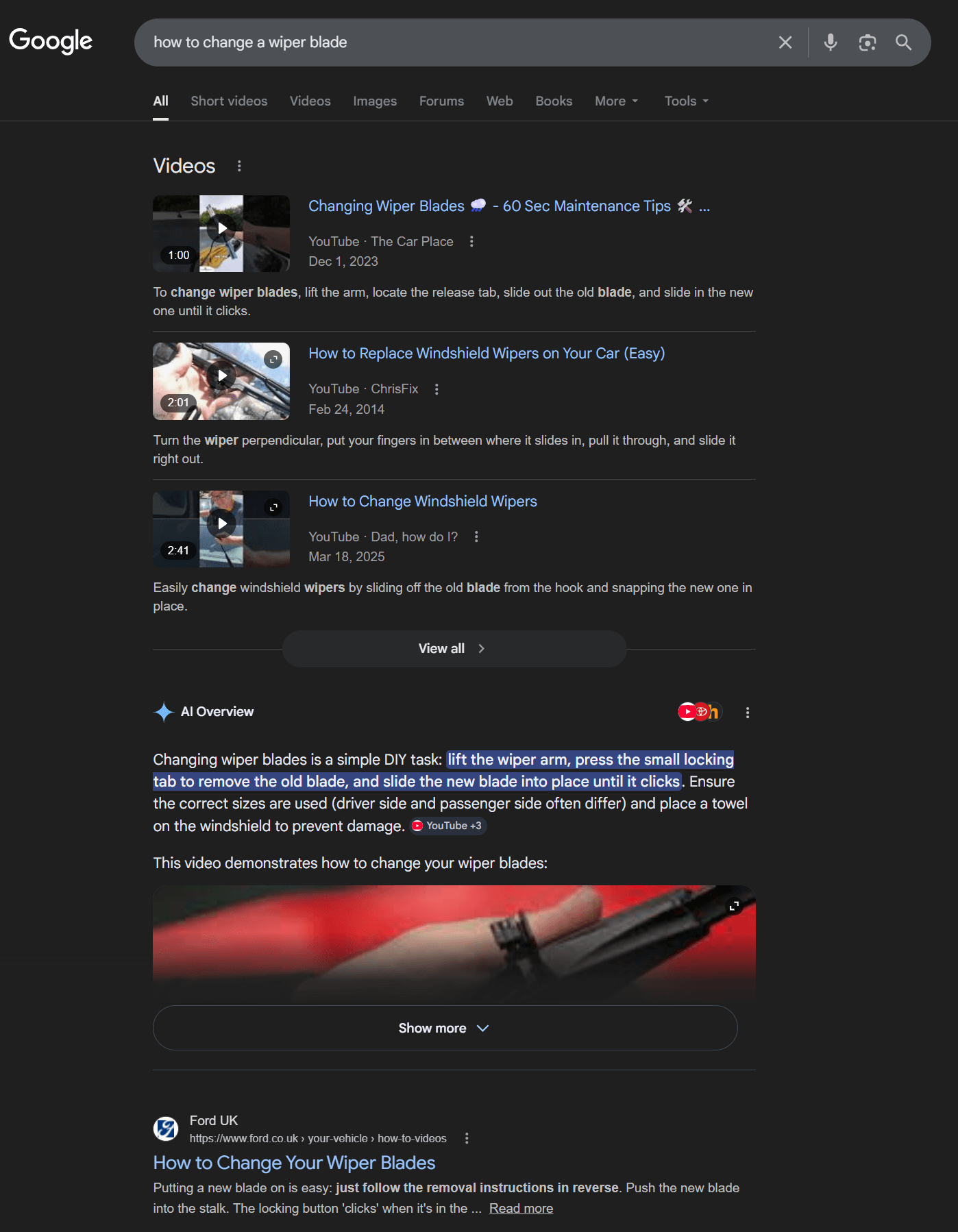
With AI SEO, though, people are more likely to ask full questions or submit fuller prompts. Because AI engines are built with a conversational element to them, people are more likely to search like they’re asking a person.
(Because realistically, you aren’t going to walk up to someone and say “how to change wiper blade?”)
Instead, you’d say something like “How do I change my wiper blade on the drivers side of my car?” Or, it may even be more elaborative, like:
“How do I change my wiper blade? I have a 2025 Honda Civic. I’m trying to change the driver’s side windshield wiper. What size wiper blade do I need and do I need any special tools?”
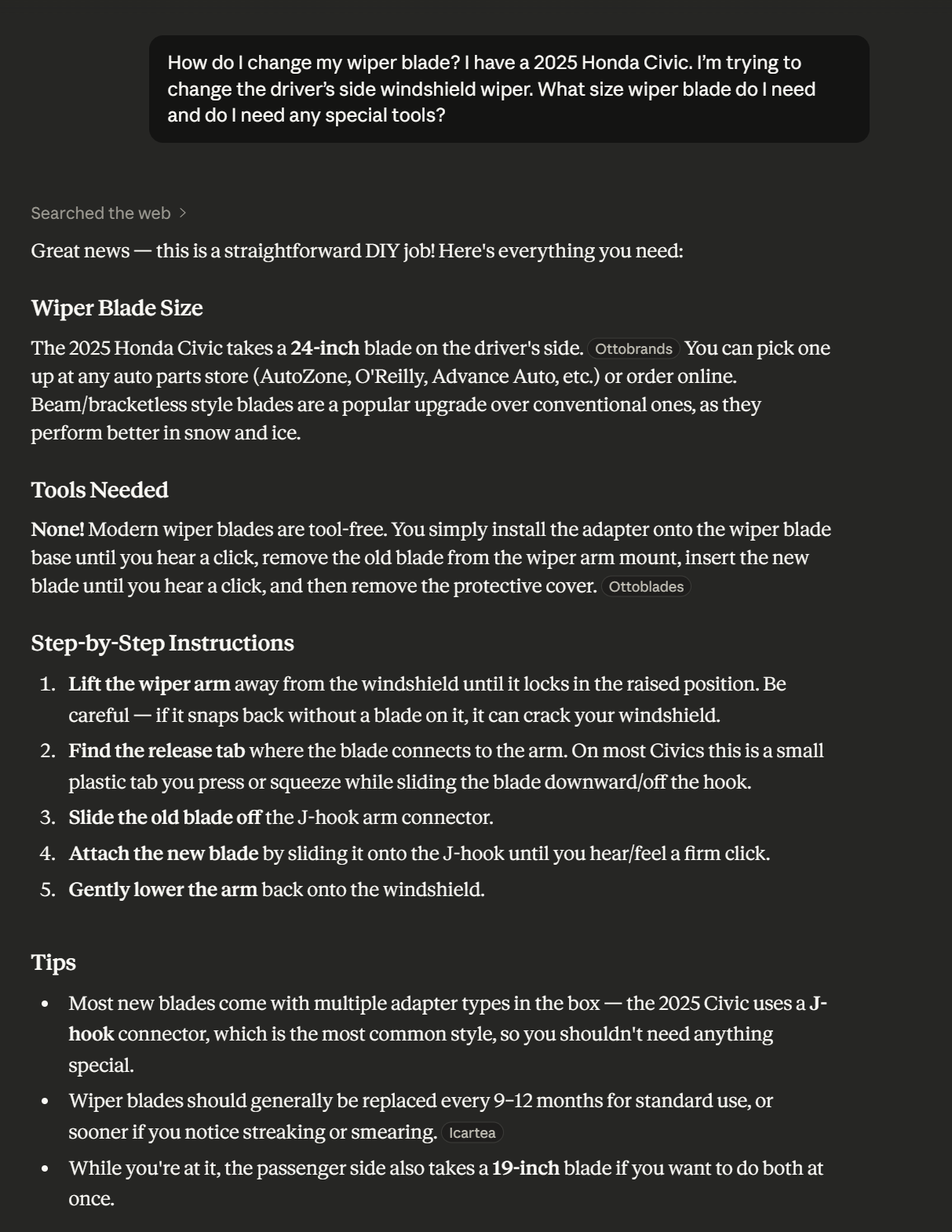
So, as you can see, AI searches are more in-depth and more likely to be full sentences or questions vs. short phrases.
3. Authority signals
| Traditional SEO | AI SEO |
| Backlinks | Brand mentions (including backlinks) |
If you compare traditional SEO vs. AI SEO, you’ll discover a slight difference between the authority signals.
Traditional SEO relies heavily on backlinks as a ranking signal. It’s looking at factors like how many backlinks you have (A recent backlinks study shows that the average number of referring domains for page-one rankers is 907!), the quality, and the source of them.
While backlinks do influence authority signals for AI search, it’s not limited to just that. Brand mentions, for example, play a pivotal role in helping you earn citations, even if they aren’t linked back to your website.
So, if you’re looking at 10 pages all addressing the same topic and your brand is mentioned 9/10 times, while your competitor is only mentioned 3/10 times, the concensus is that your brand is more likely to be pulled by AI than your competitor because you have more mentions across the web.
For AI search, backlinks just further help boost those mentions and authority signals. But unlike traditional SEO, unlinked brand mentions actually have a big impact on your ability to earn citations and mentions in AI search.
Should I switch from traditional SEO to AI SEO to save money?
No. Traditional SEO and AI SEO are two separate entities. Even though they both deal with optimization in search engines, they use different tactics and approaches. You can’t use AI SEO to optimize for traditional SEO, and vice versa.
Why doesn’t traditional SEO help with AI search visibility?
Actually, it does. Many of the things you do for traditional search help with your AI search performance. Having good technical SEO (schema, site architecture, etc.), integrating E-E-A-T signals, and well-structured/organized content are just a few traditional SEO things that influence AI search visibility.
Realistically, having a good traditional SEO foundation sets you up for success with AI SEO.
Why does my SEO strategy not work for AI search?
Just relying on a traditional SEO strategy for AI search optimization doesn’t work because the focus of AI search is a little different. SEO focuses on things like keyword targeting, rankings, and clicks, while AI search focuses on visibility, citations, and brand mentions.
Because the focus is different for AI SEO, a traditional SEO strategy isn’t geared up to meet those goals.
As mentioned before, traditional SEO strategies do still have an impact on your performance — it’s just that traditional SEO alone can’t set you up for success with AI search optimization. That’s why, if you’re trying to appear in AI search results, you need an AI SEO strategy to work in conjunction with your traditional SEO strategy.
Which should I invest in: AI SEO or SEO?
Truthfully, both. Because they are different than one another, only having one or the other won’t help you get in both AI search results and traditional search results. If you’re serious about getting visibility in AI engines, you’ll want to invest in AI SEO in addition to traditional SEO.
Conclusion: It’s not AI SEO vs. SEO but AI SEO and SEO
AI SEO and traditional SEO are two separate entities, both of which are crucial for your search dominance. It’s not a conversation of AI SEO vs. SEO, but rather using both in tandem to help you reach people wherever they search.
Not sure where to start with AI SEO services? Connect with us today to discover how we can create a custom search strategy for you!

Grow Your Visibility Beyond Google
Capture leads and traffic from emerging search platforms like ChatGPT, Perplexity, and Google AI.

Grow Your Visibility Beyond Google
Capture leads and traffic from emerging search platforms like ChatGPT, Perplexity, and Google AI.
Grow Your Visibility Beyond Google
Capture leads and traffic from emerging search platforms like ChatGPT, Perplexity, and Google AI.
Writers