

Main differences between GEO vs. SEO
-
Target platforms: GEO focuses on AI-driven search engines like Microsoft Copilot, while SEO targets traditional engines like Google and Bing.
-
Result type: GEO delivers a single, summarized answer, whereas SEO provides multiple search results pages for users to explore.
-
Content approach: GEO content must be conversational and contextually relevant, while SEO relies on keywords, backlinks, and metadata for indexing.
-
Traffic and formats: GEO often presents diverse formats—PDFs, mind maps, code—on one page, reducing clicks; SEO primarily delivers text-based results that encourage users to click through to top-ranking sites.
AI-powered search results are becoming mainstream. Now, 58% of all search results on Google see an AI Overview. There are over 2.5 billion queries on ChatGPT per day. There are over 1 billion monthly active users on AI Mode.
It’s evidence that AI search is growing and actively changing the way people search for information.
As a result, it’s increasingly necessary to optimize your website pages for these newer search engines to ensure online search visibility and ranking. Generative engine optimization (GEO) is the strategy you need to ensure you appear on generative AI search engines.
But is optimizing for GEO the same as SEO?
We break down GEO vs. SEO to show you how they’re different, whether you need both, and more.
Key similarities between GEO vs. SEO
SEO and GEO overlap in many areas and share many similarities.
Here’s an overview of how the two strategies overlap:
- Content quality: Both SEO and GEO strategies require high-quality content that provides value to users and the information they want to know.
- Content structure: Content with an organized structure that includes headings, bullet points, and clear formatting helps both search engines like Google and LLM platforms crawl and understand your content.
- Strategy foundation: SEO provides a strong foundation for a successful GEO strategy, so both channels will overlap in some of the optimizations that are required to succeed.
- Topical authority: Both LLM platforms and search engines value brands with topical authority in their niche and can reward those brands with more visibility.
Key differences between GEO vs. SEO
SEO and GEO also have many differences. Let’s dive into them below!
| Feature | GEO | SEO |
| Target platforms | Focuses on AI-driven search engines, like Microsoft Copilot | Focuses on traditional search engines, like Google and Bing |
| Type of results | Provides users with a single summarized result | Provides users with multiple search results pages to choose from |
| Content focus | Content must be conversational and contextually relevant to be indexed | Content is indexed depending on keyword insertion, link building, and other SEO best practices |
| Content formats | Results include different content formats based on your prompts, including PDFs, mind maps, and code snippets | Most results are text-based, but are gradually incorporating other formats like videos, maps, and product descriptions |
| Ranking factors | AI search engines use content quality, structure, and relevance to index and rank pages | Keywords, backlinks, and metadata are the top-ranking factors in traditional search engines |
| Traffic and metrics | Provide users with a single comprehensive answer on one page, eliminating the need to click through to another website | By listing links to top search results, users are inspired to click through to the top-ranking web pages |
| Third-party influence | Third-party trust signals like reviews have stronger influence on brand credibility and ability to get cited in search results | The biggest third-party impact for SEO comes from backlinks. Getting links from third-party authoritative resources helps boost credibility and rankings |
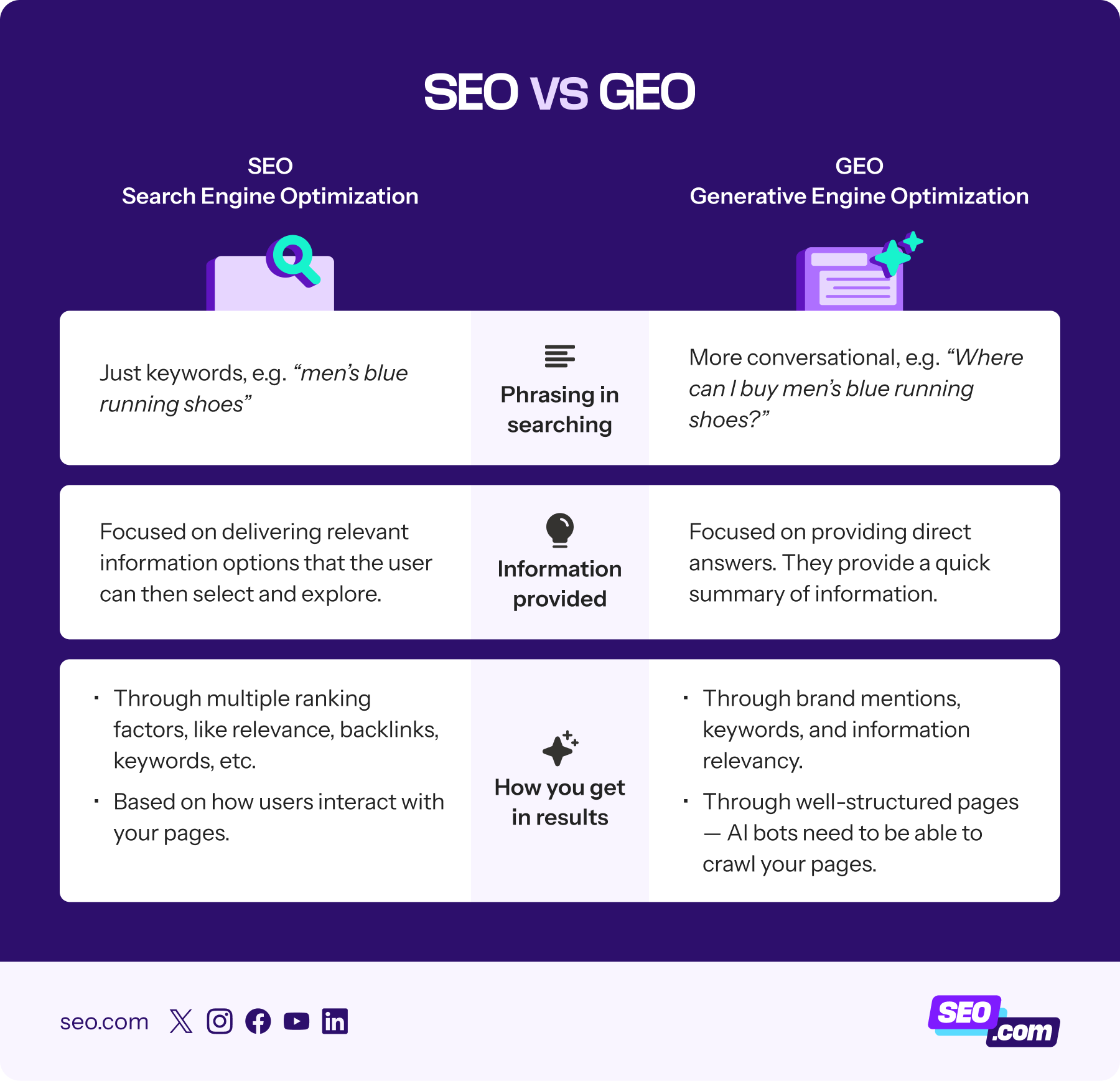
While both SEO and GEO are strategies geared toward helping brands increase their online presence, they have some distinct differences. These difference between SEO and GEO stem from the search engine they target to the types of results they produce and much more, as discussed below.
Additional reading: AEO vs. SEO: What’s the difference?
1. Target platforms
GEO is meant to help you refine and improve content so it ranks on generative AI search engines, like ChatGPT and Claude, while also appearing on AI search results, such as Google AI overviews.
SEO involves making your website more engaging, relevant, and helpful for readers while ensuring it ranks high on run-of-the-mill search engines.
2. Type of results
There are some fundamental differences in the results produced by AI search engines and traditional search engines. For starters, traditional search engines provide users with multiple search result options and leave it up to you to select the ones that answer your search query.
For example, in the case of Google, you get up to 10 options on the first page and millions more thereafter. You, the user, have to click on the link you feel answers your search query most accurately:

AI search engines like Perplexity do the work of perusing different result options, including blog posts, videos, images, audio, and social media posts. Instead of the millions of blue links provided by Google, AI search engines provide one multimodal result that summarizes all the information you need:

3. Content focus
SEO focuses on keyword targeting and information relevance to provide users with relevant results for their search queries. Therefore, when crafting SEO content, marketers focus on including as many keywords as naturally possible to increase their chances of ranking.
This optimized content comes up as a natural response to queries containing the keywords. For example, when a user is looking for answers to how to troubleshoot a garage door that refuses to open, top SEO-friendly results will have keywords like “garage door not opening.”
However, in the case of GEO, you should focus more on nailing user intent and context with conversational phrasing like “How do I fix a stuck garage door?” The goal is to structure content in a way that AI tools can understand the context and intent behind queries easily.
4. Content formats
While SEO focuses on presenting searchers with the most helpful and informative results, GEO takes a rather different approach. It aims to present users with contextually relevant content in line with users’ behaviors, demographics, and preferences.
Traditional search engines previously presented text-based content but are now embracing different content formats, including AI Overviews, social media results, videos, and product listings, all of the same types.

AI-powered search engines rely on users’ prompts to decide the type of content to present. For instance, AI searches can result in code snippets, mind maps, tables, and step-by-step solutions depending on the search query or specific prompt.
5. Ranking factors
Indexing and ranking factors refer to the conditions that content and websites must meet in order to appear in search results. SEO indexing and ranking factors are well-documented and somehow overlap with the newer and more nuanced GEO factors, like the AI Overview ranking factors that shape Google’s AI-generated results.
Here are some steps to create successful SEO strategies:
- Conduct detailed keyword research
- Include internal and external backlinks
- Include meta tags, headings, and subheadings
- Create helpful and relevant content
- Ensure a positive user experience with fast page loading speeds and mobile friendliness
While you should include all the above SEO steps in your GEO strategy, a few unique ones that will improve your chances of getting indexed and ranked on AI search engines include:
- Producing high-quality, well-structured content
- Being specific and answering questions directly
- Incorporating structured data like schema markups
- Backing up your claims, facts, and statistics with links to reputable sources
6. Traffic and metrics
The greatest drawback of GEO for business owners with websites is that it may reduce website traffic. This is because the single comprehensive summary provides searchers with all the information they need, so they won’t have to click through to any other website.
On the contrary, SEO rewards well-optimized pages with more traffic by ranking your website pages high to encourage more clicks. Additionally, it’s easier to measure SEO results than GEO results by analyzing tried-and-true metrics like click-through rate, conversion rate, and bounce rate.
However, to measure if your GEO efforts are working, you’ll have to look at impression metrics, like visibility of citations, accuracy, and content relevance.
7. Third-party influence
For GEO, third-party trust signals carry more weight than they ever did in traditional search. AI engines lean on external validation — reviews, social proof, and mentions across forums and communities — to decide whether your brand is credible enough to cite in a generated answer.
For SEO, backlinks remain the dominant third-party signal. Earning links from authoritative, relevant sites still tells Google your content is trustworthy enough to rank — the same core idea as GEO’s trust signals, just measured differently.
GEO and SEO trends in 2026
GEO and SEO influence each other, so it’s important to optimize for both to help you rank well in traditional and AI searches. But what does the future look like for GEO and SEO? Here are some upcoming trends you’ll want to know about:
1. Expertise will be more valuable
A key component to seeing success with GEO and SEO is showcasing your expertise. Both traditional and generative search engines want to deliver helpful, credible, and trustworthy information to searchers. So, showcasing your expertise is a big trend for 2026 if you want to rank in both types of search engines.
You can showcase your expertise by:
- Beefing up your author profiles with credentials, awards, and similar achievements
- Adding case studies to prove your success in your industry
- Creating original, unique content to establish authority
- Sharing expert insights to showcase knowledge
Building up your expertise will help improve your website’s E-E-A-T, which will, in turn, help you rank better in both traditional and generative engines.
2. Rise of zero-click searches
Zero-click searches will continue to rise as AI search becomes more prominent. In 2026, 68% of Google searches ended without a click.
With AI Overviews, for example, sitting at the top of search results with a summary for the query, people get what they need and leave. It’s led to a drop in clicks, which has caused a shift in what metrics people track.
Zero-click searches will continue to sustain at high levels, which means the focus will now shift to impressions, visibility, and mentions.
3. Diversified search journey
Before the rise of AI search, the search journey was relatively linear. People went to Google (or Bing) and searched for information at different points in the customer journey. For 2026 and beyond, the search journey will likely diversify, and the marketing funnel with it.
You may have people who start their research on ChatGPT and complete their journey through Google. You may see people go back and forth between different AI search platforms and traditional search engines. Regardless of what the search path looks like, it’s likely going to be more diverse.
That means you’ll need to do GEO and SEO in tandem, so you can reach people no matter where they search for information.
Can GEO and SEO work together?
Yes. Actually, GEO and SEO should work together to boost search visibility everywhere, i.e., on traditional, social media, and generative AI search engines. Having an integrated GEO and SEO strategy involves optimizing your content and website for people and search engines. Here’s how you can achieve that:
- Include keywords naturally and strategically in the content
- Ensure content is high-quality and well-structured for AI readability
- Build authority across different platforms with reviews, social media, and online forum participation
- Add structured data in the form of FAQs, how-tos, and product info to improve AI and search engine discoverability
OmniSEO® is a proprietary tool by WebFX that helps businesses rank everywhere, diversify their traffic sources, and accelerate revenue. With OmniSEO®, you get to utilize your resources and marketing efficiently and maximize the strengths of each optimization strategy.
Want to look at a real case study that shows the power of SEO and GEO together? Check out this case study from Thompson Tractor who partnered with WebFX (the team behind SEO.com) below!
Thompson Tractor Case Study
Thompson Tractor partnered with WebFX for GEO, SEO, Local SEO, and OmniSEO® looking to broaden their visibility to reach buyers wherever they research! Through their partnership with WebFX, Thompson Tractor saw the following results:
- 586% increase in traffic from generative AI sources
- 500% increase in leads driven from AI platforms
- 38% average increase in SEO leads YoY
FAQs on GEO vs. SEO
What is GEO?
Generative engine optimization is the process of adapting your content to start appearing on generative AI search engines, such as ChatGPT, Perplexity AI, or Microsoft Copilot. The term is coined from SEO, which has been the mainstream way of ensuring your content appears on traditional search engines like Google and DuckDuckGo.
With GEO, you can keep up with the changing search environment, which is now favoring artificial intelligence-based search engines and social media search engines. GEO involves optimizing content for the large language model (LLM) tasks performed by AI-powered search engines, chatbots, and search result features.
What is SEO?
Search engine optimization is the strategy of adapting website content to appear and rank high on traditional search engines like Google, Bing, and Yahoo. It involves aligning your website with traditional search engines, allowing them to crawl and index your pages.
To optimize your content for SEO, you must understand how the search engines work and identify where your website should appear in search results. SEO-optimized websites enjoy the benefits of ranking high on search engines, which often means higher and more qualified traffic that’s highly likely to drive leads and conversions.
Is GEO replacing SEO?
Nope. Contrary to popular belief, GEO is not replacing SEO. Rather, it builds on the solid foundation set by SEO. GEO enhances SEO by ensuring visibility on the fast-rising AI-powered search engines.
How is GEO different from SEO?
GEO involves optimizing websites and content for visibility on AI-powered search engines like Microsoft Copilot, while SEO focuses on optimizing websites and content for visibility on traditional search engines like Google.
How do you optimize for GEO?
Optimizing a website for GEO involves producing high-quality and well-structured content, providing clear and concise answers to queries directly, and ensuring easy indexing with schema markups and other structured data.
Since this requires a specialized approach combining technical SEO and advanced content strategy, many businesses rely on professional generative engine optimization services to implement these tactics effectively.
Start optimizing for GEO today
The search landscape has changed, and if you don’t keep up, you won’t be in valuable AI search results where your audience is. Optimizing for GEO is your key to getting in AI search results and ensuring your audience can see you wherever they’re searching.
Explore GEO services today to see if it’s the right move for you!


Grow Your Visibility Beyond Google
Capture leads and traffic from emerging search platforms like ChatGPT, Perplexity, and Google AI.
Writers