



Keywords matter for AI search in a context capacity, not an exact-match capacity. Your keywords help provide AI engines with context about what information is included on your page, so they can determine if your information is relevant to serve and cite in their responses. Keywords hold less “ranking” power for AI search, but instead, hold more power for showing relevancy.
Keywords were long a pillar of the SEO community, serving as one of the top factors for determining where you showed up in search results.
Now with AI search in the mix, it begs the question: Do keywords matter for AI search?
They do, but in a different way.
Keywords matter for AI search, but the way they matter is different
Keywords have always played a fundamental role with traditional search. You would integrate keywords into a page to signal to search engines that your page was relevant to the user’s search query. It would use those keywords, along with other signals, to help you rank for that search query.
So, keywords’ primary function was a ranking signal that showed relevancy to user queries.
But where do they stand for AI search?
Keywords matter to AI search, but they matter in a different way. They aren’t ranking signals anymore, but rather, context signals. Keywords now primarily function to provide AI search with context clues about your page, so it can determine if your information is helpful.
Why aren’t keywords a ranking signal for AI search?
So, you might be wondering, why is it that keywords aren’t a ranking signal?
Realistically, it’s because of how complex AI searches are.
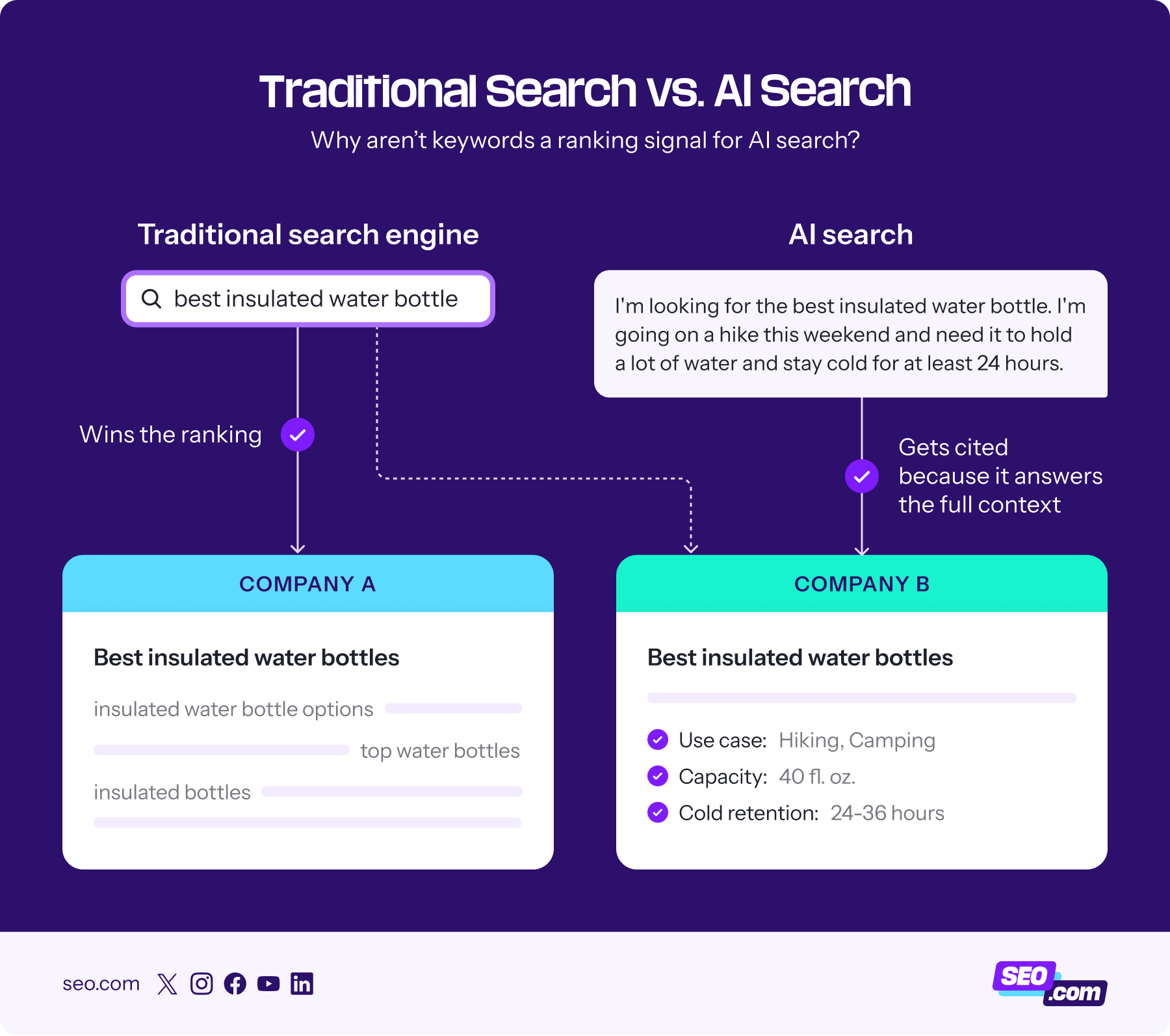
With a traditional search engine, someone types in a keyword like “best insulated water bottles” to try and generate a list of options. There isn’t really much context behind it — they just want to find an insulated water bottle.
So, any company that targets that keyword could rank for that search result.
But now for AI search, it’s different. And that’s largely because the way people search in AI engines is different. People aren’t just searching “best insulated water bottle.” They’re searching more elaborate, context-driven searches.
For example:
“I’m looking for the best insulated water bottle. I’m going on a hike this weekend and I need a water bottle that can hold a lot of water, but also keep it cold for at least 24 hours. What do you recommend?”
Now, you have more context than you did with traditional searches.
So why does this matter?
Well, let’s say you have Company A and Company B that have written a blog post about the best insulated water bottles. Company A ranks better in traditional search engines.
But, Company A doesn’t specify the size options of the water bottles in its article or provide information about how long the water stays cold. Company B does.
So if you went purely off of traditional ranking signals, like keyword ranking, Company A would be the cited source in AI engines, despite the fact that it doesn’t provide any of the additional information the user is looking for.
That’s why keywords in AI search function differently. There’s much more context to users’ queries, so keywords alone can’t account for that. Instead, keywords serve as a relevancy signal to tell search engines that the page’s content may answer the user’s query.
Should I still optimize for keywords for AI search?
Yes! Keywords may not play the same role they do in traditional search engines, but they still serve and important role for providing AI engines with context. You’ll still want to integrate relevant keywords into your content to help AI engines identify that your content is contextually relevant to a user’s search query.
Keep in mind, too, that traditional SEO is still valuable. Many bottom of the funnel searches don’t have AI Overviews summarizing information, which means you still need to follow SEO best practices (like targeting keywords) to ensure you’re showing up in searches.
So keywords aren’t going anywhere yet — they’re still playing an important role in telling AI engines the relevancy of your pages.
Get your AI search competitive advantage
The best way to stay ahead in AI search is to keep up with what’s happening in the landscape. It keeps changing, and you need to keep up with the changes. Get your unfair advantage by subscribing to our email newsletter to have the latest AI search news delivered straight to your inbox!


AI search is changing fast. Are you keeping up?
Get expert breakdowns and insights on the latest AI search trends and changes.


AI search is changing fast. Are you keeping up?
Get expert breakdowns and insights on the latest AI search trends and changes.

AI search is changing fast. Are you keeping up?
Get expert breakdowns and insights on the latest AI search trends and changes.
Expert Takes
from the SEO.com team
Writers