



You’re making marketing decisions based on an outdated funnel — and it’s costing you brand visibility.
The real marketing funnel has a new layer on top. And most marketers are absolutely oblivious to it.
For a long time, we’ve operated on one core assumption: there’s a direct line between your content and the person you’re trying to reach.
You write a blog post, they find it in search. You run an ad, they click it. You update your homepage, they read it and decide if you’re the right fit.
That assumption is breaking down.
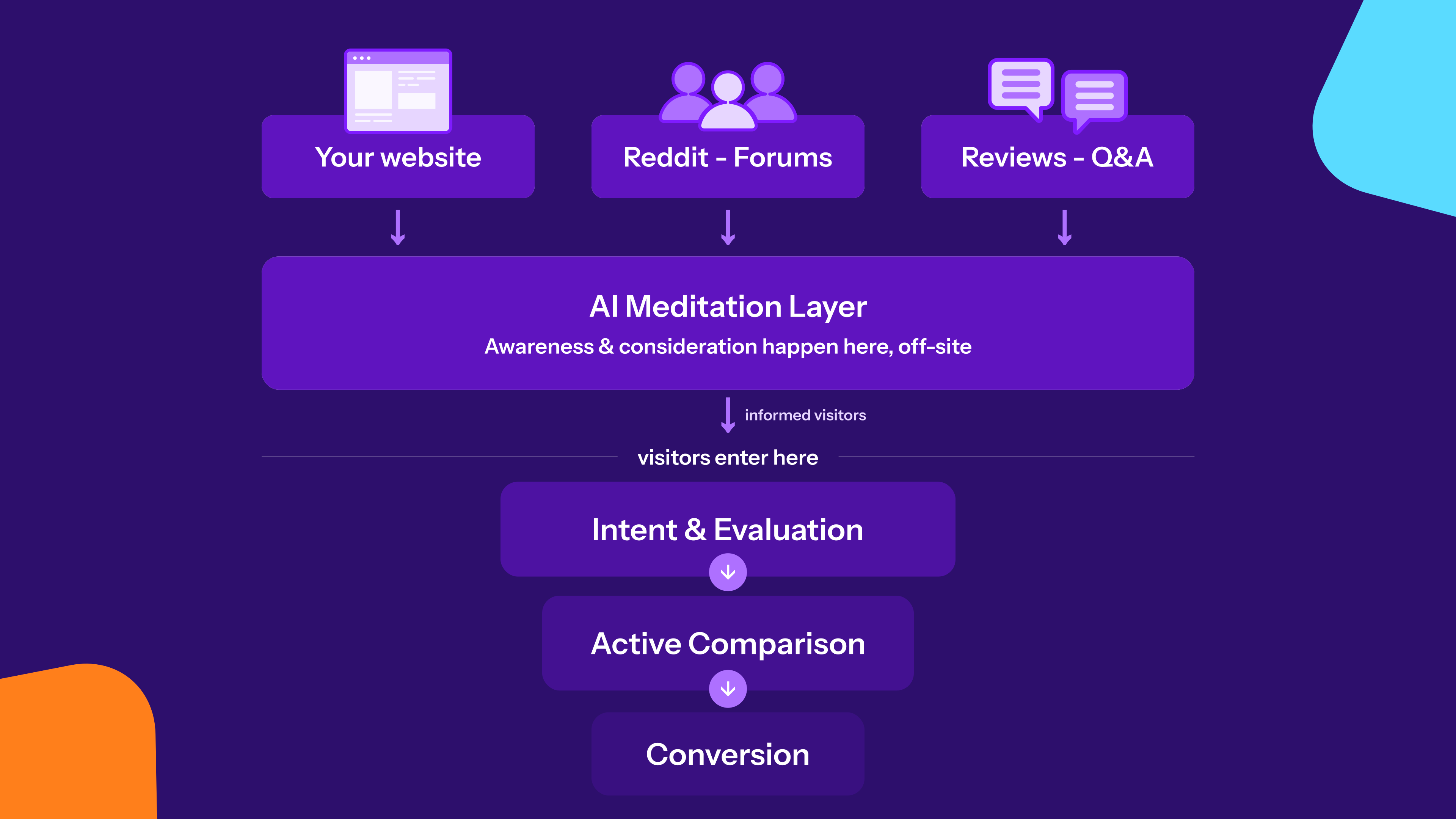
Search behavior has changed — and it’s added an entirely new layer to the top of the funnel. One where AI is consuming your content, processing it, and delivering its own version of your story to prospects before they ever touch your website.
I’ll walk you through what the new funnel looks like, how it changed, and what you can do to make sure your brand is still the one people find when they’re ready to buy.
In this blog, we’ll cover:
- Breaking Down the “AI Mediation” Layer of the Marketing Funnel
- How the Marketing Funnel Has Changed
- How the Changing Marketing Funnel Impacts the Real World
- Where Does AI Pull From? Understanding Your Digital Footprint
- What You Can Do About the Changing Marketing Funnel
Breaking down the “AI mediation” layer of the marketing funnel
Let’s define what we’re actually talking about.
I call this new layer the “AI mediation layer.” Stick with me on that.
Right now — like this very instance — large language models are crawling and indexing your website, your blog, your case studies, your reviews, your competitors’ content, and everything anyone has ever said about your brand in a public space.
Then, when someone asks a question — “What’s the best roofing company in Albany?” or “What’s the most energy-efficient heat pump?” — the AI doesn’t send them to your site.
It just answers. Right there. Using everything it’s read.
So your content now has two audiences — and most teams are only thinking about one of them.
The first is the human — the person you’ve always been writing for. That hasn’t changed. The second is the AI that reads your content, processes it alongside everything else it knows about you, and decides how to represent you before a real human ever gets involved.
If it represents you at all.
Here’s the part that should keep you up at night: There’s no session data from that AI conversation. No bounce rate, no click-through, no attribution.
You have zero visibility into the moment your brand got evaluated, compared, and eliminated.
Even on Google, there’s an AI Overview sitting above the organic results, scooping up traffic that used to be yours.
So when someone does arrive at your website, they’re not coming in blank. They’ve already formed an opinion — shaped by a conversation you never participated in.
This is actually why we’re seeing AI-driven traffic convert at higher rates than organic search.
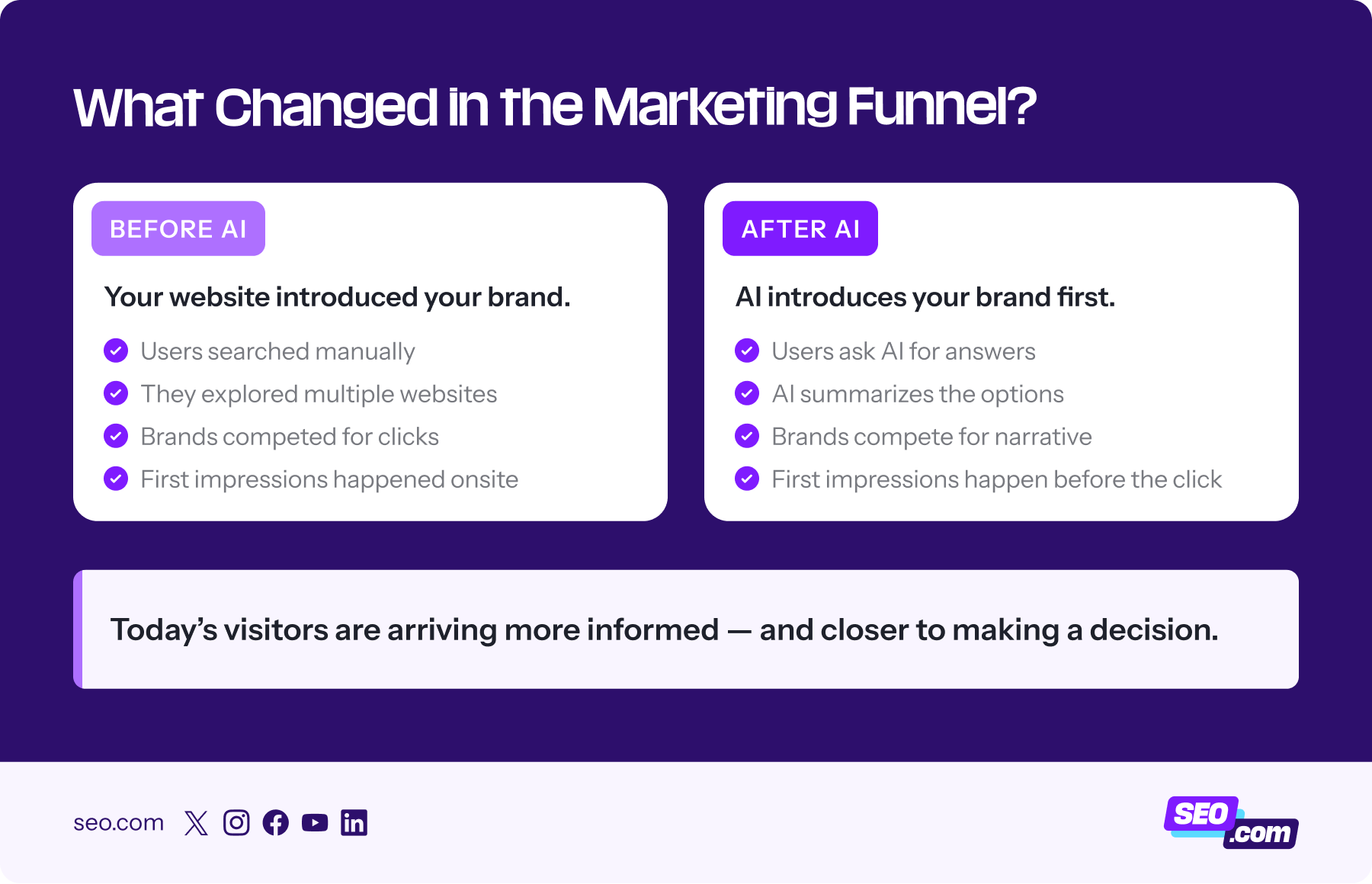
The AI mediation layer has absorbed a huge chunk of your top-of-funnel traffic. The people hitting your site today are more qualified — they just need you to confirm you’re the right choice.
How the marketing funnel has changed
Now, I know what you’re probably thinking. “AI is just a new channel — I’ll optimize for it the same way I optimized for Google.”
That’s not entirely right. Here’s why:
- The old funnel: Awareness, interest, consideration, intent, and purchase. Every stage had touchpoints you owned or could track. You could follow someone from the top all the way down.
- The new funnel: AI-mediated awareness and consideration — fed by your website and public conversations — followed by informed intent, active comparison, and hopefully, conversion.
AI didn’t slot into the old funnel. It collapsed the top stages into a single event that happens outside your owned channels, outside your analytics, and without your direct involvement.
Now, let me knock down the most common objection I hear: “This is just SEO with a new name or with extra steps.”
Not really.
SEO was about ranking in a list a human scrolled through. You competed for a position or a click. The person still read your page and formed their own opinion.
Optimizing for AI is about shaping what the AI believes to be true about your company or your service. You’re not competing for a ranking. You’re competing for the narrative inside the answer.
The brands winning right now aren’t just visible. They’re shaping how the AI tells the story of their entire brand.
How the changing marketing funnel impacts the real world
This is the part that I think will change how you think about marketing for the next few years. Stay with me.
I talked to a doctor who runs an urgent care center. He told me something that really made me think.
He started noticing that patients were walking in having already diagnosed themselves. They had described their symptoms to ChatGPT, ChatGPT told them it was worth getting checked out, and then pointed them to his clinic as the place to go.
ChatGPT did the entire top and middle of the funnel for him — awareness, research, consideration, comparison… all of it.
All before the patient ever visited his website or looked up his phone number. And by the time they showed up, they were basically already decided.
Here’s why his clinic kept showing up:
- He’d spent years building a strong public presence
- He had great local SEO
- He curated a solid review profile on his Google Business Profile
All of that content was public, indexed, and credible. So when AI needed a source to draw from, he was already there.
And that’s the key insight.
Every AI platform — ChatGPT, Perplexity, Claude — they’re drawing from the publicly indexed web. The same content that builds your authority online is the content these models are learning from.
Your reviews, your forum posts, your press coverage, your blog — it’s not just a search strategy anymore. It’s feeding every AI that touches your information in your category.
That Reddit reply, that blog post, that case study — the audience is no longer just the people who find it organically. It’s every future AI answer that draws from it.
The businesses that were already doing great SEO and collecting reviews were accidentally ahead of the curve. Now it has to be deliberate.
Where does AI pull from? Understanding your digital footprint
So if everything public feeds the model, the question becomes: what exactly is the AI pulling from?
More than most people realize.
Before, your marketing channels each had one job. Your website drove organic traffic. Reviews helped local rankings. YouTube built awareness. Press added credibility. Each channel worked in its own lane.
Now, every one of those channels also contributes to what the AI knows about you. They’re all inputs into the same model.
And not all inputs carry equal weight. The sources the AI trusts most share three traits:
- Accessible. They’re publicly available. If a search engine can’t reach it, neither can an LLM — or an AI model.
- Authentic and conversational. AI systems value real human perspectives over polished marketing copy.
- Trusted. The name, brand, and website have been mentioned and referenced across many different areas, making it a trusted source.
For example, Google Business Profile reviews are now a top-tier place to get that credibility. That’s a shift from how most marketers have thought about reviews — as a nice-to-have for trust signals and local rankings. They’re now a direct input into how AI describes your business to potential customers.
Same with YouTube.
Public video content is increasingly something AI systems reference. If you’re explaining your category or showing customer results on video, that content is feeding the model.
Private communities — Discord, Slack, gated forums — still matter for relationship building. But they have almost no AI influence because the content isn’t publicly accessible.
The takeaway: Your AI presence isn’t just a content strategy problem. It’s a whole digital footprint problem. Reviews, video, PR, community engagement — all of it has a second job now.
What you can do about the changing marketing funnel
So every public channel feeds the model. The model handles the top and middle of the funnel. And by the time someone lands on your site, they’re already educated and close to a decision.
So what do you actually do about it?
Your content strategy has to shift to be available to AI and convert people.
And “writing for AI” isn’t just blog posts. It includes your review responses, your YouTube video descriptions, your product docs, and your Reddit participation — anything public and indexed that helps the model understand who you are.
Here’s the concept I want you to take away: your AI Surface Area.
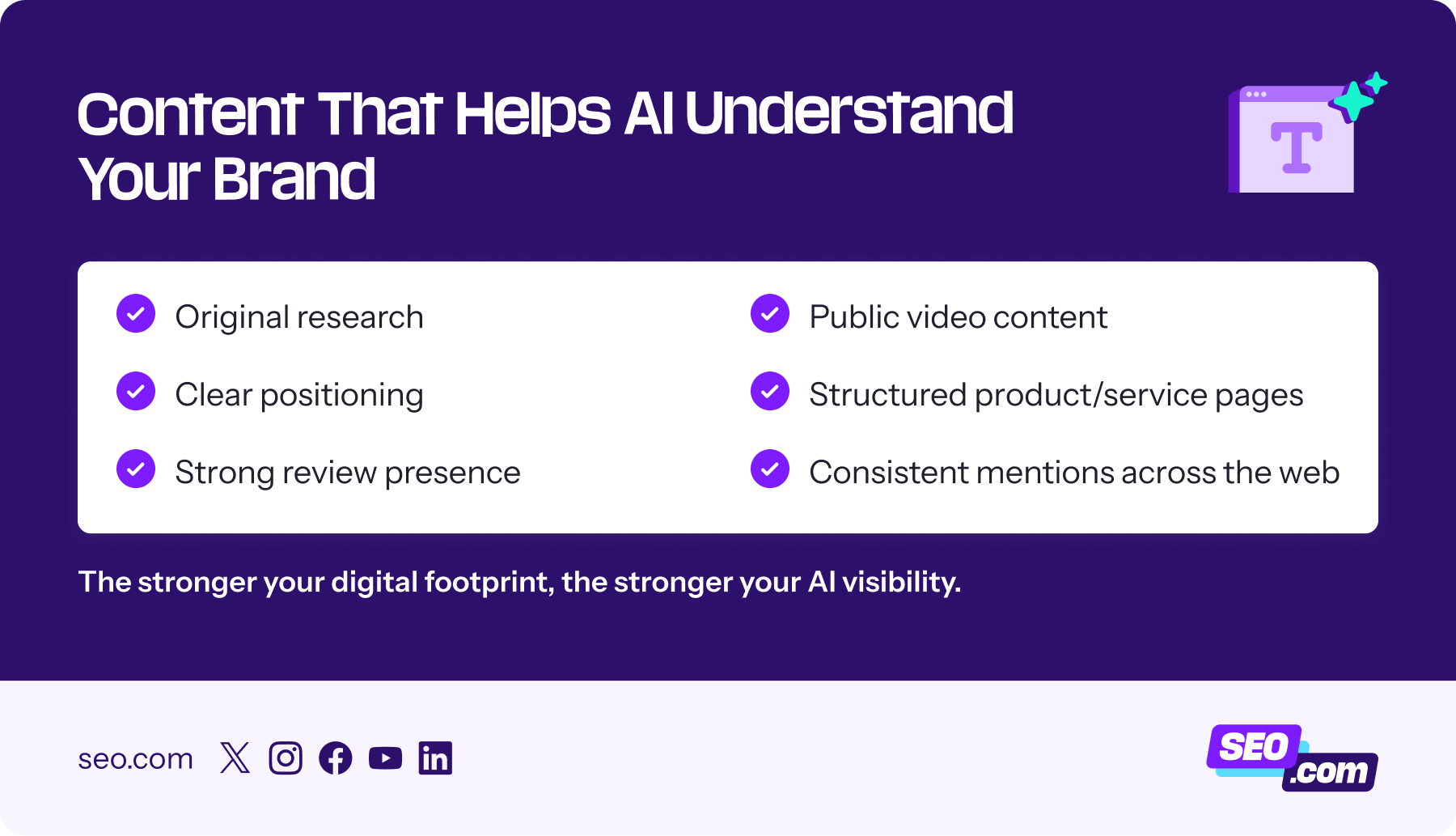
It’s the total body of public, indexed content — across every channel — that allows AI to represent your brand accurately. Your website, your reviews, your videos, your forum contributions, your press mentions. Everything the AI can access.
To grow it, focus on two things.
1. Feed the model
Publish original research, clear points of view, and structured content that owns the framing of your category. When someone asks an LLM about your space, your language and your data should be what it draws from. And don’t ignore reviews and video — they’re increasingly significant inputs.
2. Convert the informed visitor
Think back to that urgent care patient. By the time he walked in, he already knew he needed urgent care and he already knew which clinic to go to. He just needed the front desk to confirm he was in the right place.
Your website visitors…They’ve already been through awareness and consideration — in a ChatGPT conversation, in an AI overview, in a Perplexity answer.
They don’t need you to explain what you do. They need you to confirm why you’re the right choice over the alternatives the AI already mentioned.
Your landing pages, case studies, demo experience — all of it needs to be recalibrated for a shorter, more decisive journey. Less “here’s what we do,” more “here’s why we’re the right choice.”
Your next step: Run an AI Surface Area Audit
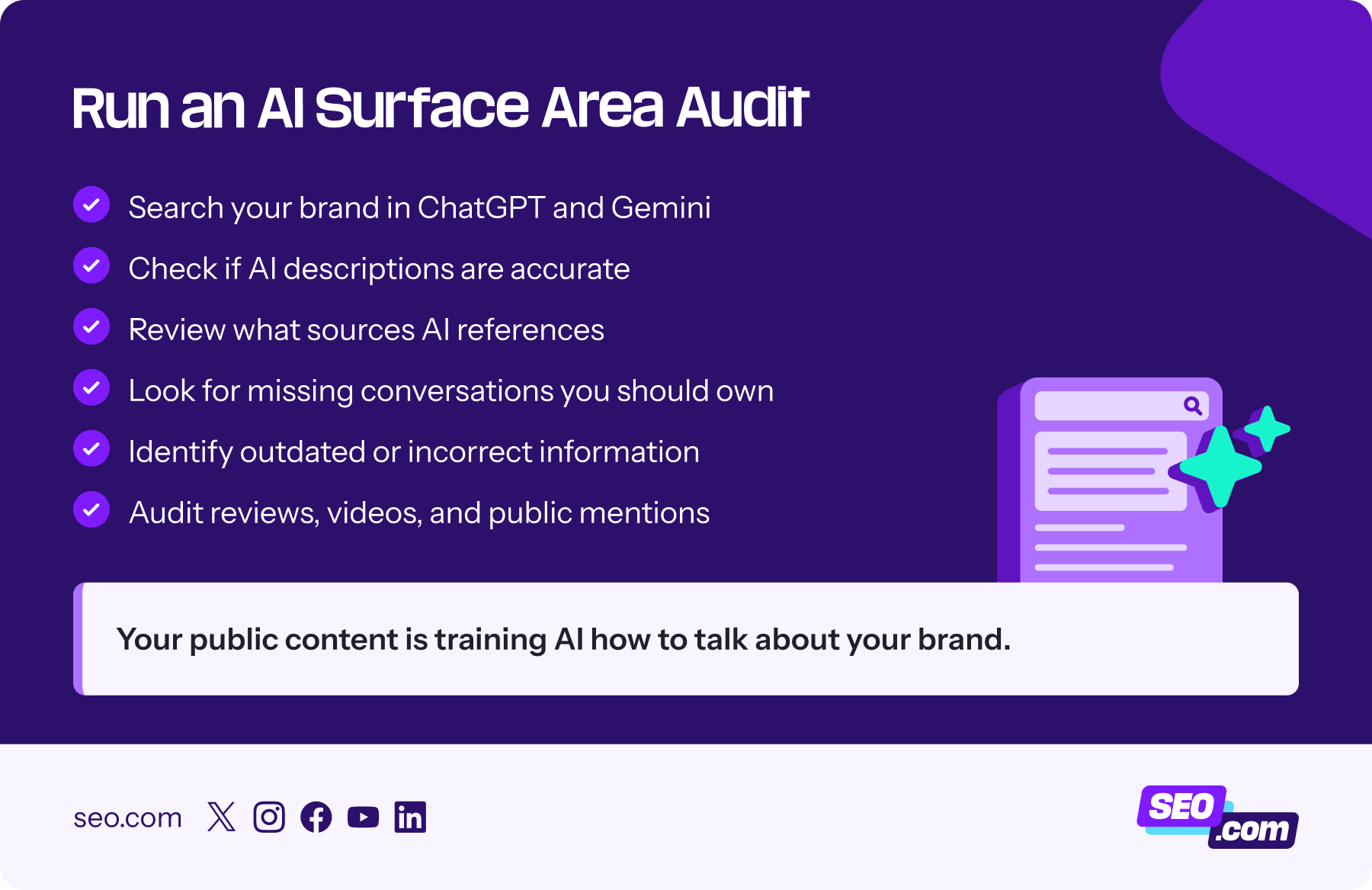
Here’s one concrete thing you can do this week: Run an AI Surface Area Audit.
It takes about thirty minutes and it’ll change how you think about your whole marketing strategy.
Here are three questions to ask as part of your audit:
- Where is Your Brand Showing Up in AI Right Now?
- Where Are You Absent from Conversations You Should Own?
- Where Are You Being Misrepresented?
1. Where is your brand showing up in AI right now?
Open ChatGPT, Gemini, AI Overviews and search for your company, your products, and the questions your customers actually ask early in their journey. Read what comes back.
Is it accurate? Is it favorable? Are you even there?
If you have AI traffic in your analytics, look at which platforms are sending it — that tells you where you’re already being surfaced.
2. Where are you absent from conversations you should own?
Look at the category-level questions your prospects are asking. Are you part of the answer?
If not, ask: What would need to exist for you to be included?
And think beyond blog posts — are your reviews strong enough to surface you? Is your video content public and indexed? Are you showing up in the communities where those questions get asked?
3. Where are you being misrepresented?
If the AI has outdated info, wrong pricing, or a competitor’s framing of what you do — you need to publish content that gives it a better source. And if your review profile is thin or your ratings are weak, that’s showing up in AI answers, too.
Reviews aren’t just social proof anymore — they’re model inputs!
Start adapting to the new marketing funnel
The brands that win the next decade won’t just have great websites. They’ll have a public digital footprint — reviews, video, content, community presence — so clear and so well-distributed that AI can’t answer category questions without referencing them.
That’s the new bar. Whether you were aware of it or not, it’s already happening.
The funnel didn’t disappear. It got compressed, moved off your property, and handed to an AI. The question is: are you feeding that AI the story you want it to tell?


AI search is changing fast. Are you keeping up?
Get expert breakdowns and insights on the latest AI search trends and changes.


AI search is changing fast. Are you keeping up?
Get expert breakdowns and insights on the latest AI search trends and changes.
Table of Contents
- Breaking Down the "AI Mediation" Layer of the Marketing Funnel
- How the Marketing Funnel Has Changed
- How the Changing Marketing Funnel Impacts the Real World
- Where Does AI Pull From? Understanding Your Digital Footprint
- What You Can Do About the Changing Marketing Funnel
- 1. Feed the Model
- 2. Convert the Informed Visitor
- Your Next Step: Run an AI Surface Area Audit
- 1. Where is Your Brand Showing Up in AI Right Now?
- 2. Where Are You Absent from Conversations You Should Own?
- 3. Where Are You Being Misrepresented?

AI search is changing fast. Are you keeping up?
Get expert breakdowns and insights on the latest AI search trends and changes.
Expert Takes
from the SEO.com team
Writers